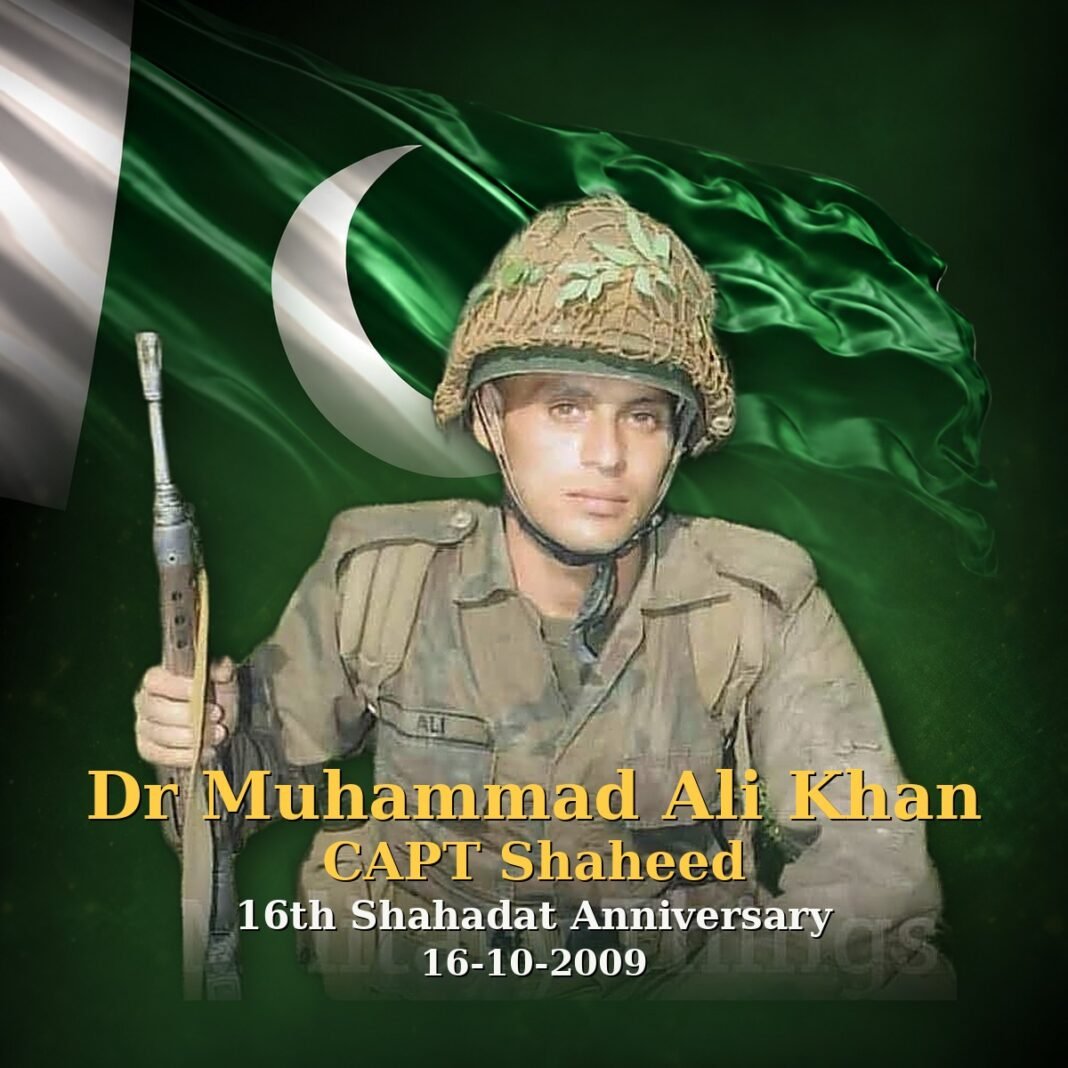
On 16 October 2009, in the dust and gunfire of Mingora, a young doctor in an officer’s uniform gave everything he had — and the Army lost one of its healers.
Captain Dr Muhammad Ali Khan was an officer of the 77 Medical Battalion, serving as the Regimental Medical Officer of 8 Frontier Force. On that day, during Operation Rah-e-Rast in Mingora, Swat, he embraced shahadat in the line of duty.
The Doctor in Uniform
An Army doctor carries two callings at once. Captain Dr Muhammad Ali Khan belonged to the Army Medical Corps, the branch whose officers learn to save lives under the same fire that takes them. As the Regimental Medical Officer — the RMO — of 8 Frontier Force, he was the man the soldiers of his battalion turned to when wounds bled and seconds mattered.
The RMO does not wait in a distant hospital. He moves with the battalion, sets up his aid post as close to the fighting as courage allows, and treats the wounded where they fall. It is a posting that asks a doctor to be a soldier first and a surgeon second — to keep his head when others are losing theirs, and to keep working when the shells are falling.
Operation Rah-e-Rast
When Captain Dr Muhammad Ali Khan deployed to Swat, the valley was a battlefield. Operation Rah-e-Rast — the Righteous Path — had been launched in May 2009 to drive the militants of the Tehreek-e-Taliban out of Swat, where they had seized control under Maulana Fazlullah. Mingora, the valley’s main town, saw some of the heaviest fighting of the campaign.
By October 2009, the Army had largely cleared the valley, but the danger had not passed. Militant remnants still struck at patrols and posts, and every operation carried the risk of ambush, bomb, and bullet. It was in this unforgiving environment — months into the grinding work of holding what had been won — that the young doctor embraced shahadat on 16 October 2009.
A Family of Martyrs
Sacrifice ran in the family. Captain Dr Muhammad Ali Khan was the brother-in-law of Major Waseem Faisal Shaheed — 107 Long Course, ex 33 Azad Kashmir Regiment, serving with 27 Aviation — who himself embraced shahadat on 8 May 2015. Two officers, two uniforms, one household that gave the nation not one son but two.
There is a particular weight to such families. The grief is doubled, but so is the pride — and the quiet knowledge that both men understood exactly what the other had chosen, because they had chosen it themselves.
The Original Tribute
The tribute posted in his honour reads as follows:
Capt Dr Muhammad Ali Khan Shaheed, ex 77Med Bn / RMO 8FF. On 16 Oct 2009, he embraced martyrdom in Ops Rah-e-Rast, Mingora Swat.
The Healers Who Fall
Armies remember their fighters, and rightly so. But the doctors — the men and women who run toward the wounded while everyone else takes cover — deserve their own place in that remembrance. Captain Dr Muhammad Ali Khan trained to heal, and he carried that training into a war zone, because his soldiers needed a doctor who would not leave them.
On 16 October each year, his shahadat anniversary is observed, and sixteen years on, the tribute still stands: a doctor-soldier of the Pakistan Army who kept his oath to the very end. The nation remembers him with pride and grief in equal measure. May Allah bless his soul and grant him a lofty station in Jannah.