The United States has cut Iran off from maritime imports and exports as part of an intensifying pressure campaign against Tehran’s oil revenue and military funding, the commander of US forces in the Middle East claimed on Friday. The claim would mark a sharp escalation in the economic war over the Strait of Hormuz.
US Central Command chief Admiral Brad Cooper said in a video message that Washington’s campaign focused on three areas: restricting Iranian oil exports, disrupting digital financing networks, and weakening the ability of Iran’s security forces to pay their personnel.
US Iran maritime trade: the American claims
“As a point of emphasis, with the exception of the humanitarian assistance we’ve allowed in, Iran has no exports and no imports by sea,” Cooper said.
He claimed US forces had prevented Iran from exporting at least $25 billion worth of crude oil in recent months. He added that CENTCOM had helped freeze nearly $350 million in Iranian cryptocurrency assets.
Cooper further claimed that Iran-aligned groups had begun withholding fighters’ pay to redirect funds to the IRGC, which he said was struggling to pay its own personnel.
“The Islamic regime is clearly feeling the economic pain, and the IRGC is increasingly showing signs of greater desperation as a result,” he said.
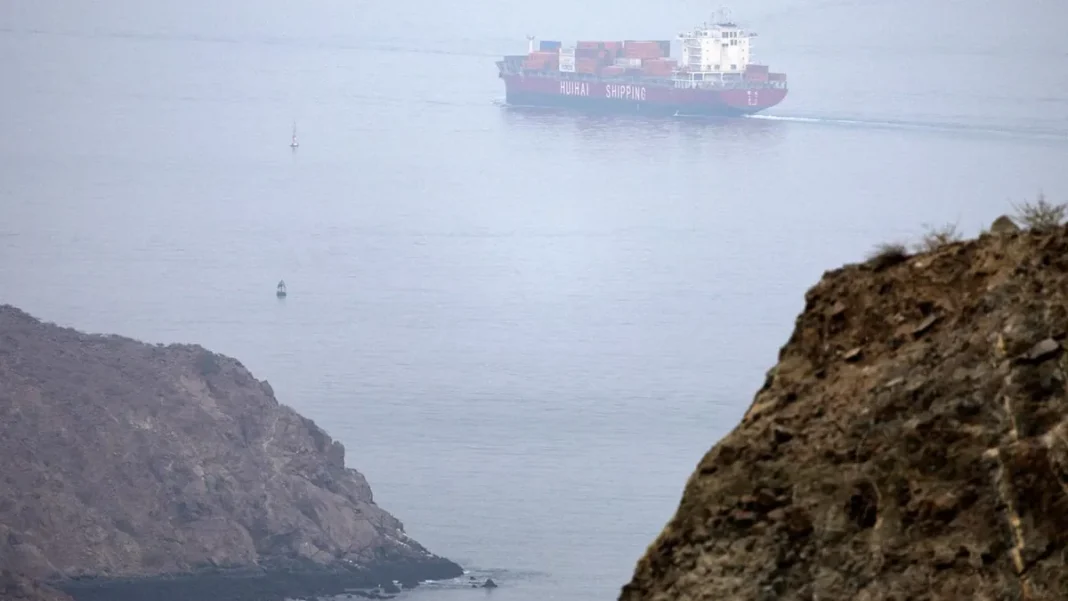
On the Strait of Hormuz, Cooper insisted commercial shipping continued to move through the waterway. “Let me be clear: the Strait of Hormuz is controlled by the United States and our regional partners, not Iran, and it remains open for business,” he said. He said about 400 merchant ships had transited the strait over the previous seven days, and that US forces had helped Gulf partners move more than 100 million barrels of crude through it in that period.
Independent data paints a grimmer picture for shipping
The United Kingdom Maritime Trade Operations agency, which tracks commercial shipping, reported that transits through Hormuz remained about 70 per cent below pre-conflict levels. It counted 125 outbound and 129 inbound transits over the past week, down from 129 and 146 the week before.
UKMTO also recorded 12 vessel attacks this week, ten of them in the Strait of Hormuz, one in the Gulf and one in the Gulf of Oman. It said a container ship was struck by an unidentified projectile near Ras Shaykh Masud on October 13, caught fire and sank the next day, though all crew were evacuated. The agency has logged 84 Hormuz incidents since the conflict began in late February, cautioning that most attacked vessels never report.
The IRGC Navy said via the Tasnim news agency that an oil supertanker carrying more than two million barrels had struck a naval mine in Hormuz, causing a massive explosion and fire. It described the vessel as a “rogue” tanker that had switched off its navigation and radar systems. It gave no vessel identity or casualty figures.
The conflict began in late February, when the United States and Israel attacked Iran, effectively closing the vital oil corridor and pushing global prices higher.
What it means for Pakistan
Pakistan has a direct stake in the Hormuz standoff. The country imports nearly all of its fuel through sea routes, and any sustained disruption in the strait feeds straight into domestic petrol and diesel prices. Pakistani motorists have already seen petrol fall to Rs386.30 a litre under the new daily pricing system, but renewed tension around Hormuz is exactly the kind of shock that has previously sent global oil prices climbing.
Original reporting: Tribune. Additional reporting: TRT World, Shafaq News.
Frequently asked questions
What did the US claim about Iran’s maritime trade?
CENTCOM Commander Admiral Brad Cooper claimed Iran had been cut off from all maritime imports and exports, except for humanitarian aid allowed in, as part of a campaign against Tehran’s oil revenue and military funding.
How much Iranian oil does the US say it has blocked?
Cooper said US forces had prevented Iran from exporting at least $25 billion worth of crude oil in recent months, and helped freeze about $350 million in Iranian cryptocurrency assets.
Is the Strait of Hormuz still open to shipping?
The US says about 400 merchant ships crossed in the past week, but UK monitors report transits are still about 70 per cent below pre-conflict levels.
How does this affect Pakistan?
Pakistan imports almost all its fuel by sea, so sustained Hormuz disruption can push up domestic petrol and diesel prices.