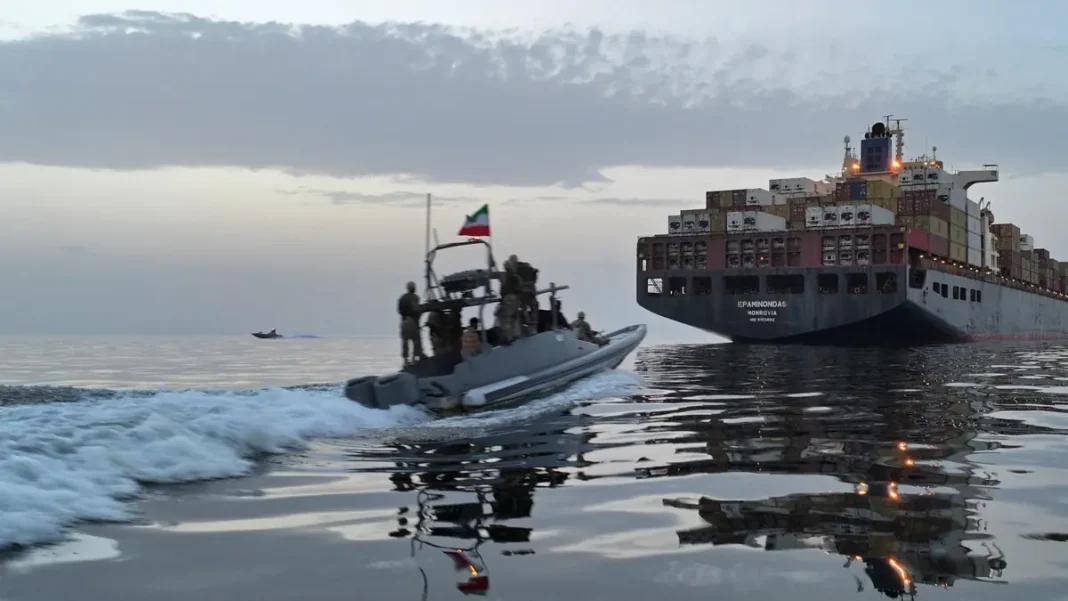
Iran’s Revolutionary Guards say an oil supertanker exploded and caught fire after striking a naval mine in the Strait of Hormuz, in the latest Hormuz supertanker mine explosion to rattle global energy markets.
The vessel was carrying more than two million barrels of crude oil when it hit the mine on Friday, according to a statement from the Islamic Revolutionary Guard Corps navy carried by the semi-official Tasnim news agency. The Guards said the tanker had been trying to cross the strategic waterway through a route Iran had not authorised.
The Hormuz supertanker mine explosion: what the IRGC claims
The IRGC described the vessel as a “rogue” tanker that had switched off all its tracking and radar systems and attempted to slip through the strait with American military backing. The statement did not name the ship, its owner or its flag, and gave no information about casualties or the scale of the damage.
“The Strait of Hormuz is closed,” the IRGC navy warned, adding that vessels defying Iranian regulations would face severe consequences for relying on what it called US support. The account could not be independently verified, and neither Washington nor the tanker’s operators had publicly responded at the time of publication.
The claim was carried across Iranian state media and picked up by international outlets including Al Jazeera, whose live coverage of the Iran conflict tracked the development through the morning.
A pattern of attacks in the strait
The explosion fits an alarming pattern. Just hours earlier, a crude oil tanker carrying 15 Indian seafarers was struck by a projectile in the same waterway on October 16, Reuters reported, citing India’s Shipping Minister Sarbananda Sonowal. And Feature Pakistan reported earlier this week that a third tanker had struck a mine in the strait, as the waterway turned into one of the most dangerous shipping lanes in the world.
The numbers underline the scale of the disruption. The United Kingdom Maritime Trade Operations (UKMTO) says 12 attacks were reported in its latest weekly reporting period, 10 of them in the Strait of Hormuz, with others in the Gulf and the Gulf of Oman. Of the vessels involved, six continued their journeys or reached port, one was lost and two were left disabled. Combined inbound and outbound transits through Hormuz remain about 70 per cent below pre-war levels, UKMTO said, warning that many attacked vessels were refusing to report incidents at all.
The backdrop is the US-led pressure campaign on Iran’s oil trade, which Washington says has barred Tehran from maritime commerce to cut off revenue for its military. The conflict began with American and Israeli strikes on Iran on February 28, followed by a ceasefire in April. Fighting later resumed as negotiations stalled, though the two sides signed a framework agreement in June.
Oil markets are already on edge. Brent crude futures were flat at $105.92 a barrel on October 16, heading for weekly gains on Middle East supply uncertainty, while US West Texas Intermediate stood at $97.75.
What it means for Pakistan’s fuel supplies
Pakistan imports the bulk of its petroleum products by sea, and every new incident in Hormuz feeds directly into the prices Pakistani motorists pay. Finance Minister Muhammad Aurangzeb has already called attacks on Gulf energy infrastructure “worrying” for Pakistan’s economic outlook, warning that the longer the infrastructure keeps getting hit, the longer any return to normal takes.
The arithmetic is visible at the pump. Petrol was selling at Rs386.30 a litre after the latest revision, with diesel at Rs396.96, under a daily pricing regime that passes global volatility straight to consumers. A two-million-barrel cargo at risk in Hormuz is not an abstract headline for Pakistan. It is a line item in next week’s fuel bill.
Original reporting: Dawn.
Frequently asked questions
What happened in the Strait of Hormuz?
Iran’s Revolutionary Guards say a supertanker carrying more than two million barrels of crude oil exploded and caught fire after hitting a naval mine while using an unauthorised route through the strait.
Has the vessel been identified?
No. The IRGC statement did not name the ship, its owner or its flag, and gave no casualty figures. The claims could not be independently verified.
How disrupted is shipping through Hormuz?
UKMTO reports 12 attacks in its latest weekly period, mostly in the strait, with transits running about 70 per cent below pre-war levels. Many attacked vessels are not reporting incidents.
Why does this matter for Pakistan?
Pakistan imports most of its fuel by sea. Attacks in Hormuz push up global crude prices, which flow into Pakistan’s daily fuel pricing and raise costs for motorists, transporters and industry.