Japanese scientists are preparing a Japan Mars moon mission that aims to do something no country has attempted before: fly to one of Mars’s moons, scoop up its soil and bring it back to Earth.
The unmanned Martian Moons eXploration (MMX) probe could help answer how the solar system and life on Earth began. It could also lay the groundwork for eventual human exploration of Mars.
The flagship H3 rocket carrying MMX is set to lift off from the Tanegashima Space Centre on Tuesday at 4:41am Japan time (12:41am PKT), according to the Japan Aerospace Exploration Agency (JAXA).
Japan Mars moon mission: a seven-year journey to Phobos
The spacecraft will arrive near Mars one year after launch. It will then orbit the moon Phobos for up to three years before landing and collecting at least 10 grams of material from the surface.
A small rover called IDEFIX, the French name for the comic hero Asterix’s dog, will first carry out surface observations to make sure the landing site is safe.
“The sampling (from) Phobos is of course the world’s first, but it means… this is the first round trip to the Martian system,” MMX project manager Yasuhiro Kawakatsu told AFP.
JAXA said the mission will also study whether Phobos could serve as a “natural space station”, working out what a round trip to Mars would require. The agency called that knowledge “essential for crewed Mars exploration”. ## What Phobos can reveal about the solar system’s birth
JAXA hopes the mission will settle a long debate about how Mars and its two moons formed. One theory, the “giant impact” hypothesis, says the moons formed after a celestial body collided with Mars. The rival “capture” hypothesis says they are asteroids that Mars’s gravity trapped.
Finding out which is right would help reveal “how a habitable environment for life might have arisen on the terrestrial planets”, JAXA said, referring to the four rocky worlds nearest the Sun: Mercury, Venus, Earth and Mars.
“MMX will shed light on the transport mechanisms that delivered water, volatiles, and organic compounds from the outer solar system to the inner rocky planet region, processes that may have played a key role in making these worlds habitable,” said Patrick Michel, a French astrophysicist working on IDEFIX.
“If Phobos and Deimos are indeed remnants of these early delivery systems, they may hold clues to the origins of life itself, or, to be more correct, to the transport of the materials that were key to the emergence of life on rocky planets,” he told AFP.
An international effort, and a race with China
MMX is a collaboration with France’s National Centre for Space Studies (CNES), the German Aerospace Centre (DLR), NASA, the European Space Agency (ESA) and about 20 universities and tech companies.
Engineers faced a tricky design problem: gravity on Phobos is extremely weak, which made the spacecraft’s landing legs difficult to build. Japan has a strong record in sample returns. JAXA’s unmanned Hayabusa-2 brought back 5.4 grams of rock and dust from an asteroid several hundred million kilometres away in 2020.
One difference this time is the destination. “We have to travel very close to Mars and return,” which means escaping the planet’s heavy gravity, Kawakatsu said. Phobos orbits only about 6,000 kilometres above the Martian surface, and Kawakatsu put it plainly: “Going deep into what we call the ‘gravity well’ is difficult.”
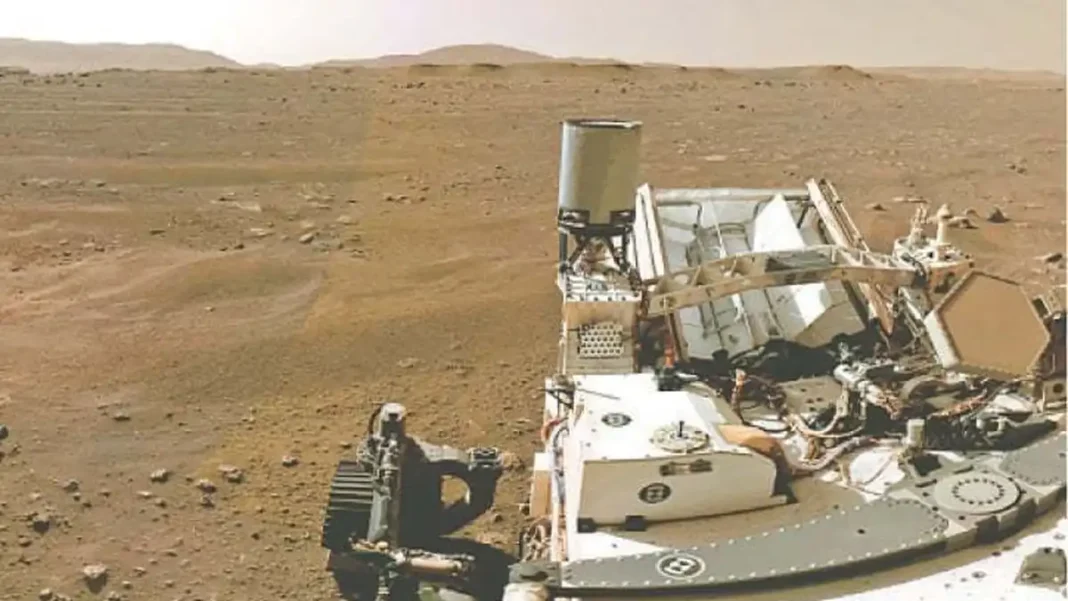
There is also a race on. China has announced its Tianwen-3 spacecraft is scheduled for launch around 2028 and hopes to return Mars samples to Earth as early as 2031, potentially before MMX gets home. NASA’s Perseverance rover has collected samples on the Red Planet since 2021, but its return mission was effectively cancelled under President Donald Trump after a January vote in the US Congress.
What happens next
If Tuesday’s launch goes to plan, MMX will reach Mars in a year and begin its long survey of Phobos. The actual sample return is years away, but the launch itself is the moment Japan becomes the first nation to attempt a round trip to the Martian system.
Frequently asked questions
What is the MMX mission?
Japan’s Martian Moons eXploration probe will fly to Phobos, collect at least 10 grams of soil and return it to Earth, the first round trip to the Martian system.
When does it launch?
The H3 rocket carrying MMX lifts off from Tanegashima Space Centre on Tuesday at 12:41am PKT.
Why Phobos?
Its soil may reveal whether Mars’s moons formed in a giant impact or were captured asteroids, shedding light on how the solar system and life began.
Who is involved?
JAXA leads the mission with France’s CNES, Germany’s DLR, NASA, ESA and about 20 universities and tech companies.
Source: Dawn