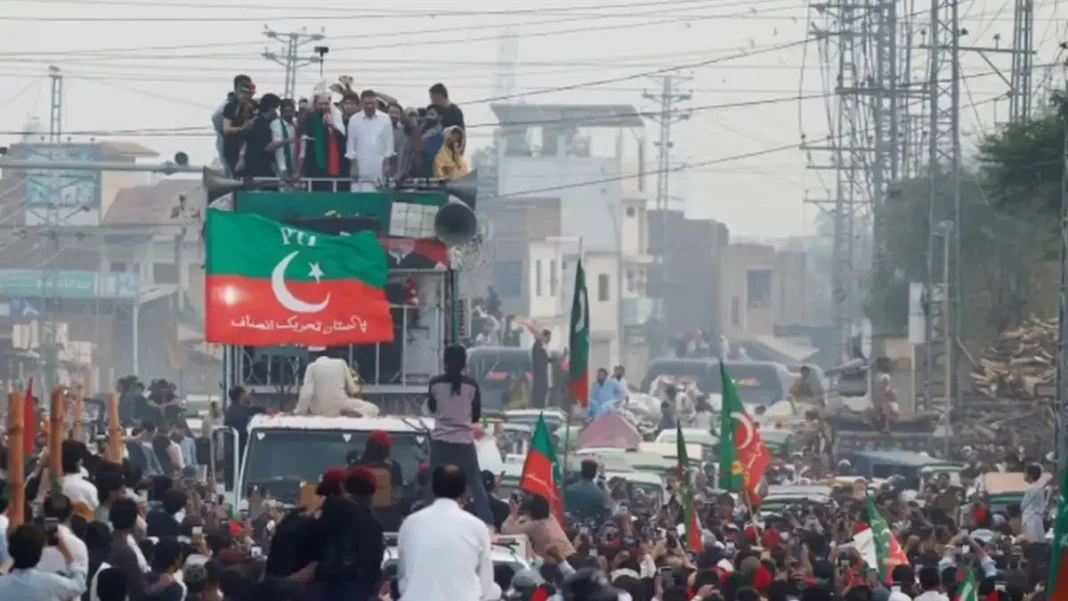
PESHAWAR: The Pakistan Tehreek-e-Insaf (PTI) has set up a fact-finding committee. Specifically, it will examine why its long march to Islamabad fell flat. According to insiders, senior leaders privately blamed poor planning and weak turnout in key Khyber-Pakhtunkhwa districts. The decision to order the PTI long march failure probe came during a joint meeting. The party’s core and political committees met on Sunday.
It came a week after two setbacks. In fact, the party lost its Khyber-Pakhtunkhwa government. The federal government imposed an emergency in the province on October 11. Leaders reviewed the emergency. They also discussed the possibility of governor’s rule. In addition, they reviewed the party’s next steps.
PTI long march failure probe: what the leaders said
Most participants pointed to inadequate preparations. Moreover, they cited poor coordination. In addition, they noted a lack of consultation with party leaders and assembly members. The panel will now examine how the protest was planned. Specifically, it will also look at why it drew weaker crowds than expected.
PTI Secretary-General Salman Akram Raja addressed the meeting. Specifically, he said participation in the march was particularly low in Charsadda and Mardan. He also flagged poor arrangements for overnight stays. In fact, tents and other essential preparations had not been made.
Several participants blamed suspended Khyber-Pakhtunkhwa Chief Minister Sohail Afridi. Specifically, they held him responsible for the shortcomings in organising the march. Raja, however, later defended Afridi. He described him as a courageous young leader committed to Imran Khan’s ideology.
Raja said a critical review of the march’s arrangements was necessary. However, he warned against presenting committee discussions out of context. He said this could push what he called conspiratorial narratives against Afridi.
Some participants reportedly argued a key point. The activity had effectively become a street movement. In fact, it was not a properly organised long march. They said it lacked clearly defined points of advance. Moreover, it lacked logistical arrangements and strategy. The account of the meeting was first published by The Express Tribune.
Access to Imran Khan and opposition roles
The committees also discussed a new assignment. Specifically, they considered giving Barrister Muhammad Ali Saif responsibility for one matter. It relates to access to jailed PTI founder Imran Khan.
Some participants made another proposal. They called for giving party members the responsibilities currently held by two leaders. Specifically, these are Mahmood Khan Achakzai and Allama Raja Nasir Abbas. Achakzai and Abbas serve as the leaders of the opposition. In fact, they hold these roles in the National Assembly and the Senate, respectively.
The proposals reflect unease within the party. Specifically, it concerns how its parliamentary ranks have performed. This is during the ongoing standoff between the government and PTI.
What the inquiry means for the party
The fact-finding panel marks a rare public admission by the PTI. Indeed, the party admits the march did not go as planned. The protest had been announced for September 27. However, it was later deferred to October 4. In addition, the federal government and the PTI held a long session of talks before the march.
Dawn’s account of the same meeting adds verified detail. It reports that more than 1,400 workers and leaders were arrested under the Maintenance of Public Order law. However, Khyber-Pakhtunkhwa’s own leaders had no clear plan. Dawn also reports that Afridi was asked repeatedly about the operational plan. He kept it to himself. In addition, the coordination committee’s head said he had not been told the plans.
The federal government imposed the emergency on October 11. It cited rising militancy in Khyber-Pakhtunkhwa. In addition, it cited the provincial government’s alleged failure to deal with it. The army has since been deployed. Meanwhile, the military campaign against militants continues.
The loss of its Khyber-Pakhtunkhwa government has deprived the PTI of its strongest political base. Without street presence as a bargaining chip, it must now work through its members in parliament. In addition, it must work through the leaders who have not been detained. As The News observes, the party now faces two central challenges. It must keep its support base intact. Moreover, it must secure concessions for its jailed leaders.
Whether the inquiry will lead to action against any leader remains to be seen. Meanwhile, the party’s priority appears to be holding its ranks together.
FAQs
Who ordered the probe into the long march failure?
The PTI’s core committee and political committee jointly constituted the fact-finding committee. Specifically, they did so during a meeting in Peshawar on Sunday, October 18.
What went wrong with the long march?
Inadequate preparations, poor coordination, and a lack of consultation with party leaders. In fact, turnout was particularly low in Charsadda and Mardan, and tents were missing.
Why is Sohail Afridi being blamed?
Several participants blamed suspended K-P Chief Minister Sohail Afridi for the organisational shortcomings. Secretary-General Salman Akram Raja defended him and urged members not to distort the discussions.
What is governor’s rule?
Under governor’s rule a province’s administration is handed to the governor, displacing the elected government. The PTI meeting discussed it alongside the October 11 emergency in Khyber-Pakhtunkhwa.
What happens next for the PTI?
The party is reviewing its future strategy. This includes its opposition leaders’ roles and access to Imran Khan. Consequently, it will lean more on its parliamentary members.