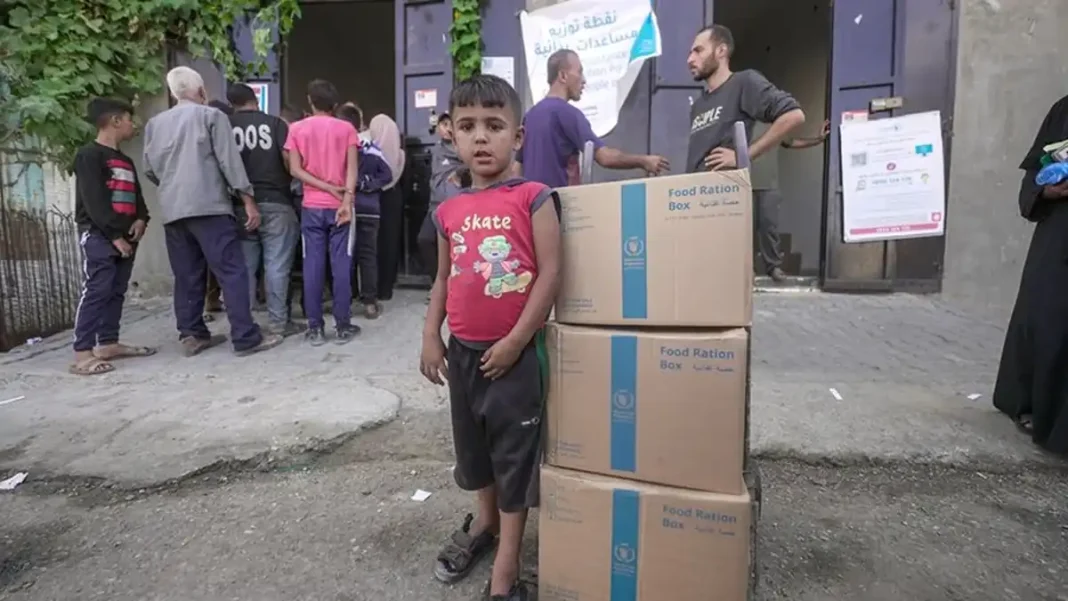
The World Food Programme will end monthly assistance to 500,000 people in Gaza. The UN agency announced the move on Monday, citing a funding shortfall. It warned that needs in the war-battered territory remain acute. Moreover, the Gaza food aid cuts will shrink rations for those who keep receiving help.
With the cutbacks, about 1.1 million Palestinians in Gaza will still receive help. That is roughly half the population. In addition, they will receive either food or cash assistance each month, in reduced amounts.
What the Gaza food aid cuts mean for families
The agency is cutting both the number of recipients and the size of what each family gets. For example, households receiving food assistance will now get one food parcel instead of two. They will also get a smaller bag of wheat flour, the WFP said in an operational note.
The 75,000 families who receive cash assistance will see their monthly amount fall. Specifically, it will drop from 1,250 shekels to 750 shekels. That is the equivalent of a fall from about $400 to $240.
According to the latest assessments, 1.4 million people remain acutely food insecure. That is two-thirds of Gaza’s population. They need humanitarian assistance to survive, WFP country director Shaun Hughes told AFP.
“People are not safe. Airstrikes continue on a daily basis. People continue to be displaced,” Hughes said from the agency’s office in east Jerusalem. “Almost everybody remains without a permanent home to live in. And the humanitarian conditions are brutal.”
Why the money ran out
The WFP is funded by governments as well as private donors. However, it has seen a sharp drop in resources. Contributions fell steeply after US President Donald Trump returned to power. Specifically, he slashed American funding for UN agencies and bilateral aid.
The agency says it needs about $450 million over the next six months. The money would fund its operations in Gaza and the West Bank. In fact, in 2026 it has received only about half its usual financing for the Palestinian territories.
The squeeze is not limited to Gaza. In September, the agency halved the number of aid recipients in the West Bank. The West Bank has been occupied by Israel since 1967. As a result, the number fell from 400,000 to 200,000.
“Now is not the time in the history of Palestine and Gaza to turn away from what is happening in Gaza,” Hughes said.
A fragile recovery at risk
Meanwhile, the cuts land as Gaza’s tentative recovery hangs in the balance. The UN’s Integrated Food Security Phase Classification declared famine conditions in Gaza in August last year. Subsequently, that classification was lifted in December, two months after a US-brokered ceasefire was announced.
Indeed, since the ceasefire, the WFP had been reaching between 1.5 million and 1.8 million people every month. “This has been a lifeline. But now, rather than being able to sustain and scale up that assistance, we’re actually having to reduce it,” Hughes said. “And that’s not because we don’t have humanitarian access to deliver food; that’s because we don’t have funding.”
Israel has kept striking Gaza since the ceasefire while pledging to target anyone involved in the October 7 attack. However, Israel still imposes heavy restrictions, although more goods have entered under the ceasefire terms. It turns away shipments of anything deemed to have potential military use. According to the United Nations, this policy has included blocking prosthetic limbs. In addition, the WFP cautioned that conditions have improved only moderately. It warned needs could rise again with the onset of winter.
Pakistan has repeatedly pressed the international community on the Palestinian question. This includes urging the UN to deliver self-determination for Kashmir and Palestine. In contrast, at home, the issue continues to draw large public demonstrations. For example, the Gaza march staged in Karachi marked the third anniversary of October 7. The human cost has been documented in several reports. One finding is that nearly 50,000 women and girls have been killed or maimed in Gaza. Meanwhile, internal UN disputes over the crisis led to the sacking of an FAO official in Gaza.
Frequently asked questions
How many people in Gaza will lose WFP assistance?
The World Food Programme will end monthly assistance to 500,000 people. In addition, about 1.1 million will still receive reduced food or cash aid each month.
How much are cash payments being cut?
Families receiving cash aid will get 750 shekels per month instead of 1,250, a fall from roughly $400 to $240.
Why is the WFP cutting aid?
The agency faces a funding shortfall. It is receiving only about half its usual 2026 financing for the Palestinian territories. This follows sharp cuts in US contributions. In addition, it needs about $450 million for the next six months.
Was there famine in Gaza?
The UN declared famine conditions in Gaza in August 2025. It lifted the classification in December, two months after a US-brokered ceasefire. Finally, the WFP warns conditions have not improved enough to withdraw aid.