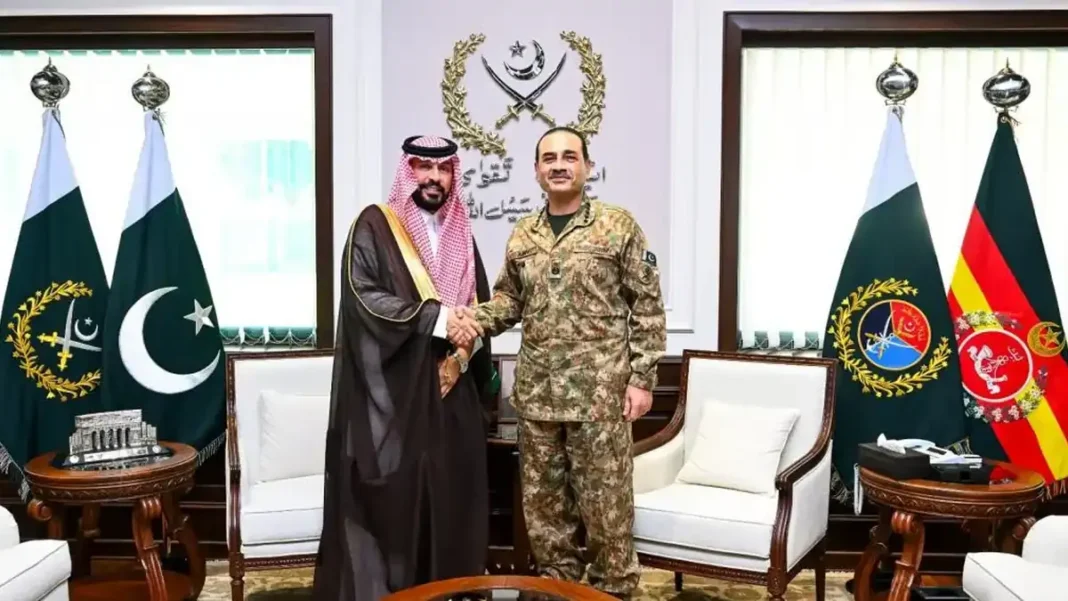
RAWALPINDI: Chief of Defence Forces and Chief of Army Staff Field Marshal Asim Munir met the new Saudi envoy to Pakistan, Dr Rajeh Tami Albugamy, on Monday, with both sides expressing satisfaction over progress made under the Makkah defence pact. The military’s media wing said the meeting took place at General Headquarters in Rawalpindi.
According to the Inter-Services Public Relations (ISPR), the ambassador called on the CDF to discuss matters of mutual interest and regional security dynamics. The statement said the two dignitaries reviewed the framework of the Makkah Joint Defence Agreement and stressed the need to strengthen defence collaboration, institutional linkages and strategic coordination.
CDF Munir congratulated Albugamy on his appointment and said he was confident the envoy’s tenure would further strengthen the longstanding ties between Islamabad and Riyadh, which he described as being rooted in shared faith, mutual trust and strategic partnership.
Albugamy assumed his diplomatic responsibilities in Islamabad last Thursday. During his first week in the post he has already met Prime Minister Shehbaz Sharif and Deputy Prime Minister and Foreign Minister Ishaq Dar.
Makkah defence pact: two pacts, one framework
The meeting sits inside a defence framework that now rests on two separate agreements. The first is a bilateral Strategic Mutual Defence Agreement between Pakistan and Saudi Arabia. The second is the broader Makkah Joint Defence Alliance, a trilateral arrangement that also brings Turkiye into the fold.
The Makkah pact, signed on Aug 7, is built on collective deterrence. Its central principle is that an attack against any one signatory is treated as an attack against all of them, and it obliges members to coordinate their responses to shared threats.
Earlier this month, Pakistan, Saudi Arabia and Turkiye convened an emergency meeting under the Makkah alliance and agreed to deploy military forces and capabilities rapidly inside the kingdom. The ISPR statement on Monday did not name any specific threat, but the development comes against the backdrop of continuing Houthi attacks on Saudi Arabia.
A diplomatic week for Riyadh
The envoy’s meetings in Islamabad have tracked the escalation closely. When Albugamy met Prime Minister Shehbaz Sharif last week, the prime minister reaffirmed Pakistan’s support for Saudi Arabia in safeguarding its sovereignty, security and territorial integrity amid the recent Houthi attacks.
DPM Dar, for his part, underlined the fraternal and strategic character of the relationship and reaffirmed what the Foreign Office described as a shared commitment to further strengthen bilateral cooperation for mutual progress and prosperity.
Pakistan’s military leadership has been equally direct. In an interview aired on Sunday, the military’s spokesman said Pakistan was providing “whatever support is needed” to defend Saudi Arabia. Lt Gen Ahmed Sharif Chaudhry said any actor that threatened peace, stability and security would automatically engage the collective deterrence mechanism under the Makkah alliance. Feature Pakistan reported on that interview earlier on Monday, when the DG ISPR laid out the same position in detail.
The regional picture has sharpened in recent days. Pakistan’s interior minister told a forum in Doha that Islamabad had worked for peace around the clock during recent talks, and two officers were killed in a Saudi helicopter crash near the Yemeni border, an incident Cairo also weighed in on. Monday’s GHQ meeting places the defence relationship at the centre of that picture.
What happens next
No joint statement beyond the ISPR release followed the meeting, and no new agreements were announced. The significance lies in the timing: a new ambassador’s first call on the CDF, coming days after the DG ISPR publicly spelled out Pakistan’s commitment to the kingdom’s defence and weeks after the alliance’s emergency meeting on rapid deployment.
With Houthi attacks continuing and the region’s security environment unsettled, the Makkah pact is moving from its August signing towards operational reality. Monday’s meeting was a stocktaking exercise. The next steps, if the alliance follows through, will be measured in exercises, deployments and the institutional machinery the two sides say they want to build.
Frequently asked questions
What is the Makkah defence pact?
The Makkah Joint Defence Alliance is a trilateral defence agreement between Pakistan, Saudi Arabia and Turkiye, signed on Aug 7. It is based on collective deterrence: an attack on one signatory is treated as an attack on all.
Who is the new Saudi envoy to Pakistan?
Dr Rajeh Tami Albugamy assumed his diplomatic responsibilities in Islamabad last week. He has met Prime Minister Shehbaz Sharif, DPM Ishaq Dar and now CDF Asim Munir in his first days in the post.
How is it different from the Pakistan-Saudi defence agreement?
Pakistan and Saudi Arabia also hold a separate bilateral Strategic Mutual Defence Agreement. The Makkah pact sits alongside it as a wider trilateral framework that includes Turkiye.