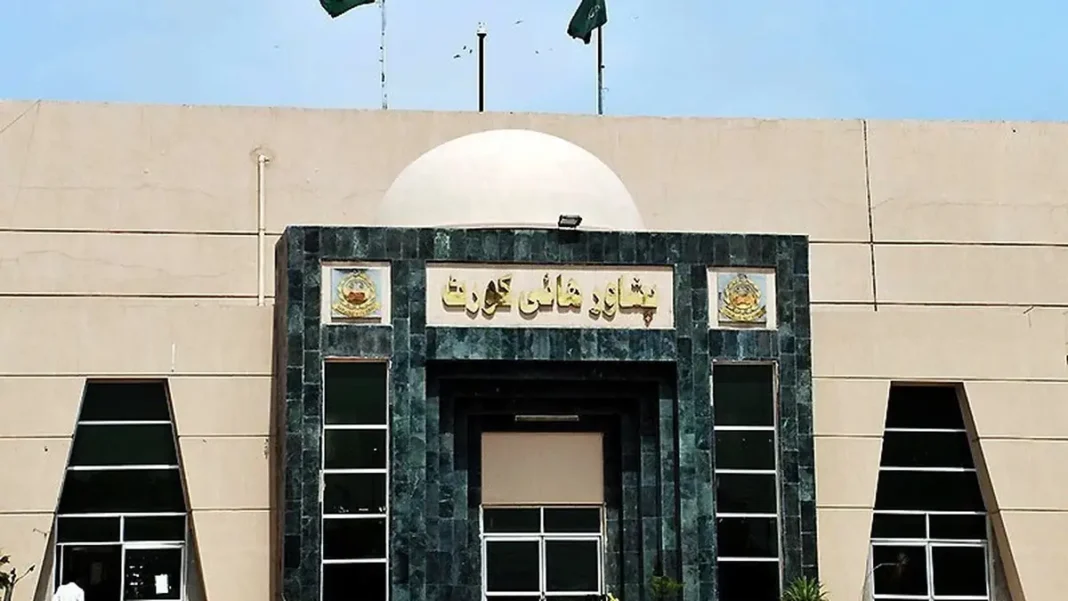
The Peshawar High Court on Tuesday began hearing seven constitutional petitions challenging the presidential proclamation of October 11 that imposed an emergency and KP governor’s rule.
A two-member bench comprising Justices Ijaz Anwar and Mohammad Faheem Wali took up the petitions, which argue that the proclamation issued under Articles 232 and 234 of the Constitution is unlawful. The petitions also challenge the resolutions passed by the National Assembly and the Senate on October 14, and by a joint sitting of parliament on October 15, endorsing the move.
The court had fixed October 20 for a preliminary hearing of the petitions, setting the stage for Tuesday’s proceedings.
Gohar seeks to widen the KP governor’s rule challenge
PTI Chairman Barrister Gohar Ali Khan, one of the petitioners, sought the court’s permission on Monday to amend his petition. He wants to add a challenge to the parliamentary resolutions and to the statutory regulatory order issued in consequence of the proclamation.
Gohar asked the court to suspend the operation of the SRO and to restrain the authorities from taking further action under it until the petitions are decided. The bench will consider the amendment request as the hearing proceeds.
The petitioners contend that the conditions required for a proclamation of emergency were not met. Article 232 allows such a proclamation when the president is satisfied that a grave emergency exists in which the security of Pakistan is threatened. Article 234 covers situations where the constitutional machinery in a province has failed. The petitioners argue that neither test was satisfied in Khyber Pakhtunkhwa.
Who else is before the court
The Tehreek Tahaffuz Aaeen-i-Pakistan, an opposition alliance, has filed its own petition. Its leaders Mahmood Khan Achakzai, Raja Nasir Abbas, Akhtar Mengal and Zainul Abideen are among the petitioners.
Former lawmakers Mohsin Dawar, Bushra Gohar and Shandana Gulzar have filed parallel petitions raising similar constitutional objections. Their case is that the parliamentary endorsements cannot cure a proclamation that was defective from the start.
The legal battle is unfolding on several fronts. The Federal Constitutional Court has already dismissed a plea concerning the appointment of a new Khyber Pakhtunkhwa chief minister as infructuous after the governor’s rule was imposed, ruling that the question no longer survived.
Why the emergency was imposed
The federal government imposed the emergency on October 11 after weeks of escalating tensions with the PTI. The immediate trigger was the party’s announcement of a protest march on Islamabad to demand the release of its founder, Imran Khan.
The Centre argued that the Khyber Pakhtunkhwa government was misusing state machinery and failing to cooperate against terrorism. The PTI rejected the charge and called the emergency an attack on the province’s democratic mandate.
Parliament endorsed the move in stages. The PML-N and PPP had finalised their plan for federal control of the province before the National Assembly and the Senate passed resolutions on October 14. A joint sitting of parliament then backed the proclamation on October 15, completing the constitutional requirement for parliamentary approval.
What happens next
The bench heard initial arguments on Tuesday and will take up the maintainability of the petitions at the next hearing. Gohar’s request to amend his petition, and his plea to suspend the SRO, will also come up for consideration.
Any interim order on the SRO could shape how the governor’s rule operates in the province in the coming weeks. The outcome of these petitions will determine whether the October 11 proclamation survives judicial scrutiny.
Frequently asked questions
What is the KP governor’s rule case about?
Seven petitions before the Peshawar High Court challenge the October 11 presidential proclamation imposing emergency and governor’s rule in Khyber Pakhtunkhwa, along with the parliamentary resolutions endorsing it.
Who filed the petitions?
PTI Chairman Barrister Gohar Ali Khan, the opposition alliance Tehreek Tahaffuz Aaeen-i-Pakistan, and former lawmakers Mohsin Dawar, Bushra Gohar and Shandana Gulzar are among the petitioners.
What did Gohar ask the court to do?
He sought permission to amend his petition to challenge the October 14 and 15 parliamentary resolutions and the consequent SRO, and asked the court to suspend the SRO’s operation until the case is decided.
When will the court decide?
No date has been announced. The bench will first consider the amendment request and the maintainability of the petitions before moving to detailed arguments.