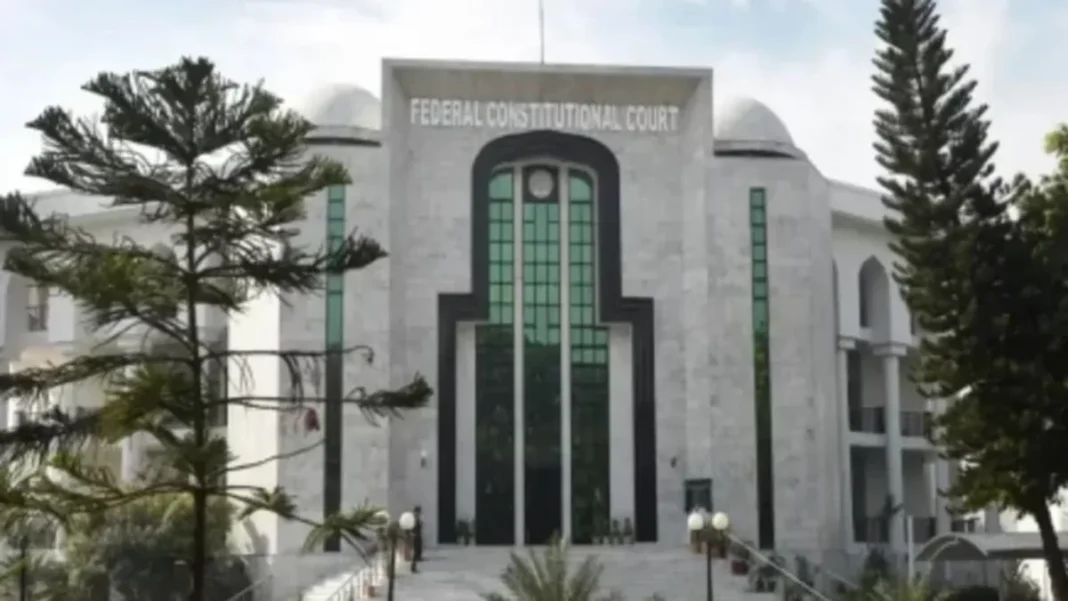
FCC reinstates Karachi ATC judge after Sindh de-notification
The Federal Constitutional Court (FCC) has reinstated a judge of the Anti-Terrorism Court (ATC-IV), Karachi, who was de-notified by the Sindh government following an amendment to the Anti-Terrorism Act (ATA), 1997.
The constitutional court ruled that the newly prescribed upper age limit could not be applied retrospectively to curtail an existing fixed-term appointment.
In a 15-page judgement authored by Justice K K Agha, a division bench led by Justice Syed Hasan Azhar Rizvi set aside a Sindh High Court decision and declared the de-notification unlawful and without legal effect.
The vested-rights question at the heart of the case
The court held that the Anti-Terrorism (Sindh Amendment) Act, 2025, contained neither an express provision nor any necessary implication making the newly introduced age limit applicable to appointments made for a fixed tenure before the amendment came into force.
The petitioner, a retired district and sessions judge, was appointed as judge and presiding officer of ATC-IV, Karachi, by the Sindh government on September 19, 2024, under Section 14(2) of the ATA, 1997, for a term of two and a half years under Section 14(3). His tenure was due to expire in March 2027.
At the time of his appointment, he was approximately 70 years old, and the law then in force prescribed no upper age limit for appointment as an ATC judge. Following the 2025 amendment, which introduced an upper age limit of 65 years, the Sindh government de-notified four ATC judges above that age on October 22, 2025.
The FCC observed that the central question was not whether the legislature was competent to prescribe an upper age limit, but whether the amended provision was intended to apply to appointments already made for a fixed tenure and thereby curtail their subsisting tenure.
“The petitioner, having been appointed for a specified tenure under the law then in force, had acquired a vested right to hold office for that period, subject to the conditions governing its lawful continuation or premature termination,” the judgement stated.
Why the retrospective application failed
The court added that where an amended provision admitted of two reasonably possible interpretations, the interpretation preserving the existing right should be preferred.
It noted that the expression “appointed under this section” in the amended provision could be construed as covering persons already appointed under Section 14, but could equally refer to appointments made after the amendment came into force. The mere fact that the cessation of office would take effect after the amendment’s commencement did not, by itself, establish that the legislature intended to affect rights already accrued under earlier appointments.
The bench emphasised the importance of certainty in law, saying citizens must be able to know what the law is at a particular time. It noted that retrospective legislation was generally an exception rather than the rule and that an intention to give a law retrospective effect was ordinarily expressly stated.
The court held that the Sindh High Court had failed to appreciate that applying the newly prescribed age limit to existing fixed-term appointments would impair vested rights. “The interpretation adopted by the High Court, therefore, cannot be sustained,” it said.
Ruling covers three judges
Allowing the petition, the FCC declared the petitioner’s de-notification, along with those of two other ATC judges, to be without lawful authority and of no legal effect.
The court directed that the petitioner be deemed to have continued in office notwithstanding the de-notification and remain entitled to serve as judge of ATC-IV, Karachi, until completion of his two-and-a-half-year tenure.
It transferred powers exercisable by the federal government concerning Anti-Terrorism Courts in Sindh to the provincial government.
Sindh has seen several legal reforms recently, including a move to amend the witness protection law 13 years after its enactment, and high-profile Karachi court proceedings such as the Iqrar-ul-Hassan case.
Source: The Express Tribune
FAQs
What did the Federal Constitutional Court decide?
It reinstated a judge of ATC-IV, Karachi, declaring his de-notification by the Sindh government unlawful, and voided the de-notifications of two other ATC judges as well.
Why was the judge de-notified?
After the 2025 amendment to the Anti-Terrorism Act introduced a 65-year upper age limit, the Sindh government de-notified four ATC judges above that age on October 22, 2025.
What was the court’s reasoning?
The court held that the new age limit could not retrospectively curtail a fixed-term appointment made before the amendment, as the petitioner had acquired a vested right to complete his two-and-a-half-year tenure.