


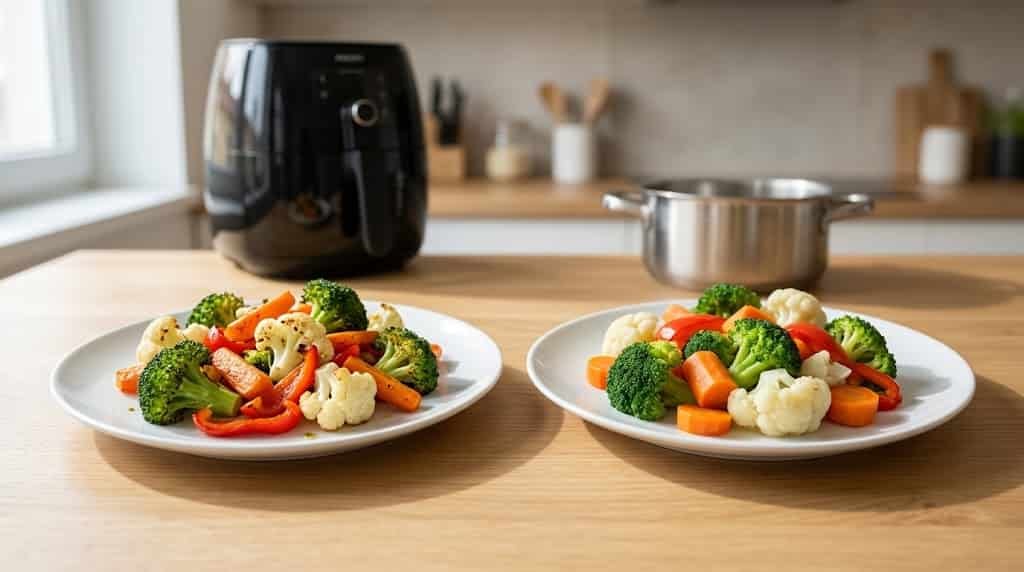
Air-Fried vs Boiled Vegetables: Which Cooking Method Keeps More Nutrients?
You bought fresh broccoli, carrots, cauliflower and bell peppers because you wanted to eat healthier.
Then comes the surprisingly complicated part.
How should you cook them?
For generations, boiling has been one of the simplest ways to prepare vegetables. Drop them into hot water, wait a few minutes and dinner is ready.
Air fryers have completely changed the modern kitchen, however.
They promise crispy vegetables with very little oil, shorter cooking times and considerably less mess than traditional frying.
But if nutrition matters more than crunch, an important question appears:
Are air-fried vegetables healthier than boiled vegetables?
More specifically, which cooking method keeps more vitamins, minerals and antioxidants?
The simple answer is that air frying will often have an advantage over boiling for nutrients that can escape into cooking water, but there is no universal winner for every nutrient and every vegetable.
Cooking time, temperature, vegetable type, amount of water and whether you consume the cooking liquid can completely change the result.
Let’s look at what the science actually tells us.
Why Cooking Method Matters for Vegetable Nutrition
Vegetables contain an impressive combination of vitamins, minerals, fibre and plant compounds.
However, these nutrients do not all behave the same way during cooking.
Some vitamins are sensitive to heat.
Others dissolve easily in water.
Some antioxidants become easier for our bodies to access after cooking.
Minerals generally tolerate heat relatively well but can move from vegetables into cooking water.
This means asking whether “cooked vegetables” are healthy is too broad a question.
How you cook them matters.
Research comparing household cooking techniques has repeatedly demonstrated that boiling, steaming, microwaving and other methods can produce very different nutrient-retention results.
The vegetable itself matters too.
Broccoli will not necessarily react to heat in exactly the same way as carrots, potatoes or spinach.
That is why claims such as “raw is always healthiest” or “cooking destroys nutrients” are misleading.
Nutrition is more complicated — and much more interesting.
What Happens When You Boil Vegetables?
Boiling exposes vegetables to two things that can affect nutrients:
Heat and water.
The heat can degrade certain sensitive nutrients.
At the same time, water-soluble nutrients can move out of the vegetable and into the cooking liquid.
Vitamin C provides a classic example.
It dissolves in water and is also sensitive to heat.
Several B vitamins can also be affected during cooking.
Research comparing cooking techniques has found that boiling can produce some of the greatest vitamin C losses among common household cooking methods.
One study examining different vegetables found vitamin C retention varied dramatically depending on the food and preparation method, with boiling generally producing lower retention than microwaving.
That does not mean boiled vegetables become nutritionally useless.
Far from it.
They still provide fibre and numerous nutrients.
The important point is that some of what started inside your vegetables may end up floating in the water you pour down the sink.
Why Air Frying Works Differently
Despite its name, an air fryer does not fry food in the same way as a deep fryer.
It functions more like a powerful compact convection oven.
Hot air circulates rapidly around the food, creating browning and a crisp exterior without requiring vegetables to sit in a large amount of oil.
Most importantly for our comparison, vegetables are not submerged in water.
That eliminates one major pathway through which water-soluble nutrients can leave the food.
This gives air frying a potential nutritional advantage over boiling.
But there is a catch.
Air fryers operate at relatively high temperatures.
Heat-sensitive nutrients can still degrade, particularly when vegetables cook for too long or become heavily browned.
So air frying does not magically preserve every vitamin.
The goal should be cooking vegetables until they are pleasantly tender rather than turning them into dark, dried-out pieces.
Air-Fried vs Boiled Vegetables: Which Keeps More Vitamin C?
If vitamin C is your main concern, boiling often struggles.
Vitamin C is both water-soluble and sensitive to heat.
When vegetables containing vitamin C sit in boiling water, some of the vitamin can move into the water while some can degrade during heating.
Research involving vegetables such as broccoli and spinach has demonstrated substantial variation in vitamin C retention depending on cooking technique.
Studies have frequently found greater losses from boiling than from methods using little or no cooking water.
This is particularly relevant for vegetables naturally rich in vitamin C, including broccoli, bell peppers and Brussels sprouts.
Air frying avoids direct immersion in water, which removes the leaching problem.
However, prolonged exposure to high temperatures can still reduce vitamin C.
The practical lesson?
Cook vegetables for only as long as necessary.
What About B Vitamins and Folate?
Several B vitamins are also water-soluble.
Folate, or vitamin B9, provides an excellent example.
Cooking can reduce folate content, with the size of the loss depending heavily on the food and cooking technique.
When vegetables are boiled, some folate can move into the cooking liquid.
Research reviews have therefore suggested that methods limiting direct contact with water can help preserve folate compared with prolonged boiling.
There is an important exception.
If you eat the cooking liquid, you may recover some of the nutrients that escaped from the vegetables.
This is why vegetables cooked directly in soup, lentils or curry should not automatically be treated like vegetables boiled separately and drained.
The nutrients have not necessarily disappeared.
Some have simply moved into the liquid you are about to eat.
Minerals Behave Differently From Vitamins
Potassium, magnesium, iron and other minerals cannot simply be “destroyed” by cooking heat in the way some vitamins can degrade.
But minerals can still leave vegetables.
How?
Through water.
During boiling, some minerals can leach into the cooking liquid.
Recent research examining household cooking methods confirms that mineral retention varies according to vegetable type, preparation and cooking method.
Cutting vegetables into very small pieces can increase the surface area exposed to water, potentially increasing nutrient movement into the liquid.
Therefore, if you boil vegetables, using larger pieces and avoiding unnecessarily long cooking times can help.
Again, keeping the cooking liquid for soup or sauce changes the equation considerably.
Does Air Frying Destroy Antioxidants?
Here things become particularly interesting.
Vegetables contain many beneficial plant compounds beyond traditional vitamins and minerals.
These include polyphenols, carotenoids and glucosinolates.
Cooking can reduce some of them.
But heat can also make certain compounds easier to extract or absorb.
For example, carotenoids found in vegetables such as carrots and tomatoes can sometimes become more accessible after cooking because heat softens plant cell structures.
So seeing a lower laboratory measurement of one compound after cooking does not automatically mean the food became “less healthy.”
Bioavailability matters too.
What matters nutritionally is not simply how much of a compound exists in the food, but how much your body can actually access and use.
Broccoli Is a Great Example
Broccoli demonstrates why cooking advice cannot be reduced to one rule.
Broccoli contains vitamin C, folate, carotenoids and glucosinolates.
These compounds respond differently to heat.
Research on cruciferous vegetables has shown that boiling can cause substantial losses of glucosinolates because these compounds can move into cooking water.
Steaming generally performs much better for preserving them.
Emerging research also suggests air frying can preserve significant amounts of certain phenolic compounds and other phytochemicals, although results depend heavily on cooking conditions.
This means lightly cooked broccoli can offer a very different nutritional profile from broccoli boiled until extremely soft.
What About Carrots?
Carrots tell a different story.
They are rich in carotenoids, particularly beta-carotene, which the body can convert into vitamin A.
Cooking carrots is not necessarily nutritionally inferior to eating them raw.
Heat can soften plant tissues and make carotenoids more accessible during digestion.
Adding a small amount of dietary fat may further help the body absorb fat-soluble carotenoids.
That makes lightly air-fried carrots with a small amount of oil an appealing option.
But again, more heat is not automatically better.
Burning vegetables does not create additional nutrition.
Are Air-Fried Vegetables Actually Healthy?
Yes — air-fried vegetables can absolutely form part of a healthy diet.
The biggest mistake is confusing air frying with deep frying.
Deep frying submerges food in hot oil.
Air frying relies primarily on circulating hot air and generally requires much less added oil.
If you take broccoli, cauliflower, carrots or zucchini, add a small amount of oil and seasoning, and cook them until tender, you still have vegetables.
The air fryer did not suddenly transform broccoli into junk food.
In fact, the improved texture may help some people eat more vegetables.
And that matters.
The healthiest vegetable cooking method is not very useful if you dislike the result so much that you stop eating vegetables.
The Oil Question
Air-fried vegetables often taste better with a little oil.
Should that concern you?
Not necessarily.
Dietary fat adds calories, so pouring large quantities of oil over vegetables can substantially increase the energy content of the meal.
But a modest amount of oil can improve flavour and may help with absorption of fat-soluble compounds such as carotenoids.
The key word is modest.
You do not need to soak vegetables in oil before putting them into an air fryer.
A light coating is usually enough for browning and texture.
Are Boiled Vegetables Unhealthy?
Absolutely not.
Boiling gets unfairly attacked in many nutrition discussions.
Yes, it can cause greater loss of certain water-soluble nutrients.
But boiled vegetables remain vegetables.
They still contain fibre and can retain substantial amounts of many nutrients.
Boiling can also make some foods softer and easier to eat or digest.
And when the cooking liquid becomes part of the dish, nutrient loss through leaching becomes less concerning.
Consider vegetable soup.
Vitamin C may still decline because of heat, but minerals and other water-soluble compounds that move into the broth remain in the meal if you drink the broth.
The same principle applies to many traditional curries and stews.
So context matters.
Air Frying vs Boiling for Weight Loss
People searching for the healthiest way to cook vegetables often have weight management in mind.
Both methods can work.
Plain boiled vegetables contain no added cooking oil, making them naturally low in calories.
Air-fried vegetables may contain additional calories if oil is added.
However, air frying can produce better flavour and texture with relatively little oil compared with traditional frying.
If crispy air-fried cauliflower helps you replace French fries or another calorie-dense side dish, that can be a very useful dietary change.
Weight management depends on the overall diet rather than one cooking appliance.
What Is the Healthiest Way to Cook Vegetables?
There probably isn’t one method that wins every category.
But if nutrient retention is your main goal, steaming deserves serious attention.
Steaming cooks vegetables without immersing them in water.
That can reduce leaching of water-soluble vitamins and minerals.
Research comparing cooking techniques has frequently found steaming performs well for nutrient retention, although results vary by vegetable and nutrient.
Microwaving with minimal water can also perform surprisingly well.
Studies have found strong vitamin C retention with short microwave cooking in several vegetables.
Air frying can also be an excellent option, particularly when you want browning and crispness without boiling vegetables in water.
The healthiest kitchen may therefore use several cooking methods instead of choosing only one.
A Simple Nutrient-Retention Ranking
For many vegetables, a practical approach would look something like this:
Light steaming is an excellent everyday option.
Short microwave cooking with minimal water can preserve nutrients surprisingly well.
Air frying provides good texture while avoiding nutrient leaching into cooking water.
Boiling remains useful, particularly when you consume the cooking liquid.
But prolonged boiling followed by throwing the water away may produce greater losses of certain water-soluble nutrients.
This ranking is not absolute.
Different vegetables and nutrients behave differently.
How to Air Fry Vegetables Without Overcooking Them
If you want to preserve nutrients, avoid the “more crispy must be better” mentality.
Cut vegetables into reasonably even pieces.
Use only enough oil to lightly coat them if oil is desired.
Avoid overcrowding the basket because vegetables may cook unevenly.
Check them before the maximum cooking time suggested by a recipe.
You want vegetables tender and lightly browned rather than burnt.
Different vegetables also need different cooking times.
Thin bell pepper slices will cook much faster than large carrot pieces.
How to Boil Vegetables More Nutritiously
If boiling remains your preferred method, you can still reduce nutrient loss.
Use the minimum amount of water necessary.
Avoid cutting vegetables into extremely tiny pieces before boiling.
Do not cook them longer than needed.
And whenever appropriate, reuse the cooking liquid.
Add it to soup, gravy, curry or another dish.
This allows you to consume some of the nutrients that moved into the water.
What About Raw Vegetables?
Raw automatically sounds healthier.
But that assumption is also too simplistic.
Raw vegetables can provide excellent amounts of heat-sensitive nutrients such as vitamin C.
But cooking can improve digestibility and increase the accessibility of certain plant compounds.
Some vegetables are also simply more enjoyable cooked.
The best diet usually includes variety.
Eat salads.
Eat steamed vegetables.
Air fry some broccoli.
Cook tomatoes.
Put vegetables into soup.
Nutrition does not require choosing one preparation method forever.
The Biggest Nutritional Mistake Has Nothing to Do With Your Air Fryer
People can become obsessed with tiny differences in nutrient retention while missing the much bigger picture.
Imagine two people.
One carefully researches whether steaming preserves 10% more of a particular nutrient but eats vegetables only twice a week.
The other eats a variety of vegetables every day and alternates between steaming, roasting, air frying and occasional boiling.
Who probably has the better dietary pattern?
The second person.
Cooking method matters.
But eating enough vegetables matters much more.
A perfectly cooked vegetable that remains untouched on your plate provides exactly zero nutrients to your body.
Air-Fried vs Boiled Vegetables: The Final Verdict
So, which keeps more nutrients: air-fried or boiled vegetables?
For many water-soluble nutrients, air frying has a logical and often practical advantage because the vegetables are not submerged in water.
Boiling can cause vitamin C, folate and some minerals to move into the cooking water, particularly when vegetables are cut small, cooked for a long time and then drained.
Air frying avoids that leaching.
However, high temperatures and long cooking times can still damage heat-sensitive compounds.
That means lightly air-fried vegetables are very different from vegetables cooked until dark and dried out.
Boiling also becomes more nutritionally attractive when you consume the cooking liquid.
And neither method universally beats steaming or short microwave cooking for every nutrient.
The real answer depends on the vegetable, nutrient and cooking technique.
If your goal is maximum nutrient retention, you do not need to throw away your saucepan or become obsessed with your air fryer.
Use cooking methods strategically.
Steam vegetables when you want gentle cooking with minimal nutrient loss.
Use an air fryer when you want crisp, flavourful vegetables without deep frying.
Boil vegetables when the recipe requires it, but avoid unnecessarily long cooking and consider keeping the nutrient-rich cooking liquid.
Most importantly, eat a wide variety of vegetables regularly.
Broccoli does not need to win a nutritional perfection contest before you eat it.
Neither does a carrot.
The difference between eating vegetables and not eating them is far more important than arguing over every percentage point of vitamin retention.
So if your air fryer makes vegetables tasty enough that you genuinely look forward to eating them, keep using it.
Your healthiest cooking method may ultimately be the one that keeps vegetables nutritious — and keeps them coming back to your plate.