MQM-P Warns Protests Over Sindh University Admissions
The Sindh university admissions row intensified on Monday, with the Muttahida Qaumi Movement-Pakistan (MQM-P) threatening street protests over alleged discrimination against Karachi students, while the provincial government rejected the accusations and insisted admissions were strictly merit-based.
Sindh Assembly Opposition Leader Ali Khursheedi accused the Pakistan Peoples Party (PPP)-led government of manipulating admission quotas, facilitating fake domiciles and depriving Karachi’s youth of their educational rights. He warned MQM-P would mobilise its workers and take to the streets if the alleged irregularities were not addressed.
Speaking at the Sindh Assembly’s media corner, Khursheedi questioned admission arrangements at a medical university in Lyari. He alleged that students from Lyari, Gadap and Keamari could benefit from the town-based quota while those from Ranchore Line were excluded. He urged the provincial law minister to investigate who introduced the arrangement and under whose instructions.
Sindh Universities and Boards Minister Muhammad Ismail Rahoo accused Khursheedi of misleading the public through baseless claims, and said all universities in the province were equally important to the government.
Rahoo maintained that admissions were conducted strictly on merit, with transparency and in accordance with prescribed rules. No quota had ever been reserved for any particular ethnicity or linguistic group, he said, adding that Karachi University’s admission policy excluded no student from any area. Students from Karachi, Hyderabad, Sukkur, Larkana, Mirpurkhas, Shaheed Benazirabad and other districts were treated equally, he said.
The quota question in Sindh university admissions
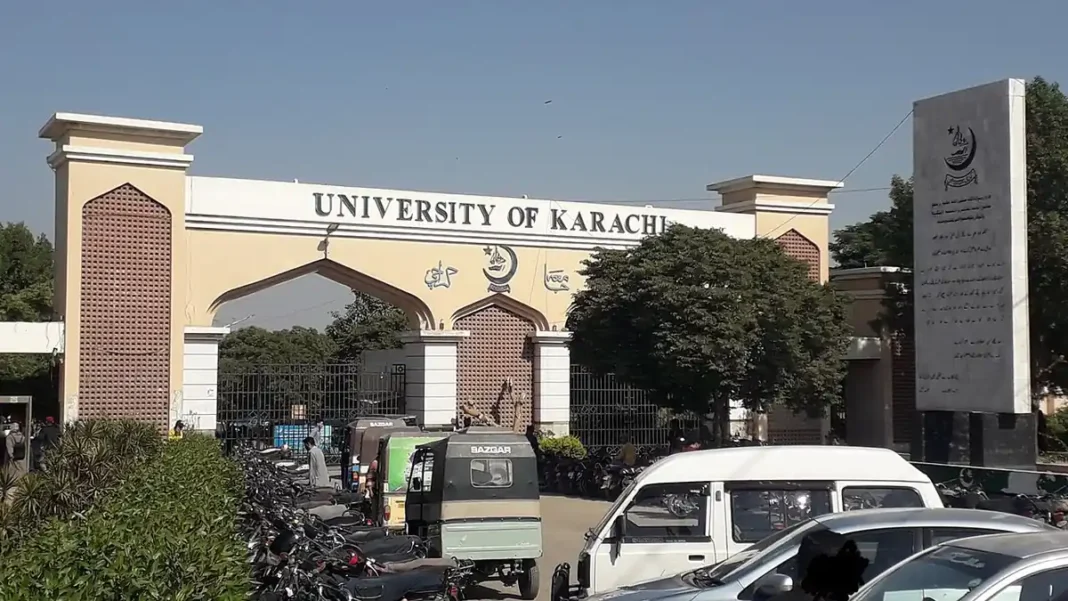
The dispute is not new. Feature Pakistan reported on 7 November that Karachi University admission quotas were already under pressure from a social media campaign, triggering a wider debate in Sindh’s academic circles.
For the 2026 session, 1,815 students from districts outside Karachi were offered admission to four-year BS programmes in December 2025. Of these, 1,018 enrolled in the first year, against a total intake of 9,691.
The pressure at that stage related specifically to the university’s Law Department. The report noted that the Dean of Law, Barrister Sarfraz Mitlo, appointed by the Sindh chief minister as the university’s controlling authority, had himself publicly questioned the admission policy approved by the Academic Council.
That gives the row an unusual shape. The man questioning the policy is the university’s own controlling authority, appointed by the same government that now defends it. Educationists have asked why the university alone is being asked to abandon a policy that other public universities in the province also follow, since several give preference to applicants from their own cities or districts first.
What each side is saying
Khursheedi’s charge is that the system is being bent against Karachi. His examples are specific: a town-based quota at a medical university in Lyari that, in his account, helps students from some neighbourhoods and shuts out others, and fake domiciles that let ineligible applicants take seats meant for Karachi students. His remedy is an investigation by the provincial law minister into who introduced the arrangement and on whose instructions.
Rahoo’s answer is that there is nothing to investigate. He says admissions follow the rules, no quota is reserved for any ethnic or linguistic group, and Karachi University excludes no student from any area.
Neither side has produced documents in public to settle the argument.
What happens next
The threat of street protests raises the stakes. MQM-P has said it will mobilise its workers if the alleged irregularities are not addressed, moving a debate about admission rules onto the streets of Karachi. The provincial government has shown no sign of backing down, and Rahoo’s reply was a flat denial rather than an offer of talks.
Admissions touch thousands of families every year, and the argument over who gets a seat at a public university is among the most sensitive in Sindh politics. A single entry test for undergraduate admissions has been proposed by the Higher Education Commission, which would change how students apply across the country. For now, the system in Sindh is run district by district, and each season brings the same argument back.
The same week, 7,000 students in Karachi were declared absent in exam results, which prompted protests of their own, and Sindh has opened scholarships for transgender students. The admissions row sits inside a wider argument about access to education, and the protest threat means it will not stay inside the assembly’s media corner for long.
Frequently asked questions
What is the Sindh university admissions row about?
MQM-P says Karachi students face discrimination through manipulated quotas and fake domiciles. The Sindh government says admissions are strictly merit-based.
Who made the protest threat?
Sindh Assembly Opposition Leader Ali Khursheedi, of MQM-P. He warned the party would mobilise its workers and take to the streets if the irregularities were not addressed.
What did the Sindh government say in reply?
Minister Muhammad Ismail Rahoo said the claims were baseless, admissions followed prescribed rules, and students from all districts were treated equally.
How many outside-Karachi students did Karachi University admit?
For the 2026 session, 1,815 students from outside Karachi were offered admission to four-year BS programmes, and 1,018 enrolled in the first year of a total intake of 9,691.
Which university is at the centre of the row?
Karachi University. The pressure related specifically to its Law Department, and the university’s Dean of Law, Barrister Sarfraz Mitlo, who is also its controlling authority, publicly questioned the admission policy approved by the Academic Council.