


Aiwan-e-Sadar Pakistan: Meaning, History and Visiting Guide
“Aiwan-e-Sadar” is the name Pakistanis use every day for the President House — but what does it actually mean, and is it different from Aiwan-e-Sadr? This guide explains the name, the building’s story, and how (and when) ordinary citizens can visit.
Quick answer: Aiwan-e-Sadar (ایوانِ صدر) means “the President’s House” — Aiwan = house/palace, Sadr = president. It is the same building as Aiwan-e-Sadr (just a transliteration difference): the official residence of Pakistan’s President on Constitution Avenue, Islamabad, built 1970–1981 and first occupied in 1988. The public can visit only on designated open days announced by the presidency.
In this guide
What “Aiwan-e-Sadar” Means
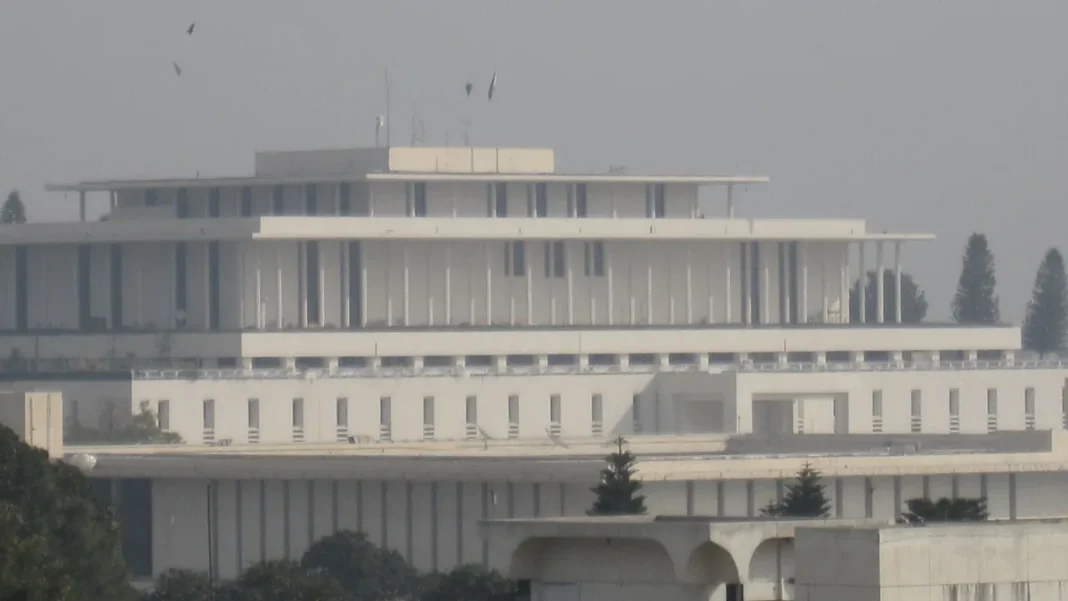
In Urdu, Aiwan (ایوان) means a grand house, hall or palace, and Sadr (صدر) means president, chief or head. So Aiwan-e-Sadr = “the President’s House” — the exact Urdu equivalent of “President House”. The presidency’s own website and official documents use the Sadr spelling; Sadar is the common phonetic rendering in Pakistani English and Roman Urdu. Both refer to the same white-marble step pyramid on Constitution Avenue.
Sadar vs Sadr vs Saddar — Don’t Confuse Them
- Aiwan-e-Sadr / Aiwan-e-Sadar: the President House, Islamabad (same building, two transliterations).
- Saddar: the commercial heart of Rawalpindi (and a Karachi neighbourhood) — a completely different place. Searching “sadar Islamabad” almost always means the President House, not a market.
- Awane Sadar: another Roman-Urdu variant of the same name.
The Building’s Story in Brief
Construction began in 1970 and took 11 years; American architect Edward Durell Stone designed the modern step pyramid in white marble with Islamic geometric detailing and Mughal-style gardens. Ghulam Ishaq Khan became the first resident president in 1988. In 2022 it became the world’s first ISO 50001-certified green presidency with a 1-megawatt solar plant. Full details: our President House Islamabad history and the President Secretariat overview.
Visiting Guide: Open Days and Rules
- Open days: the presidency opens to the public on specifically announced days — first in December 2018 (9am–4pm, CNIC required), and periodically since on public holidays. There is no walk-in daily access.
- How to know: watch announcements on president.gov.pk and official government channels.
- What to bring: original CNIC; expect security screening.
- Rules inside: electronic devices (including phones) are typically prohibited; dress formally; follow the escorted route — it is a working presidency, not a museum.
- Getting there: Constitution Avenue, Red Zone — arrive by taxi/private car; public transport does not enter the zone.
Frequently Asked Questions
Is Aiwan-e-Sadar the same as Aiwan-e-Sadr?
Yes — the same building. “Sadar” is the common phonetic spelling; “Sadr” is the official transliteration. Both mean the President House, Islamabad.
What does Aiwan-e-Sadar mean in English?
“The President’s House” — Aiwan (grand house/palace) + Sadr (president).
Can tourists visit Aiwan-e-Sadar?
Only on designated public open days announced by the presidency. Bring your CNIC, expect security checks, and leave phones behind.
Is “Sadar Islamabad” a market or the President House?
The President House. The market called Saddar is in Rawalpindi (and Karachi) — a different place with a similar-sounding name.