


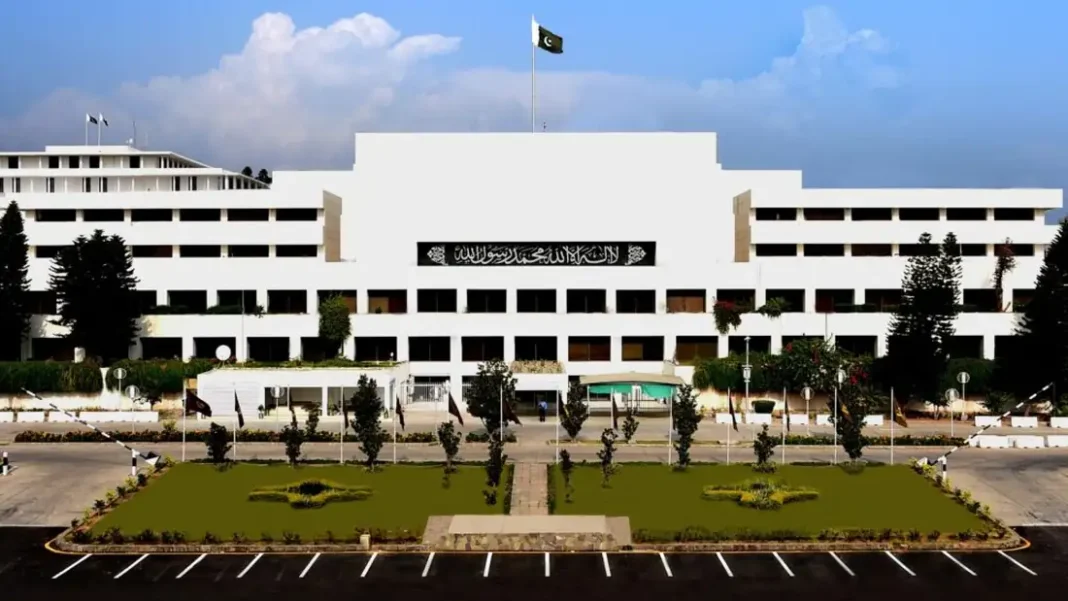
Pakistan’s finance minister is Muhammad Aurangzeb, the former JPMorgan banker and Habib Bank CEO who has held the portfolio since 11 March 2024 in Prime Minister Shehbaz Sharif’s cabinet. His tenure has centred on IMF programmes, revenue mobilisation and stabilising an economy that narrowly avoided default. Here is the complete profile.
Quick answer: The current finance minister of Pakistan is Senator Muhammad Aurangzeb, in office since 11 March 2024. A former JPMorgan executive and CEO of Habib Bank (Pakistan’s largest bank by deposits), he also holds the Revenue Division. He steered Pakistan through its IMF Extended Fund Facility, presented federal budgets, and chairs economic reform drives including the PM’s Access to Finance Plan 2026–2028.
In this guide
Who is Muhammad Aurangzeb
A banker, not a career politician. Before entering government, Aurangzeb was president and CEO of Habib Bank Ltd (HBL), Pakistan’s biggest bank by deposits, where customer accounts grew from 12 million to 36 million during his tenure. Before HBL he was CEO of JPMorgan’s Global Corporate Bank in Singapore — a pedigree that made his appointment a signal: Shehbaz Sharif wanted a technocrat, not a party loyalist, running the economy.
He was among Pakistan’s highest-paid bank CEOs (reported annual package around PKR 352 million) and gave it up — along with his Dutch nationality, which he renounced on taking office — to join the cabinet. On 2 April 2024 he was elected to the Senate on a Punjab technocrat seat with 128 votes, securing the parliamentary status unelected ministers must attain within six months. More on who the finance minister is.
The role: what the finance minister controls
Finance plus Revenue. Shehbaz Sharif bifurcated the old Ministry of Finance, Revenue and Economic Affairs: Aurangzeb kept Finance and the Revenue Division (tax policy, FBR oversight), while the Economic Affairs Division went to Ahad Cheema. That makes Aurangzeb the government’s point man on budgets, taxation, debt management and IMF relations.
His in-tray since 2024: completing IMF reviews under the Extended Fund Facility, broadening Pakistan’s narrow tax base, managing debt servicing that consumes a huge share of revenue, and privatisation of state enterprises. In 2026 he has chaired the Access to Finance Steering Committee driving the PM’s Access to Finance Plan 2026–2028 — covering SME, agriculture, IT, housing and export finance — and represented Pakistan at the World Bank–IMF Spring Meetings in Washington. See the current finance minister page for his latest moves.
Record so far
Stabilisation over stimulus. Aurangzeb’s budgets have prioritised macroeconomic stability: revenue targets built on taxing previously under-taxed sectors (retail, agriculture income, real estate), tight expenditure control, and meeting IMF structural benchmarks. Inflation, which ravaged household budgets in 2023, eased significantly — though critics argue the stabilisation has come at the cost of growth and has squeezed the salaried class.
His technocratic style — data dashboards, weekly monitoring of finance initiatives, direct engagement with banks — contrasts with the political wheeling of predecessors. Supporters credit him with restoring creditor confidence; detractors, including some within the PML-N old guard, grumble that a banker cannot do a politician’s job of selling painful reforms. The ministers of Pakistan guide places him in the full cabinet context.
Finance ministers before him
A revolving door. Pakistan has had 45 finance ministers, and the portfolio is famously a political graveyard. Aurangzeb’s immediate predecessors: Shamshad Akhtar (caretaker, Aug 2023–Mar 2024), Ishaq Dar (Sep 2022–Aug 2023, the PML-N veteran passed over for the job in 2024), and Miftah Ismail. The first finance minister of Pakistan was Malik Ghulam Muhammad (1947–1951), later the country’s third Governor-General.
The third banker to hold the job after Shaukat Aziz and Shaukat Tarin, Aurangzeb represents a recurring Pakistani experiment: importing private-sector credibility to a ministry where political pressures usually win. Whether the experiment survives the next election cycle is the open question — the federal finance minister’s office has rarely kept the same occupant for long.
Who is the finance minister of Pakistan in 2026?
Senator Muhammad Aurangzeb, in office since 11 March 2024 — a former JPMorgan executive and Habib Bank CEO serving in Shehbaz Sharif’s cabinet, holding the Finance and Revenue portfolios.
What is Muhammad Aurangzeb’s background?
Banking: CEO of JPMorgan’s Global Corporate Bank in Singapore, then president/CEO of Habib Bank (Pakistan’s largest bank by deposits). He renounced Dutch nationality to take the ministry and was elected Senator in April 2024.
What are the finance minister’s main achievements?
Steering Pakistan through IMF programme reviews, presenting stabilisation budgets, easing inflation from 2023 peaks, and chairing the Access to Finance Plan 2026–2028 for SME, agriculture and housing credit.

 — the ex-JPMorgan banker steering Pakistan's economy. Profile, role and key policies.)