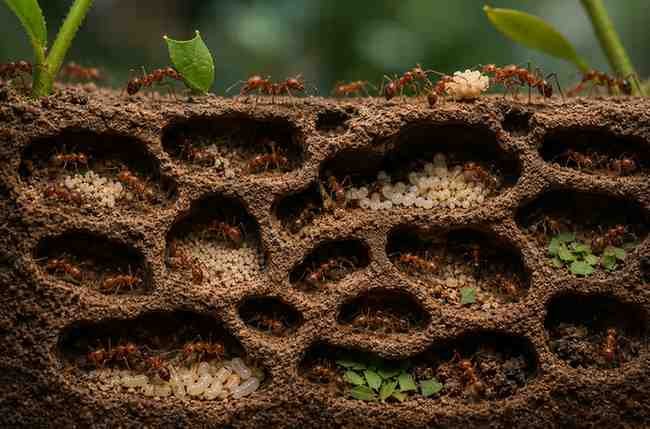
Most people ignore ants, but inside there is a civilization of ants.
They walk across walls, disappear into soil, and carry tiny crumbs across the ground. However, the moment you stop and watch them closely, everything changes.
You suddenly notice order, teamwork, and planning. Then one surprising thought enters your mind. What if ants run one of the most organized societies on Earth?
The civilization of ants may look small from the outside, yet it contains systems that resemble human cities, armies, farms, transportation routes, childcare centers, and communication networks.
Scientists continue to study ants because these tiny insects achieve extraordinary things without modern technology, machines, or written language.
Even more fascinating, ants have survived on Earth for more than 100 million years.
That means ants existed long before humans built the first city.
The Civilization of Ants Runs on Teamwork
No ant survives alone for long.
Every colony depends on cooperation. Each ant performs a specific duty that helps the colony grow stronger. Some ants search for food. Others protect the nest. Meanwhile, worker ants clean tunnels and care for babies.
The queen focuses on reproduction.
This structure keeps the entire colony stable.
Ant civilization works because every member understands its role. Ants never waste energy fighting for status or power inside their colony. Instead, they focus completely on survival and progress.
As a result, some ant colonies contain millions of members living together in perfect coordination.
Humans often struggle to maintain unity in large societies. Ants somehow achieve it naturally.
Civilization of Ants in Underground Cities
Many ant nests look simple from the surface. Yet underground, the reality looks astonishing.
Ant colonies contain tunnels, storage rooms, sleeping chambers, nurseries, farming areas, and waste zones. Some nests even include ventilation systems that control airflow and temperature.
Leafcutter ants create some of the most advanced underground structures in nature.
These ants cut leaves and carry them back to their nests. However, they do not eat the leaves directly. Instead, they use the leaves to grow fungus, which becomes their food source.
In other words, ants developed farming millions of years before humans.
The civilization of ants proves that intelligence does not always require a large brain. Organization and cooperation can create powerful systems even in tiny creatures.
How Ants Communicate Without Words
Humans use language, phones, and technology to share information.
Ants use chemicals.
They release special chemical signals called pheromones. These signals guide other ants toward food, danger, or new nesting areas.
For example, when an ant discovers food, it leaves a chemical trail on the ground as it returns home. Other ants detect that trail and follow it directly to the source.
Soon, hundreds of ants begin moving in a perfectly organized line.
This communication system allows the civilization of ants to respond quickly to changing situations. Ant colonies adapt with remarkable speed because every member constantly exchanges information.
Scientists now study ant communication to improve robotics and artificial intelligence systems.
Nature still teaches humanity many lessons.
Ant Armies Defend Their Colonies Fearlessly
Some ants behave like peaceful workers.
Others behave like elite soldiers.
Army ants launch massive attacks with shocking coordination. Thousands move together like a living wave through forests and fields. They hunt insects, spiders, and even small animals.
Soldier ants protect entrances with their powerful jaws. Fire ants sting enemies aggressively. Meanwhile, trap-jaw ants strike with incredible speed.
The civilization of ants survives because ants understand defense and discipline. Every colony protects its territory seriously.
Even stronger, ants never panic in danger.
They react immediately.
That calm and organized response often helps them defeat much larger enemies.
Ants Practice Farming and Animal Care
The world of ants becomes even stranger once you discover their farming systems.
Leafcutter ants grow fungus farms underground. Meanwhile, some ant species rear aphids the way humans raise cattle.
Aphids produce a sweet liquid called honeydew. Ants protect aphids from predators and carry them from plant to plant. In return, ants collect honeydew as food.
This relationship benefits both species.
The civilization of ants, therefore, includes agriculture and livestock management. These behaviors sound almost unbelievable until you observe them closely.
Scientists often describe ants as nature’s greatest social engineers.
After all, very few creatures organize resources as efficiently as ants do.
The Civilization of Ants Inspires Modern Science
Researchers around the world study ant behavior carefully.
Why?
Ants solve complex problems using simple methods.
For example, ants find the shortest routes to food sources without maps or GPS. Scientists now use similar principles in computer science, internet systems, and delivery networks.
This concept became known as “ant colony optimization.”
The civilization of ants also inspires architects and engineers. Some building designers study ant nests to improve natural ventilation inside modern structures.
At the same time, robotics experts study how ants cooperate in groups. They hope future robots can work together with the same efficiency.
Tiny ants continue shaping big ideas.
Ants Show the Power of Discipline
Humans often associate power with size.
Ants challenge that belief completely.
A single ant looks weak. However, thousands of ants working together become unstoppable. They carry objects much heavier than their bodies, build giant colonies, and survive floods, attacks, and environmental changes.
Most importantly, they never stop working.
The civilization of ants succeeds because discipline drives every action. Ants stay focused on collective goals instead of personal comfort.
That lesson carries surprising importance for human societies as well.
Strong systems grow through cooperation, consistency, and shared responsibility.
Ants demonstrate that truth every single day.
Why the World of Ants Fascinates Scientists
Scientists estimate that more than 20 quadrillion ants currently live on Earth.
That number sounds almost impossible to imagine.
Ants exist in forests, deserts, cities, farms, and jungles. They adapt to different climates with incredible success. Some species build floating rafts during floods. Others survive extreme heat underground.
The civilization of ants continues evolving through survival strategies developed over millions of years.
Despite their tiny size, ants shape ecosystems everywhere. They improve soil quality, recycle organic material, spread seeds, and control insect populations.
Without ants, many ecosystems would struggle badly.
That reality alone shows how important these insects truly are.
Final Thoughts
Most people see ants as ordinary insects.
In reality, ants represent one of nature’s greatest wonders.
The civilization of ants reveals how teamwork, discipline, communication, and organization can build extraordinary systems even without advanced technology.
These tiny creatures farm food, raise young, defend territories, construct underground cities, and solve problems together every day.
They remind humanity that strength does not always come from size or power.
Sometimes, true strength comes from unity.
The next time you notice a line of ants crossing the ground, pause for a moment and watch carefully.
You may not just witness insects.
You may witness one of the oldest and most successful civilizations on Earth.