Quick Facts
- Location: Shigar District, Gilgit-Baltistan, Pakistan, in the Karakoram range
- Altitude: The glacier spans roughly 3,050 m at its snout near Askole up to 5,128 m at the Hispar Pass; Snow Lake lies at around 4,877 m
- Famous For: Being the world’s third-longest glacier outside the polar regions, the Snow Lake basin, and the Biafo-Hispar traverse
- Nearest City: Skardu, around 95-115 km of jeep road from the trek’s start at Askole
- Accessibility: Reached by air (Islamabad to Skardu) or long road journey, then a 7-8 hour jeep ride to Askole and a multi-day glacier trek
- Known Landmarks: Snow Lake (Lukpe Lawo), Hispar Pass, Baintha and Namla campsites, Baintha Brakk (the Ogre) on the horizon
- Best For: Experienced trekkers, mountaineers, photographers, and wilderness adventurers
Why Visit Biafo Glacier
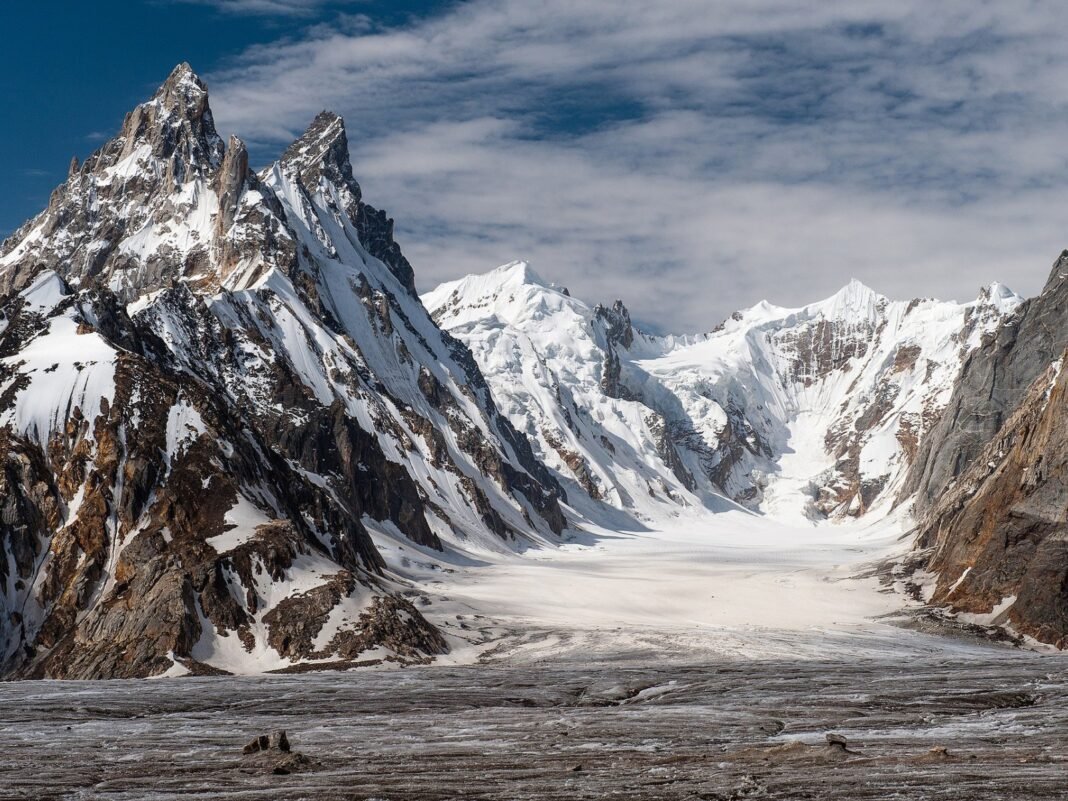
The Biafo Glacier is not a roadside viewpoint you photograph from a parking lot and drive away from. At 67 kilometres long, it is the third-longest glacier outside the polar regions, a river of ice so vast that trekkers need several days just to walk along it. Where most glaciers hide their ice under steep valleys, the Biafo lies open for days of walking, flanked by granite towers and the jagged wall of the Panmah Muztagh, with peaks like Baintha Brakk (7,285 m), known as the Ogre, rising above the horizon.
What makes this biafo glacier travel guide worth reading is that the Biafo is the gentler half of one of the great adventures on Earth. Joined with the 49-kilometre Hispar Glacier at the 5,128-metre Hispar Pass, the two glaciers form a highway of ice more than 100 kilometres long, considered the world’s longest glacial system outside the polar regions. This frozen highway once linked two ancient mountain kingdoms, Nagar in the west and Baltistan in the east, and today it carries one of the most serious treks in the Karakoram. If you are wondering where is Biafo Glacier and whether it is worth the effort, the answer is that very few places on Earth feel this remote, this old, and this alive with ice.
Then there is Snow Lake. High at the head of the Biafo, where the glacier meets the Hispar and its tributary the Sim Gang, lies a basin of snow and ice about 16 kilometres wide, one of the largest ice basins outside the polar regions, with ice measured up to 1,600 metres deep. The British explorer Sir William Martin Conway named it Snow Lake in 1892 for its calm, lake-like appearance. Standing at its edge, surrounded by unbroken white and ringed by peaks that few people have ever climbed, is an experience that belongs on any serious trekker’s lifetime list.
Finally, the Biafo is a living lesson in how glaciers work. Unlike most Karakoram glaciers, which are fed mainly by avalanches crashing off steep walls, the Biafo is nourished mainly by direct snowfall, which is why scientists study it so closely. Walking it, you cross crevassed icefalls, stroll beside flower-covered lateral moraines at camps like Namla and Mango, rest at the green meadow of Baintha, and may spot ibex or markhor on the cliffs above. This is expedition country, but it rewards careful planning with the deepest silence you will ever hear.
History of Biafo Glacier
The human history of the Biafo Glacier begins long before any European saw it. In ancient times, the Biafo-Hispar ice highway served as a route for traders moving between the regions of the Indian subcontinent, China, and Tibet, and for warriors. Nagar forces in the west crossed this route to attack the Baltistan kingdom in the east, and later generations of Hunza people used the same pass to reach Askole, even coming over to play polo matches with the people of Askole. It was, in effect, a high mountain Silk Road of ice.
The first European contact came in stages. Colonel Henry Haversham Godwin-Austen surveyed the lower eastern bank of the glacier in 1860-1861 but did not penetrate its central or upper reaches. The first real exploration was the 1892 Karakoram expedition of British mountaineer Sir William Martin Conway, who approached from the Nagar side with climbers including Oscar Eckenstein and Matthias Zurbriggen. Conway’s team traversed the length of the glacier, mapped it with plane-table surveys, and on 18 July 1892, from a camp at 4,960 metres, Conway looked out over the vast upper snow basin and named it Snow Lake. His party completed the first end-to-end crossing of the combined Biafo-Hispar system in 84 days on snow and ice, and the Survey of India incorporated his observations into official mapping in the late 1890s.
In the twentieth century the traverse became a classic of exploratory mountaineering. The English trekker H. W. Tilman crossed the route in 1937, and the basin continued to draw glaciologists, who confirmed the extraordinary depth of the Snow Lake ice, around a mile thick in places. Today the glacier lies within the Central Karakoram National Park, and every summer a small number of licensed expeditions and trekking groups follow Conway’s route, crossing the Biafo to Snow Lake, climbing over the Hispar Pass, and descending the Hispar Glacier to the village of Hispar in Nagar.
Top Things to Do in Biafo Glacier
Trek the Biafo Glacier to Snow Lake
The signature experience is the multi-day trek from Askole up the glacier to the Snow Lake basin. The first three campsites above Askole, Mango, Namla, and Baintha, sit off the ice beside the lateral moraines and are famous for flowing water, flower-covered ground, and at Namla a waterfall close to the camping area. Baintha, a large green meadow, is often used as a rest day with streams nearby and granite walls for rock climbing. Beyond Baintha the trek continues across the glacier’s boulder-strewn surface toward Snow Lake, days of strenuous but unforgettable walking. This is a full expedition trek that takes around two to three weeks including the Hispar side, and it demands a licensed guide, porters, and proper acclimatisation.
Cross the Hispar Pass
At 5,128 metres, the Hispar Pass is where the Biafo ends and the Hispar Glacier begins, the meeting point of the two kingdoms’ ancient highway. The pass is a broad, wind-scoured saddle of snow with views across the Snow Lake basin and toward the Ogre and the Latok group. Crossing it is the emotional high point of the traverse. Trekkers usually camp near the pass before descending the long, gentler Hispar Glacier toward Hispar village. Altitude sickness is a real danger at this height, so ascend slowly and listen to your guide.
Wildlife Watching
The Biafo’s lateral valleys are some of the best places in the Karakoram to see mountain wildlife. A signboard at Namla, the first campsite, describes it as a sighting place for snow leopards. Markhor and ibex are frequently seen on the surrounding cliffs, Himalayan brown bears roam the higher pastures, and golden marmots whistle from the moraine rocks. Sightings are never guaranteed, especially of the elusive snow leopard, but patient trekkers with binoculars often spot ibex herds. Keep a respectful distance and never feed wild animals.
Photography on the Ice
The Biafo is one of the most photogenic glaciers in Pakistan. The contrast of grey moraine, blue crevasses, green meadows at the campsites, and the white expanse of Snow Lake gives photographers endless material. Early morning light on the Panmah Muztagh peaks and the night sky over a glacier camp are special. Bring spare batteries, because cold drains them fast, and a sturdy tripod for night shots.
Famous Places In and Around Biafo Glacier
- Snow Lake (Lukpe Lawo) – The 16-kilometre-wide ice basin at the head of the glacier, one of the largest outside the polar regions.
- Hispar Pass (5,128 m) – The high saddle where the Biafo meets the Hispar Glacier.
- Hispar Glacier – The 49-kilometre glacier descending westward to Nagar and Hunza.
- Askole Village – The thousand-year-old last settlement before the wilderness, start of the trek.
- Namla, Mango and Baintha Camps – Flower-covered campsites with waterfalls and meadows on the route.
- Baintha Brakk (the Ogre, 7,285 m) – One of the world’s hardest climbed peaks, visible from the upper glacier.
How to Reach Biafo Glacier
Reaching the Biafo is an expedition in itself. Most travellers start in Islamabad. The fastest route is the roughly one-hour flight from Islamabad to Skardu, though flights are weather-dependent and often cancelled in bad weather. The road alternative runs from Islamabad up the Karakoram Highway to Jaglot and then along the Skardu road, a journey of around 640 kilometres that takes 18 to 22 hours of driving, usually split over two days with a night stop in Chilas or Gilgit.
From Lahore, add several more hours; the road distance to Skardu is around 900 kilometres or more, so most travellers from Lahore drive to Islamabad first and fly or continue by road. From Karachi, the practical option is to fly to Islamabad and then to Skardu, or to take a long multi-day road journey north. The nearest airport to the glacier itself is Skardu Airport, with daily flights from Islamabad in good weather.
From Skardu, the trailhead is the village of Askole in the Braldu valley of Shigar District. The jeep track from Skardu to Askole covers roughly 95 to 115 kilometres and takes 7 to 8 hours over rough mountain road, crossing bridges and narrow cliff sections. Only 4×4 jeeps can do this road, and it is usually open from late May or June until October. From Askole, the trek begins on foot; the glacier snout is a day or two of walking away.
Road conditions are fair in summer but the track is rough, dusty, and occasionally blocked by landslides after rain. In winter the road beyond Skardu is usually closed by snow. Transport options are private jeeps hired in Skardu, tour vans and coasters for groups arranged through Skardu-based trekking companies, and public vans part of the way for budget travellers, though the final stretch to Askole almost always needs a hired jeep. Every trekker needs a licensed guide and porters, arranged through a registered tour operator, plus a permit for the Central Karakoram National Park.
Route Details
- Fly or drive from Islamabad to Skardu (1-hour flight or 18-22 hour road journey).
- Spend a night in Skardu to organise permits, guides, porters, and supplies.
- Take a 4×4 jeep from Skardu to Askole, around 95-115 km, 7-8 hours over rough mountain road.
- Trek from Askole across the Biafo snout to the first camps: Mango, Namla, and Baintha (3-4 days).
- Continue up the glacier to Snow Lake at around 4,877 m (2-3 more days).
- Cross the Hispar Pass at 5,128 m and descend the Hispar Glacier to Hispar village.
- Drive from Hispar back to Karimabad (Hunza) or Gilgit.
Where to Stay in Biafo Glacier
There are no hotels on the glacier itself; accommodation on the trek is in expedition tents at established campsites, and your tour operator provides tents, kitchen tents, and sleeping arrangements. In Askole village there are simple guesthouses and homestays used by trekking groups on the night before and after the trek.
Skardu, the gateway city, has the full range of options. Luxury travellers can find high-end hotels and resorts around Skardu and on the road toward Shigar, mid-range hotels cluster in the city centre and along the main roads, and budget guesthouses and hostels serve backpackers. During the June to September trekking season, book Skardu accommodation in advance, especially the better-known mid-range and luxury properties. For the trek itself, your operator handles everything, but bring a good sleeping bag rated for well below freezing, since even summer nights on the glacier are cold.
Where to Eat: Local Foods of Biafo Glacier
On the glacier, your expedition cook prepares the meals, typically simple, filling mountain food: lentils, rice, pasta, potatoes, eggs, and endless cups of tea and soup. Trekkers with special dietary needs should inform the operator in advance. In Askole and Skardu, you eat Balti cuisine. The region’s staples are wheat-based: flatbreads baked fresh, hearty barley and wheat dishes, and meat cooked simply with local spices. Dried apricots, a Baltistan speciality, appear in both sweet and savoury dishes, and fresh trout from mountain streams is served in Skardu’s restaurants.
Skardu’s bazaar has restaurants serving Pakistani, Chinese, and continental food alongside local dishes, plus bakeries and tea houses. A simple meal in a local eatery is budget-friendly, while hotel restaurants cost more. On the trek, carry high-energy snacks like nuts, dried fruit, and chocolate, because the long walking days burn enormous energy. Drink only boiled or purified water on the trek; your crew will handle this.
Weather in Biafo Glacier
The Biafo sits at extreme altitude, so the weather is severe and changeable. Askole, at around 3,030 metres, already has a harsh mountain climate, and conditions on the glacier are colder still, with the upper glacier and Snow Lake well below freezing for most of the year. Summer brings the only reliable trekking window, with relatively stable weather, long daylight, and daytime temperatures on the lower glacier that can feel pleasantly warm in the sun. Nights are always cold, even in July and August, and storms can arrive suddenly at any time, bringing snow even in midsummer. Winter is brutally cold and the route is completely inaccessible.
| Season | Temperature Range | Conditions |
|---|---|---|
| Winter (Dec-Feb) | Around -30°C to -15°C at Askole; far colder on the glacier | Deep snow, route closed, no access to the glacier |
| Spring (Mar-May) | Around -10°C to 8°C at Askole | Snow still heavy on the glacier; route not yet open for treks |
| Summer (Jun-Aug) | Around 0°C to 18°C at lower camps; below freezing at night on the ice | Best trekking season; long days, stable spells, occasional storms |
| Autumn (Sep-Oct) | Around -8°C to 10°C at lower camps | Clear skies early on; route closes as snow returns in October |
Language and Culture of Biafo Glacier
The gateway region of the Biafo is Baltistan, and the language you will hear in Askole and Shigar is Balti, a Tibetic language written in the Perso-Arabic script. Most people involved in tourism also speak Urdu, and guides working with foreign expeditions speak English. The people of Baltistan are predominantly Muslim, known for hospitality toward travellers, and the porters of Askole are famous across the mountaineering world for their strength on the great Karakoram treks.
Cultural norms are conservative. Dress modestly, ask permission before photographing people, and respect prayer times and local customs in the villages. On the trek, the Balti porters have their own traditions and pace; treat them with respect, tip fairly through your operator, and follow your guide’s instructions about campsites, which are often near grazing areas used by local herders. Because the glacier lies in the Central Karakoram National Park, leave no trace: carry out all rubbish, use established toilet arrangements, and never wash directly in glacial streams.
Shopping in Biafo Glacier
There is no shopping on the glacier, so buy everything you need in Skardu before heading to Askole. Skardu’s bazaar is the place for trekking supplies, warm clothing, dried fruits and nuts for the trail, and souvenirs. Baltistan is famous for its dried apricots, apricot oil, and handmade woollen products such as shawls, caps, and socks, which make practical souvenirs from a cold-weather trip. Local handicrafts include woodwork and traditional Balti caps.
Askole has small village shops with basic supplies like biscuits, tea, and soap, but do not rely on them for trekking gear. There are no shopping malls anywhere near the glacier; Skardu has regular markets and small shopping centres for everyday needs. Bargaining is normal in the bazaar, done politely and with a smile.
Travel Tips for Biafo Glacier
Packing Essentials
Pack for an expedition, not a holiday. You need a four-season sleeping bag, insulated jacket, waterproof shell, warm layers, sturdy broken-in trekking boots, crampons or microspikes for glacier travel (your operator usually provides technical gear), glacier sunglasses, high-SPF sunscreen, a headlamp with spare batteries, and a comprehensive first-aid kit including altitude medication prescribed by your doctor. A duffel bag for porter-carried gear and a daypack for the trail are standard.
Safety Tips
The Biafo is serious mountaineering terrain. Never walk on the glacier without a guide; crevasses are hidden under snow. Acclimatise properly, the itinerary builds in rest days for a reason. Drink plenty of water, watch for signs of altitude sickness in yourself and others, and descend if symptoms worsen. Weather changes fast, so always carry warm and waterproof layers even on sunny mornings. Register with your tour operator and inform someone of your itinerary. Travel insurance that covers helicopter evacuation at high altitude is essential.
Money & Connectivity
Bring all the cash you need in Pakistani rupees from Skardu or Islamabad; there are no ATMs beyond Skardu and none on the trek. Mobile signals are weak to non-existent on the glacier. In Skardu and Gilgit, the local operator SCO (Scom) has the most reliable coverage in Gilgit-Baltistan, with Jazz and Telenor working in towns. Expect no signal at all once you leave Askole. Satellite phones or messengers, arranged through your operator, are the only reliable communication on the trek.
Best Time to Visit Biafo Glacier
Summer (June to August)
This is the prime season and the only time full treks run. The jeep road to Askole is open, the glacier camps are snow-free enough for tents, and daylight is long. July and August offer the most stable weather, though afternoon storms are still possible. Book guides and porters months ahead, as the short season fills quickly.
Early Autumn (September)
September brings clearer skies and fewer trekkers, with beautiful light for photography. It is colder, especially at night, and the season can end abruptly if early snow closes the road to Askole. Experienced trekkers who are well equipped often prefer this quieter window.
Late Spring (May)
May is marginal. The road to Askole may open late in the month, but the glacier is still deeply snow-covered and full traverses are not practical. Only consider it if your operator confirms conditions.
Winter (November to April)
The route is closed. Askole itself endures extreme cold, and the glacier is unreachable. Do not attempt a winter visit.
Final Thoughts
The Biafo Glacier is one of the great wilderness journeys left on Earth. It asks a lot: weeks of your time, real money, serious fitness, and the patience to deal with mountain weather and remote logistics. In return it gives you something almost no other trek can, days of walking on one of the planet’s largest rivers of ice, nights under some of the clearest skies you will ever see, and the rare privilege of standing at Snow Lake, a place only a small number of people visit each year.
If you go, go prepared and go respectfully. Travel with a licensed operator, listen to your Balti guides and porters, and leave the glacier as clean as you found it. For more ideas across the north, browse the Explore Pakistan section, and if the Karakoram has captured you, the Hunza Valley guide covers the western end of the great ice highway. The Biafo rewards those who take it seriously, and it never leaves them unchanged.
FAQs
Where is Biafo Glacier located?
The Biafo Glacier is in Shigar District, Gilgit-Baltistan, Pakistan, in the Karakoram range. Its snout lies near Askole village, and it runs northwest to meet the Hispar Glacier at the Hispar Pass.
How long is Biafo Glacier?
The glacier is 67 kilometres long, making it the third-longest glacier outside the polar regions, after the Fedchenko Glacier in Tajikistan (77 km) and the Siachen Glacier (70 km).
What is the best time to visit Biafo Glacier?
June to September is the trekking season, with July and August offering the most stable weather. The route is closed in winter.
How do I reach Biafo Glacier?
Fly or drive from Islamabad to Skardu, take a 4×4 jeep to Askole (7-8 hours), then trek on foot. The full traverse to Snow Lake and over the Hispar Pass takes two to three weeks.
Is the Biafo Glacier trek safe for beginners?
No. It is a strenuous expedition trek on crevassed glacier terrain at altitudes up to 5,128 m. It suits fit, experienced trekkers with a licensed guide and proper acclimatisation.
What is Snow Lake?
Snow Lake (Lukpe Lawo) is a 16-kilometre-wide basin of snow and ice at the head of the Biafo Glacier, around 4,877 m high, named by explorer Martin Conway in 1892. Its ice is up to 1,600 metres deep.
Where can I stay near Biafo Glacier?
Trekkers sleep in expedition tents at established campsites. Skardu has hotels and guesthouses of all levels for before and after the trek, and Askole has simple guesthouses.
What food is available on the Biafo trek?
Your expedition cook prepares mountain meals on the trek. In Skardu and Askole you will find Balti cuisine: wheat flatbreads, barley dishes, dried apricots, and fresh trout.