Standing in the middle of the plains of southern Punjab, far from any famous tourist circuit, is one of the most astonishing buildings in Pakistan. The Bhong Mosque took nearly fifty years to build, employed around a thousand craftsmen, and won the Aga Khan Award for Architecture in 1986. This Bhong Mosque travel guide brings together everything a visitor needs: its real history, how to get there, the best season to visit, where to stay nearby, and what to see around it.
Quick Facts
- Location: Bhong village, Sadiqabad Tehsil, Rahim Yar Khan District, Punjab, Pakistan
- Altitude: Lowland plains of southern Punjab (no significant elevation)
- Famous For: A mosque built over 1932-1982 that won the Aga Khan Award for Architecture in 1986; intricate tilework, mirror work, calligraphy, and a fusion of Islamic and colonial architectural styles
- Nearest City: Sadiqabad (under an hour by road); Rahim Yar Khan city, about 50 km away
- Accessibility: Good metalled roads from Sadiqabad and Rahim Yar Khan; nearest airport is Sheikh Zayed International Airport, Rahim Yar Khan
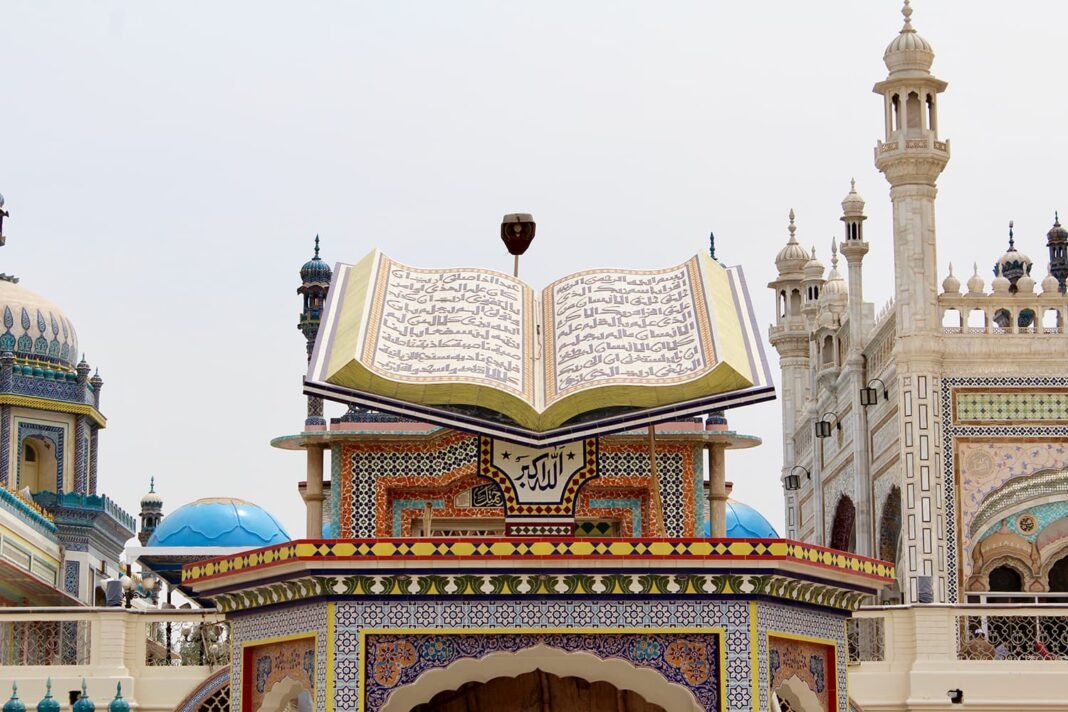
- Known Landmarks: The mosque itself, its palace compound, the adjoining madrasa and smaller mosque, and the white marble Quran monument outside the veranda
- Best For: Architecture lovers, photographers, history enthusiasts, and religious travelers
Why Visit Bhong Mosque
The Bhong Mosque is not a monument built by an empire. It was built by one man, Sardar Raees Ghazi Muhammad, a wealthy landlord of Bhong, who began the project in 1932 and kept refining it for the rest of his life. That personal devotion shows in every surface: red stone and marble carved by masons brought from Rajasthan, glazed tiles fired by Multani craftsmen, frescoes and calligraphy painted by artists from Karachi. Few buildings in the world carry the fingerprints of so many different craft traditions at once.
The second reason to visit is the award. In 1986, the Aga Khan Award for Architecture — one of the most respected architecture prizes in the world — chose this village mosque as a winner. The jury praised it as a building that “enshrines and epitomises the popular taste in Pakistan with all its vigour, pride, tension and sentiment.” It is the rare Pakistani building that international architecture students study, and you can walk through it in an afternoon.
Third, the mosque sits in real, working rural Punjab. There is no ticket queue, no crowd of tour buses, and no staged experience. You arrive in a farming village near the Sindh border, you are received with the famous hospitality of the region, and you see a masterpiece in the middle of everyday life. For travelers who have already seen the great Mughal mosques of Lahore, Bhong offers something those cannot: a living building, still in daily use, that grew slowly over half a century instead of being finished in a ruler’s lifetime.
Finally, the area around Bhong rewards the curious. The same trip can include Patan Minara near Rahim Yar Khan, the Cholistan forts of Islam Garh and Derawar, and the bazaars of southern Punjab. Bhong is best done as a one- or two-day excursion from Rahim Yar Khan, and it fits naturally into a wider southern Punjab itinerary.
History of Bhong Mosque
The story of the Bhong Mosque begins in 1932, when Sardar Raees Ghazi Muhammad, the landlord of a large estate in Bhong, commissioned a mosque that would be the jewel of his palace compound. The compound already contained a smaller mosque and a madrasa; the new mosque was meant to be the most glorious building on the estate. Sardar Ghazi Muhammad conceived, directed, and funded the entire project himself, and he kept changing and improving it for decades.
The construction was carried out by specialists gathered from across Pakistan and India: master masons from Rajasthan, craftsmen from Multan for glazed tile, mosaic and woodwork, and painters and calligraphers from Karachi. Workshops were set up to train local craftsmen in skills that had traditionally passed from father to son, and over the fifty years of work, around a thousand workers and craftsmen were trained in indigenous crafts.
The building’s long timeline was partly deliberate and partly forced by nature. Around 1950, waterlogging and salinity began damaging the structure, so the main building was demolished and rebuilt on a raised platform about 20 feet high, which changed the design again. Materials were sourced with extraordinary care: red stone, marble, and sandstone, with black and grey stone imported from Italy, Hungary, and Austria. Traditional materials — teak, ivory, onyx, coloured glass, glazed tiles, fresco, mirror work, gilded tracery, and calligraphic inlay — were combined with modern industrial materials such as terrazzo and artificial stone facing.
Architecturally, the mosque is deliberately eclectic. The builders borrowed stylistic elements from nearby Lahore and from Iran, Spain, and Turkey, and combined them with Western colonial elements of the 1940s. Sardar Ghazi Muhammad died in 1975, and his son, Raees Shabbir Muhammad, carried the work forward. The mosque was completed and opened for worshippers in 1982. In 1986 it won the Aga Khan Award for Architecture, presented by Prince Karim Aga Khan. In recognition of his contribution, the government of Pakistan posthumously conferred the Sitara-i-Imtiaz on Sardar Raees Ghazi Muhammad on Pakistan Day, 23 March 2004, and in 2004 Pakistan issued a postage stamp bearing the mosque’s picture.
Top Things to Do in Bhong Mosque
Study the award-winning architecture
Give the building the slow attention it deserves. Walk around the exterior first, then move inside, and look for the meeting of styles: Mughal-style arches next to Spanish-inspired tilework, Persian calligraphy beside colonial-era detailing. The jury of the Aga Khan Award singled out exactly this quality — the mosque’s bold, popular fusion of signs and symbols. Guides and caretakers at the mosque can point out the sections built in different decades.
See the craft details up close
The mosque rewards close looking: mirror work that catches the light, inlaid marble, painted frescoes, carved teak and sandalwood, and Quranic calligraphy worked into tile panels. Much of it was made by hand over decades. Photography is a major reason many visitors come, and the morning light is the best for the facade.
Visit the white marble Quran monument
Just outside the veranda stands a white marble Quran monument, a recent addition to the complex that visitors photograph alongside the mosque. It makes a fitting foreground for pictures of the main building.
Offer prayers and visit the women’s mosque
Bhong is a working mosque, not a museum. Visitors are welcome to join the prayers, and the complex also has a separate smaller Juma Masjid for women. The main prayer hall holds about two and a half thousand worshippers. Dress modestly, keep your voice low, and avoid visiting during the Friday congregational prayer if you only want to sightsee.
Explore the compound: madrasa and hujra
The mosque stands within the palace compound that also holds a madrasa and the hujra (chamber) where Sardar Ghazi Muhammad himself used to worship. The complex historically served as the only center of education for the area’s children, and the Aga Khan Award plaque on the mosque records the names of the master artisans who built it.
Famous Places In and Around Bhong Mosque
- Patan Minara: An ancient tower about 8 km from Rahim Yar Khan city, believed by some archaeologists to date back to the Mauryan period and possibly used as a watchtower since Alexander’s era.
- Islam Garh Fort: The old Bhinwar Fort in the Cholistan area of Khanpur Tehsil, with an inscription dating its rebuilding to 1665, now in a dilapidated but evocative state.
- Derawar Fort: The great square fort of the Cholistan Desert, one of the most photographed historic sites in southern Punjab.
- Sadiqabad bazaar: The nearest large town on the N-5 highway, good for supplies and a meal before or after the visit.
- Rahim Yar Khan city: The district headquarters with hotels, hospitals, and the Indus Hospital at Bhong itself, useful as an overnight base.
How to Reach Bhong Mosque
Bhong is reached by road. The mosque lies about 50 km southwest of Rahim Yar Khan city, and under an hour from Sadiqabad, which sits on the N-5 National Highway. The nearest airport is Sheikh Zayed International Airport at Rahim Yar Khan, which has flights from major Pakistani cities. From the airport or city, hire a private car or taxi for the half-day trip — public transport to the village itself is limited, so a private vehicle is the practical choice.
From Islamabad: This is a long journey. Take the motorway network south toward Multan and Bahawalpur, then join the N-5 south to Sadiqabad. It is a full day’s drive, so most travelers break the trip in Multan or Bahawalpur. Alternatively, fly from Islamabad to Rahim Yar Khan and drive the last stretch.
From Lahore: Drive south on the N-5 through Multan and Bahawalpur to Sadiqabad — a full day’s drive of several hundred kilometres. The road is a major national highway and in generally good condition. Flying to Rahim Yar Khan and driving onward is the comfortable alternative.
From Karachi: Drive north on the N-5 through Hyderabad and Sukkur toward Sadiqabad, again a full day’s drive, or fly to Rahim Yar Khan and continue by road. Travelers coming from interior Sindh often combine Bhong with Sukkur and the shrines of upper Sindh.
The nearest railway station is at Sadiqabad or Rahim Yar Khan, both on the main Karachi-Peshawar line, with trains from across the country. From either station, continue by taxi. Within the area, rickshaws and local vans connect Sadiqabad to nearby towns, but for Bhong itself a hired car is best. Roads in the area are metalled and in reasonable condition; winter travel is the most comfortable, while summer afternoons are extremely hot.
Route Details
The standard route, described by travel guides for the area, is: from Sadiqabad, take the Sadiqabad-Kashmore road to the small town of Ahmadpur Lamma, then turn westward onto the road leading to Bhong village. The mosque stands in the heart of the village and is signposted locally; anyone in Bhong can direct you to it. The drive from Sadiqabad takes well under an hour, and from Rahim Yar Khan city roughly an hour. Set out early in the morning to enjoy the mosque in soft light and to avoid the midday heat.
Where to Stay in Bhong Mosque
There are no tourist hotels in Bhong village itself — it is a small rural town — so visitors stay in Sadiqabad or Rahim Yar Khan. Rahim Yar Khan city, about 50 km away, is the better base: it has the widest choice of accommodation, from mid-range hotels to simple guesthouses, along with restaurants, hospitals, and fuel stations. Sadiqabad, closer to the mosque, has a smaller selection of budget hotels and guesthouses suited to an overnight halt. Because no specific hotel in these towns has been verified for this guide, book through a reputable booking platform and check recent guest reviews before you travel. For a day trip, you do not need to stay overnight at all — arrive from Rahim Yar Khan in the morning and return by evening. If you are camping-minded, note that there are no organized campsites in the area; the hotel route is the sensible one.
Where to Eat: Local Foods of Bhong Mosque
Bhong sits in the Saraiki-speaking belt of southern Punjab, and the food reflects it: hearty, wheat-based, and cooked in desi ghee. In Sadiqabad and Rahim Yar Khan you will find the usual Punjabi staples — dal, sabzi, tandoori roti, and grilled meats — served at dhabas and family restaurants at budget-friendly prices. The region’s most famous sweet is sohan halwa, the dense ghee-based confection associated with Multan and southern Punjab; buy a box from a reputable sweet shop in Rahim Yar Khan to take home. Roadside dhabas along the N-5 serve fresh chai, parathas, and omelettes through the day, and a full dhaba meal is inexpensive. Carry drinking water with you to Bhong, as the village has only small shops. For travelers with sensitive stomachs, eat at busier restaurants in the cities where turnover is high.
Weather in Bhong Mosque
Bhong has an arid climate with extremely hot summers and mild, pleasant winters — typical of the plains of southern Punjab near the Sindh border. Winter is by far the best season for sightseeing; summer visits are possible but plan around the fierce afternoon heat.
| Season | Temperature Range | Conditions |
|---|---|---|
| Winter (Nov-Feb) | 10-25°C | Mild and pleasant; cool mornings, ideal for visiting |
| Spring (Mar-Apr) | 20-30°C | Warm with cool breezes; good for travel |
| Summer (May-Aug) | 35-45°C | Hot and dry; visit early morning or late afternoon only |
| Monsoon (Jul-Sep) | 25-35°C | Occasional rainfall; humid spells |
Language and Culture of Bhong Mosque
The main language of the area is Saraiki, with Punjabi and Urdu widely understood; Urdu works fine for visitors. The culture is that of rural southern Punjab: deeply hospitable, conservative, and religious. As a guest at a working mosque, dress modestly — long trousers and covered shoulders for men, and a headscarf and loose clothing for women — remove your shoes before entering the prayer areas, and keep your voice down. Ask before photographing worshippers. Elders are treated with great respect, and a polite greeting goes a long way. The local economy is agricultural, built on cotton, wheat, and sugarcane, and the pace of life is slow; accept tea when it is offered, and you will find people eager to tell you the mosque’s story.
Shopping in Bhong Mosque
Bhong village has only small general stores, so do your shopping in Sadiqabad or Rahim Yar Khan. The city bazaars sell the region’s agricultural produce, including dates and cotton products, and Rahim Yar Khan’s sweet shops are the place to buy sohan halwa and other mithai. For handicrafts, look for the glazed pottery and tile-style souvenirs that echo the mosque’s own decoration, though these are easier to find in Multan’s bazaars than locally. There are no shopping malls in the immediate area; this is a trip for experiences, not retail.
Travel Tips for Bhong Mosque
Packing Essentials
Carry sun protection — a hat, sunglasses, and sunscreen — because the plains sun is strong even in winter. Bring drinking water, a light shawl or scarf for mosque entry, and comfortable walking shoes. If visiting in winter, a warm layer for the cool mornings is enough; in summer, light cotton clothing is essential.
Safety Tips
The area is generally calm and welcoming to visitors. Travel during daylight, keep valuables out of sight, and use a reputable driver if hiring a car. As with anywhere in rural Pakistan, it is wise to let your hotel know your plans for the day. Women travelers will be most comfortable visiting with a companion and dressing conservatively.
Money & Connectivity
Carry cash: Bhong village has limited banking, though the town does have basic amenities including a bank. ATMs are plentiful in Sadiqabad and Rahim Yar Khan — withdraw there before heading to the village. Mobile signals from all major networks reach the area, and data coverage is adequate for navigation and messaging.
Best Time to Visit Bhong Mosque
Winter (November to February) — the best season
Temperatures sit between 10 and 25°C, the air is clear, and you can comfortably spend hours walking the compound and photographing the tilework. This is the ideal window for the trip.
Spring (March to April) — very good
Warm days with cool breezes make spring the second-best season. The surrounding farmland is green, and the light is excellent for photography.
Summer (May to August) — avoid if possible
With temperatures reaching 35 to 45°C, sightseeing is limited to the early morning. If you must come in summer, arrive at opening time and leave by midday.
Monsoon (July to September) — acceptable
Occasional rain breaks the heat, but humidity rises. Roads remain passable, and the mosque is less visited in this season.
Final Thoughts
The Bhong Mosque is proof that great architecture does not need a great empire behind it — one determined patron, fifty years, and a thousand trained hands were enough. It is among the most significant modern Islamic buildings in the world, yet it stands quietly in a Punjab village, still serving the community it was built for. That combination of world-class craft and complete lack of pretension is what makes the visit memorable.
Plan it as a winter day trip from Rahim Yar Khan, give the building a slow morning, and pair it with the Cholistan forts or Patan Minara if you have a second day. For more ideas across the country, browse Explore Pakistan, or compare the experience with northern landmarks like Malam Jabba and the Hunza Valley.
FAQs
Where is Bhong Mosque located?
In Bhong village, Sadiqabad Tehsil, Rahim Yar Khan District, Punjab — about 50 km southwest of Rahim Yar Khan city and under an hour from Sadiqabad on the N-5 highway.
What is the best time to visit Bhong Mosque?
November to February, when temperatures are a mild 10-25°C. March and April are also good; avoid the 35-45°C heat of May to August.
How do I reach Bhong Mosque?
Fly or take the train to Rahim Yar Khan (or Sadiqabad on the main railway line), then hire a car. From Sadiqabad, take the Sadiqabad-Kashmore road to Ahmadpur Lamma and turn west to Bhong village.
Why is Bhong Mosque famous?
It was built over nearly 50 years (1932-1982) by Sardar Raees Ghazi Muhammad with craftsmen from across the subcontinent, and it won the Aga Khan Award for Architecture in 1986 for its fusion of Islamic and colonial styles.
Is Bhong Mosque safe for families?
Yes. It is a calm, working mosque in a welcoming village. Dress modestly, visit in daylight, and families will find it a comfortable half-day outing.
Where can I stay near Bhong Mosque?
Stay in Rahim Yar Khan city (about 50 km away), which has the best choice of mid-range hotels and guesthouses, or in Sadiqabad for a closer, simpler overnight halt.
What food is the area known for?
Hearty Saraiki-Punjabi food — dal, tandoori roti, grilled meats at roadside dhabas — and the region’s famous sohan halwa sweet, best bought in Rahim Yar Khan.
How much time do I need at Bhong Mosque?
Two to three hours is enough to see the mosque, the compound, and the marble Quran monument. Most visitors do it as a half-day trip from Rahim Yar Khan, optionally adding Patan Minara or a Cholistan fort.