KARACHI: The Sindh government has announced revised completion dates for four garbage transfer stations in Karachi, with three expected to be completed by November 2026 and the fourth by March 2027.
Sindh Chief Minister Syed Murad Ali Shah shared the update during the inauguration of the first phase of Sindh’s first sanitary engineered landfill at Jam Chakro.
Where each station stands
According to Local Government Minister Syed Nasir Hussain Shah, work on the Sharafi Goth station is 71.43 per cent complete, with construction expected to finish by October 30, 2026.
The Imtiaz station has reached 62.82 per cent completion, while Gutter Baghicha is 51.92 per cent complete. Both stations are scheduled for completion by November 30, 2026.
The Dinga Mor station is only 14.11 per cent complete and is expected to be ready by March 30, 2027.
The four stations were previously used as informal dumping sites and are being upgraded under the World Bank-funded Solid Waste Emergency and Efficiency Project (SWEEP). They were originally scheduled for completion by August 2026, but construction was delayed by waste removal work, encroachments and land handover issues.
Why these stations matter
Once completed, the four stations will have a combined capacity to handle 6,500 tonnes of waste daily. Waste collected at these stations will be transferred to larger vehicles and transported to the Jam Chakro landfill for disposal.
The design ends the old practice of dumping at scattered informal sites. With the engineered landfill now taking its first waste, the transfer stations become the missing middle link — collecting garbage from neighbourhoods, compacting it, and sending it onward in bulk.
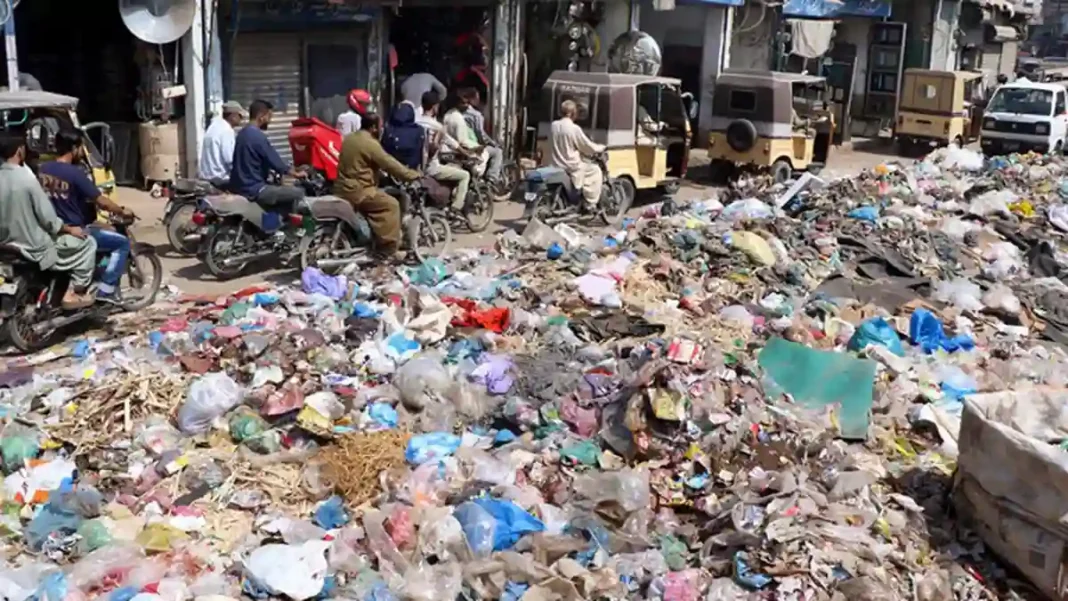
Karachi generates thousands of tonnes of solid waste every day, and mismanaged dumping has been one of the city’s longest-running civic complaints. Fire-safety and civic-compliance failures in the city’s buildings have underlined how far the metropolis still has to go on basic urban governance.
What to watch
The November deadline for three of the four stations is now the immediate test. The Dinga Mor station, barely past 14 per cent completion, has the longest road ahead and its March 2027 date assumes no further land or encroachment disputes.
For Karachi residents, the practical change will be visible only when collection improves at the street level. Transfer stations work only if the trucks that feed them run on schedule — and that remains the weak link in the city’s waste chain.
The capital is working through a similar overhaul: the CDA’s waste dumping between I-10 and I-11 was taken up in the National Assembly this week, alongside a new rural waste-collection drive in Islamabad.
FAQs
When will Karachi’s garbage transfer stations be completed?
Three stations — Sharafi Goth, Imtiaz and Gutter Baghicha — are expected to be completed by November 2026. The Dinga Mor station is scheduled for March 2027.
How much waste will the four stations handle?
Together, the four stations will handle 6,500 tonnes of waste daily once operational.
What is the SWEEP project?
The Solid Waste Emergency and Efficiency Project is a World Bank-funded programme to improve Karachi’s solid waste collection and disposal system, including the transfer stations and the Jam Chakro engineered landfill.