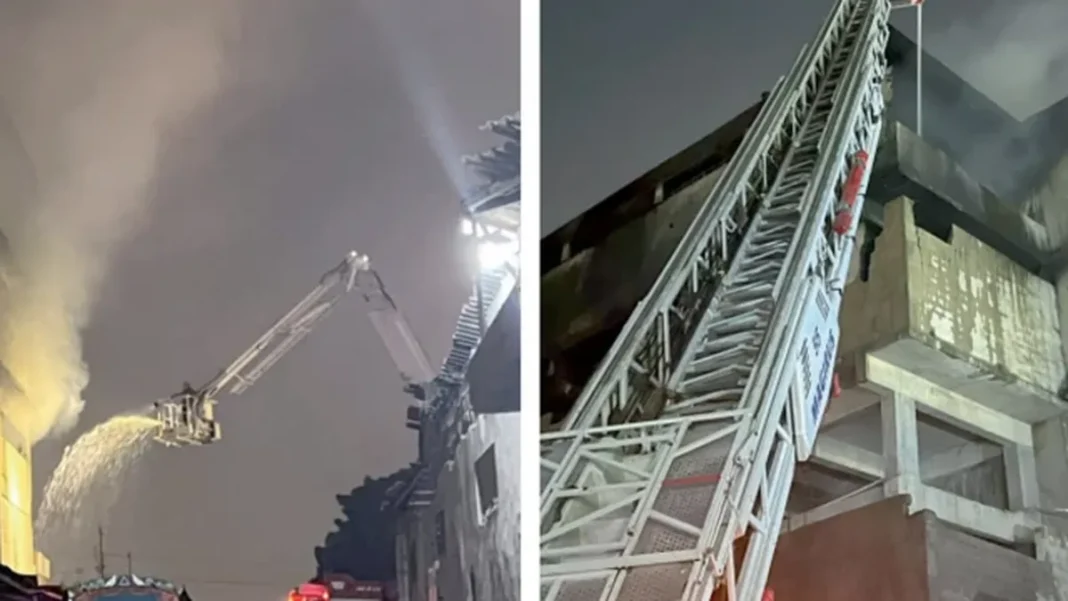
Firefighters in Karachi ended a long and difficult night on Monday after bringing a major garment factory blaze in the SITE industrial area under control. The Karachi SITE factory fire was declared controlled at around 9:15pm on October 19, capping an eight-hour battle that gutted the unit’s upper floors and left the building structurally weakened.
The blaze, classified as third-degree, drew one of the largest firefighting responses seen in the city this year. More than a dozen fire tenders, three snorkels and two water bowsers took part, along with a Pakistan Navy fire tender. Cooling operations were expected to continue for hours. The Express Tribune reported the timeline of the rescue effort in its coverage of the blaze.
Upper floors gutted as flames spread fast
The fire spread through the factory’s second and third floors, where plastic rolls, cardboard, wood, thread, garments and foam fed the flames. Dense smoke made the work difficult for crews moving inside.
KMC Chief Fire Officer Humayun Khan said all goods on the second and third floors were destroyed. Firefighters used foam and water to contain the flames. Khan warned the intense heat had weakened the building, leaving it in a precarious condition.
The third-degree classification was used to mobilise all relevant departments and rush resources to the site. At first, the corporation sent 11 fire tenders and two water bowsers, with crews fighting the flames from inside and outside the building.
Water shortage slowed the early response
Fire brigade officials at the site said a shortage of water slowed the initial effort. The Karachi Water and Sewerage Corporation (KWSC) responded by activating additional hydrants to keep supplies flowing.
KWSC said around 300,000 gallons were supplied, mostly from Crush Plant Hydrants I and II, with the rest from Nipa, Sakhi Hassan and Safoora. Emergency water arrangements were made on the orders of KWSC CEO Ahmed Ali Siddiqui and kept running until the operation ended.
Probe ordered into the Karachi SITE factory fire
Sindh Chief Minister Syed Murad Ali Shah stepped in as the operation continued. He directed the administration and rescue authorities to bring in more resources, get the fire under control and protect nearby buildings.
The chief minister also sought a detailed report from the Karachi commissioner and the Industries Department. He ordered a prompt and thorough investigation into the cause of the fire. He further directed a comprehensive review of fire safety arrangements across industrial areas to prevent similar incidents in the future.
A follow-up to our earlier coverage
This story follows Feature Pakistan’s earlier report when the fire was first reported in the SITE area, while crews were still battling the flames.
Karachi’s long struggle with industrial fires
The blaze adds to Karachi’s painful record of factory fires. The Supreme Court recently dismissed Sindh’s plea against the acquittal of accused in the Baldia factory fire case, a reminder of how far back the city’s industrial safety crisis stretches.
SITE and Korangi house hundreds of units, many storing combustible material close to production lines. Plans for a garments city at Port Qasim have raised hopes of safer industrial zones. The blaze comes at a sensitive time for the garments trade, with textile exporters already warning of a steep decline in October-to-December orders.
The probe ordered by the chief minister will test whether this latest warning leads to real change. For now, the damaged factory stands as another reminder of the cost of weak fire safety in the country’s industrial hub.
FAQ
How long did it take to bring the Karachi SITE factory fire under control?
Firefighters battled the blaze for around eight hours before it was declared under control at 9:15pm on October 19, according to KMC Chief Fire Officer Humayun Khan.
What caused the SITE garment factory fire?
The exact cause is not yet known. The chief minister has ordered a probe by the Karachi commissioner and the Industries Department to determine what started the fire.
How much damage did the fire cause?
All goods stored on the second and third floors were destroyed. The building’s structure was left weakened and in a precarious condition after hours of intense heat.
Why was the fire classified as third-degree?
The third-degree classification was used to mobilise all relevant departments and ensure resources, including water, equipment and extra crews, reached the site quickly.
What did the Sindh chief minister order after the fire?
Syed Murad Ali Shah ordered additional resources during the operation, sought a detailed report, directed a thorough investigation into the cause and asked for a review of fire safety arrangements in industrial areas.