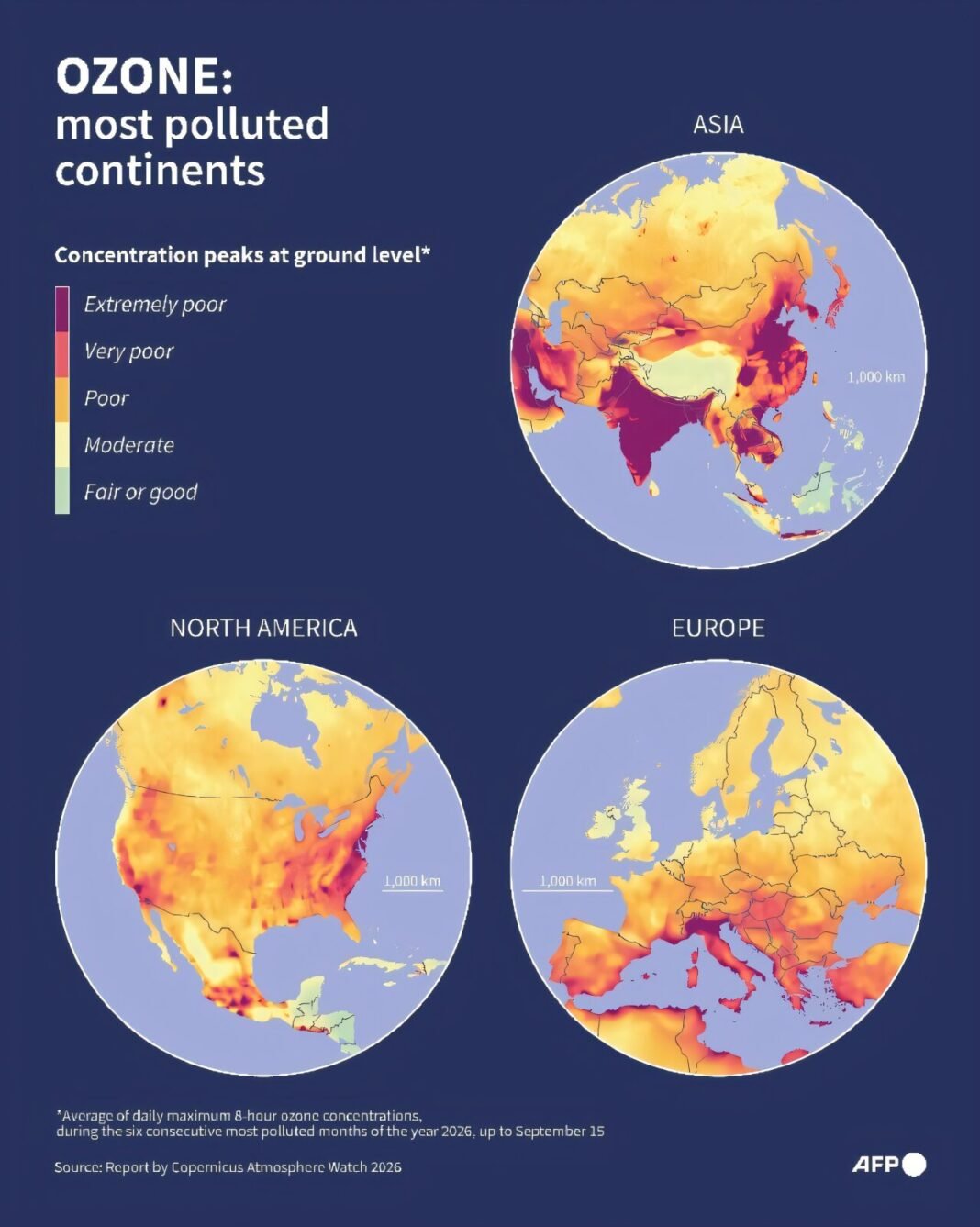
LAHORE: Lahore has been listed among the cities with “extremely poor” ozone levels in a European Union report that found one-third of the world’s population was exposed to dangerously high ozone pollution this year.
The analysis, released on Wednesday by the EU’s Copernicus Atmosphere Monitoring Service, covered the first eight months of 2026. It found that record heatwaves and wildfires, combined with emissions from vehicles, industry and fires, had driven ground-level ozone to extreme levels across the globe.
Between January 1 and September 15, some 34 per cent of the global population breathed “extremely poor” air, with ozone concentrations well above the World Health Organisation’s guidance. Another 17 per cent breathed “very poor” air, while only 5 per cent enjoyed “good” ozone levels.
Asia hit hardest
Asia recorded the highest exposure of any continent. About 53 per cent of its population breathed “extremely poor” air and another 22 per cent breathed “very poor” air. New Delhi, Dhaka, the Chinese megalopolis of Chongqing and Pakistan’s Lahore were named among the cities with the worst ozone levels.
The report linked the continent’s pollution to industrialisation, economic development and transport, alongside wildfires and the burning of agricultural residue.
Elsewhere, two-thirds of the population in North America and 45 per cent in Europe were exposed to “poor” or “very poor” air quality. The report noted that EU regulation had been effective in cutting most air pollutants, but ozone had resisted those efforts.
“Air pollution does not stop at borders. It can travel thousands of kilometers, crossing continents and oceans and affecting air quality far from its source,” CAMS director Laurence Rouil said in the report.
The health toll
Ground-level ozone forms when heat and sunlight react with airborne emissions. It can damage lung tissue, cause breathing problems, trigger asthma attacks and lead to other health problems.
The report linked ozone pollution to 60,000 premature deaths a year in Europe, according to Ian Marnane, an official at the European Environment Agency. In North America, ozone levels remained “relatively unchanged” despite ambitious emissions policies.
One bright spot was Oceania, including Australia and New Zealand, where 66 per cent of the population enjoyed “good” ozone levels and 34 per cent lived under “fair” conditions.
What is ground-level ozone pollution?
It forms when heat and sunlight react with emissions from vehicles, industry and wildfires. Unlike the protective ozone layer high in the atmosphere, ground-level ozone harms lungs and triggers breathing problems.
Why is Lahore’s ozone level rated extremely poor?
The Copernicus report points to the mix of vehicle and industrial emissions, agricultural residue burning and intense summer heat that drives ozone formation across South Asia.
What is the WHO guideline for ozone exposure?
The WHO sets 100 micrograms of ozone per cubic metre as the maximum recommended exposure, averaged over eight hours.