Houthis Free 600 Detainees in Sanaa
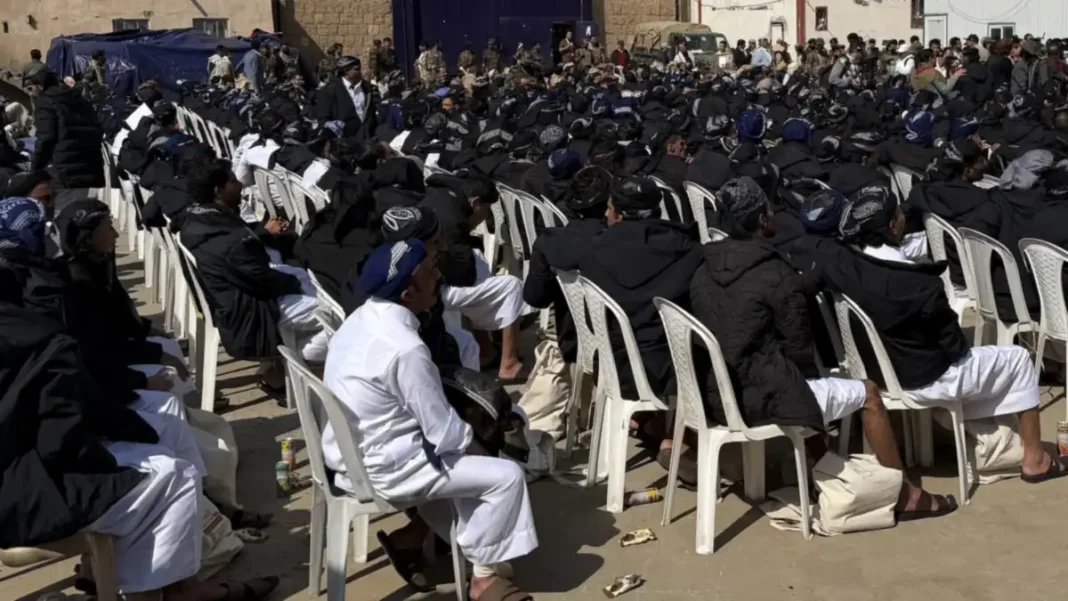
The Houthis free 600 detainees in Sanaa on Sunday, the International Committee of the Red Cross said, in the largest unilateral release of the country’s war.
The freed men were fighters from Saudi-backed government forces, captured on several fronts, and many had spent years in detention, according to Abdulqader al-Murtada, who heads the Houthis’ prisoners committee. He said the group included elderly and sick men.
Red Cross delegates interviewed each detainee in private, checked their health and helped arrange their return home, the ICRC said in a statement.
The Houthis’ National Committee for Prisoners’ Affairs organised the release. It was not part of the Stockholm Agreement, the United Nations-brokered framework for prisoner exchanges, and the ICRC said it played no part in deciding who would be freed or how many.
Al-Murtada called it “the largest unilateral prisoner release and pardon operation in the history of the conflict”. He said it brought the total freed under the Houthis’ amnesty initiatives to 2,612, all without an exchange. Those figures could not be independently verified, and the government has not commented.
Houthis free 600 detainees as fighting spreads in the south
The release came on a day of heavy fighting in the south: a Houthi missile strike killed eight people and wounded 12 at a checkpoint in Lahj province, near Aden, military and government sources told AFP.
Yemen’s military said it was redeploying troops from the Bab el-Mandeb area, west of Taiz, to defend Aden. The move leaves the Houthis in control of ground overlooking the strait, a major setback for the government campaign.
The withdrawal appears to end a six-week government counteroffensive to retake the Red Sea coast. The Houthis seized the coastline in a rapid advance in September, and have since taken the al-Maqatirah mountains, on the main road from Aden to Taiz. Taiz has been under Houthi siege for weeks, and government forces said on Sunday they would keep working to break it.
Why Bab el-Mandeb matters
Bab el-Mandeb is the narrow strait where the Red Sea meets the Gulf of Aden, a vital trade gateway between Asia and Europe. Control of its shores shapes shipping through the Suez Canal. The Houthis seized the Red Sea coast in a rapid advance in September and have expanded their control along the coastline since, tightening their grip on the strait. Government forces pulled back from the Bab el-Mandeb area on Sunday, leaving the Houthis in control of ground overlooking it.
The fighting has also spilled beyond Yemen. The Houthis have fired missiles and drones at Saudi Arabia, and the Saudi-led coalition has carried out airstrikes on Houthi positions. The coalition intercepted Houthi missiles near Riyadh earlier this month, and clashes in Al-Jawf killed a senior commander.
The wider war between the United States, Israel and Iran has added pressure: Russia and China urged an immediate end to the war against Iran at the United Nations, while a second drone attack hit Bahrain in three days.
How the truce collapsed
Fighting resumed in July, breaking a truce brokered by the United Nations in 2022. The truce unravelled in the summer after the Houthis allowed an Iranian plane to land in Sanaa, defying Saudi control of Yemeni airspace.
The United Nations says more than 1,600 people have been killed and over 300,000 displaced since fighting resumed. Taiz hosts about half of them, and fighting there is still intensifying while humanitarian conditions worsen.
The Houthis seized Sanaa in 2014, driving the internationally recognised government from the capital. Aden has served as its seat since then, and recent attacks there targeted the presidential palace and an air force base.
What happens next
The ICRC said it remained ready to act as a neutral intermediary in future releases if asked. It has played that role before, and the latest release shows the channel still exists even as fighting grows worse.
No reciprocal release has been announced by the government. The Houthis called the move a humanitarian initiative and accused their adversaries of failing to make matching moves, a claim the government has not answered.
For the 600 freed men, the immediate question is the journey home. Many were captured far from their families, and the Red Cross said it would keep helping with returns.
Frequently asked questions
How many detainees did the Houthis release?
The Houthis released 600 detainees in Sanaa on Sunday, November 15, 2026. The Red Cross confirmed the release.
Who organised the release?
The Houthis’ National Committee for Prisoners’ Affairs organised it, with support from the International Committee of the Red Cross.
Was the release part of a prisoner exchange?
No. The release was unilateral and did not fall under the Stockholm Agreement, the United Nations-brokered framework for prisoner exchanges.
What is happening at Bab el-Mandeb?
Government forces are withdrawing from the Bab el-Mandeb area to defend Aden, leaving the Houthis in control of ground overlooking the strait.
What is the Stockholm Agreement?
The United Nations-brokered framework for prisoner exchanges agreed in December 2018. The latest release was unilateral and fell outside it.