Lawyers Demand Repeal of 26th and 27th Amendments
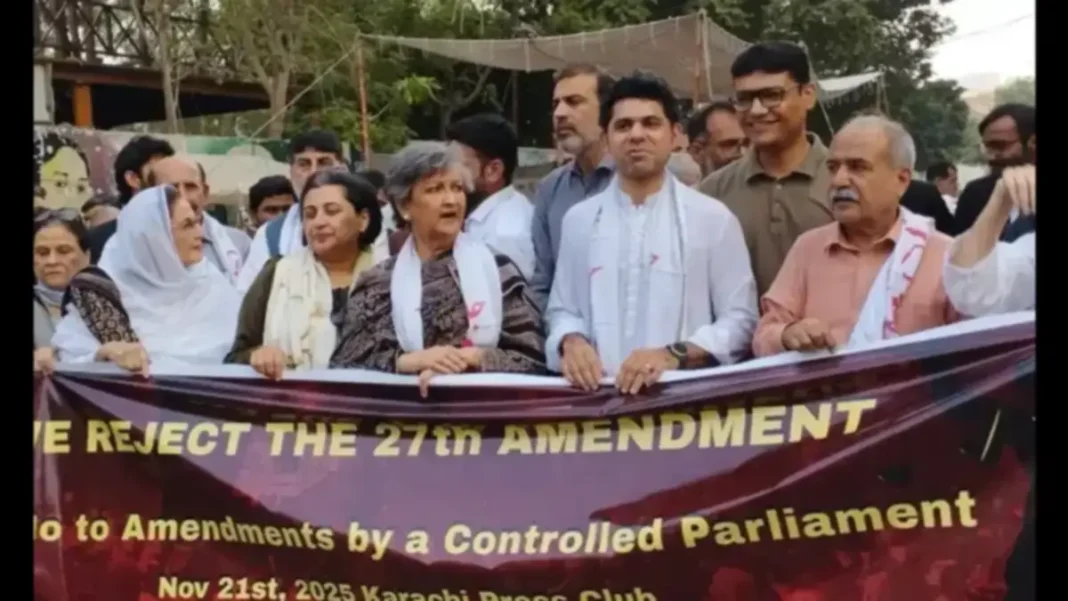
One hundred members of the legal fraternity and civil society have called for the 26th and 27th Amendments to be repealed, in an open letter issued on Tuesday, Dawn reported. The letter reacts to remarks by PPP Chairman Bilawal Bhutto-Zardari, whose party helped pass both amendments.
The 26th Amendment was enacted in October 2024 and the 27th in November 2025, both through both houses of Parliament amid outcry from the PTI-led opposition. Last week Bilawal, who backed both amendments when they passed, said the 27th was “passed neither through political consensus nor mutual agreement; it was passed with brute majority”. He added that the 26th Amendment did have mutual agreement.
Bilawal also questioned the state of the judiciary after the 27th Amendment, noting that resignations of senior judges followed. Later he clarified that he was “not disowning” the amendment, but noting that it lacked the “unanimous consensus” of the 18th Amendment and the 1973 Constitution.
The letter, signed by retired Supreme Court Justice Mansoor Ali Shah among others, said: “Pakistan’s constitutional order belongs to its people. It cannot be seized by a majority that its own members admit was never theirs to wield.” It demanded that the “constitutional order that existed prior to the 26th Amendment must be restored”, with any future judicial reform coming through an “open and consultative process”.
What the 26th and 27th Amendments changed
The 26th Amendment carved a constitutional bench out of the Supreme Court, its members chosen by a reconstituted Judicial Commission of Pakistan in which judges no longer held a majority. A year later, the 27th Amendment turned those benches into a separate Federal Constitutional Court (FCC), which is said to have effectively dethroned the Supreme Court as the highest judicial forum.
The 27th Amendment also changed the military’s chain of command and granted immunities to government officials. Two of the Supreme Court’s senior-most judges, including Justice Shah, resigned in protest the day it became law.
The criticism is not new. The International Commission of Jurists found judicial capture in Pakistan after the two amendments, the Human Rights Commission of Pakistan warned of democratic erosion, Bilawal’s own speech at the FCC raised questions from lawyers, and Khawaja Asif hit back at Bilawal over the remarks. The letter adds the legal fraternity’s voice to that criticism.
Reserved seats at the centre of the argument
The letter also called for reserved seats to be returned to their “lawful claimants”, in an apparent reference to the opposition. The PTI was deprived of its reserved seats in the 2024 elections after its electoral symbol was revoked. A Supreme Court bench declared the PTI eligible, but the order was not implemented and was later overturned by the constitutional bench, which handed the seats to the coalition parties.
“The government cannot continue exercising parliamentary authority derived from a process that the governing coalition’s own leadership has now publicly called into question,” the letter read. “These seats must be restored to their rightful claimants through the appropriate legal and constitutional mechanism.”
It noted that Bilawal had called the stripping of the seats “a joke”, said the treasury benches had put them “in their pockets”, and accused the government of amending the Constitution using seats that are “not yours”. The signatories pointed out that these words came “from the government’s key coalition partner whose votes were required to pass both the 26th and 27th Amendments”.
The lawyers argued that a two-thirds majority is the safeguard the Constitution demands. A majority “made up with seats that were unjustly denied to the opposition is not the majority the Constitution demands”, they said, and an amendment passed without one “is void from its very inception”.
“A court cannot rise higher than its source”
The letter said the questions applied directly to the FCC, which “owes its existence wholly to the 27th Amendment”. “Its jurisdiction, its composition and its authority all come from a constitutional change whose legitimacy is now openly repudiated by the very people who brought it into being. A court cannot rise higher than its source. An institution whose authors cannot defend how it was built has no foundation left to stand on,” it said.
It added that Pakistan has seen “far too many admissions of wrongdoing that have led to no consequences”, and said: “This cycle must end. The question is no longer simply whether a wrong was committed, but whether consequences and meaningful action will follow.”
The signatories called it a “moment to begin repairing the grave damage” to the judiciary and the constitutional order. The letter carries no legal force, but it puts the ruling coalition in a difficult spot: its own key partner has now questioned the majority behind both amendments.
Frequently asked questions
What does the letter demand?
It demands that both the 26th and 27th Amendments be repealed, that the constitutional order from before the 26th Amendment be restored, and that reserved seats be returned to their lawful claimants. Any future judicial reform should come through an open and consultative process.
Who signed the letter?
One hundred members of the legal fraternity and civil society, mostly lawyers and also including activists and academics. Retired Supreme Court Justice Mansoor Ali Shah is among the signatories.
What did Bilawal Bhutto-Zardari say?
He said the 27th Amendment was “passed neither through political consensus nor mutual agreement; it was passed with brute majority”. He later clarified that he was “not disowning” the amendment, but noting that it lacked the unanimous consensus of the 18th Amendment and the 1973 Constitution.
What did the 27th Amendment do?
It turned the constitutional benches created by the 26th Amendment into a separate Federal Constitutional Court, which is said to have effectively replaced the Supreme Court as the highest judicial forum. It also changed the military’s chain of command and granted immunities to government officials.
What happened to the PTI’s reserved seats?
The PTI lost its reserved seats in the 2024 elections after its electoral symbol was revoked. A Supreme Court bench declared the party eligible for the seats, but the order was not implemented and was later overturned by the constitutional bench, which handed the seats to the coalition parties.