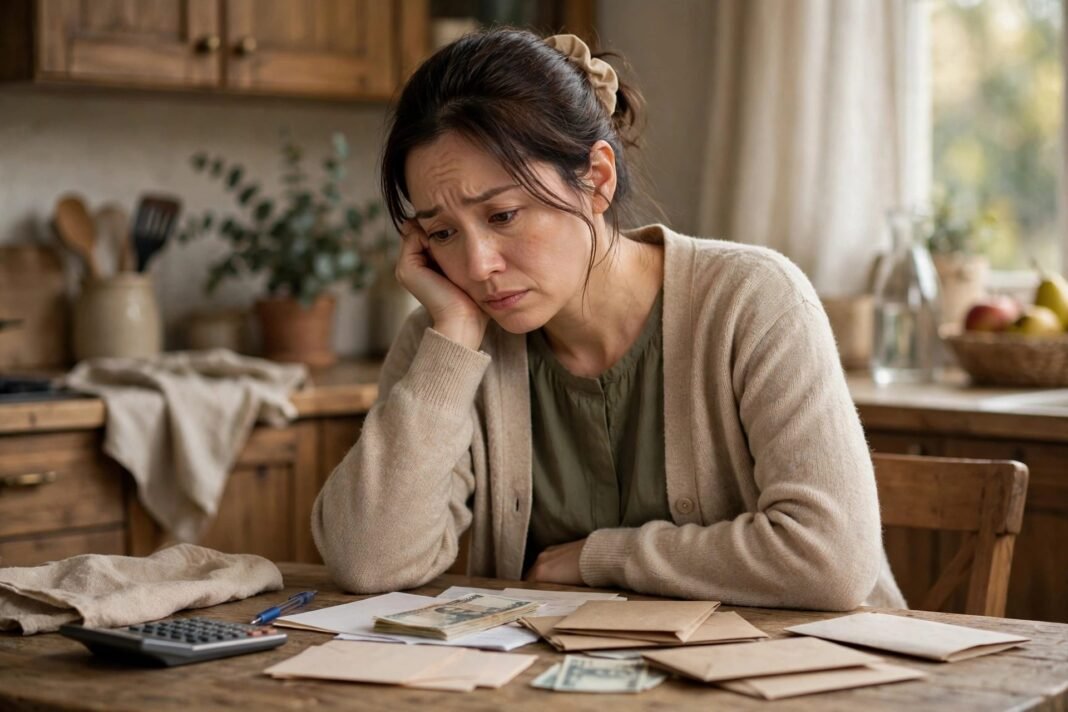
She needs money for her child’s medicine. The words are ready in her mind, yet they stop in her throat. So she says nothing, and the need stays with her. Many women fear asking for money, even from their own family. In fact, the fear can feel stronger with family than with anyone else. This article looks at why that fear runs so deep, what it costs, and how a woman can ask with a clear head.
Why Women Fear Asking for Money
For many women, asking for money feels like failing. She may earn little, or she may earn nothing at all. Either way, the ask feels heavy. So she puts it off, day after day.
Shame is often the first reason. She worries that asking will make her look weak. In her mind, a strong woman should manage on her own. As a result, she hides the need instead of naming it.
Pride plays a part too. She has given so much to her family, and she does not want to feel small in front of them. However, pride can turn into silence, and silence can turn into going without.
Fear of refusal is another reason. A “no” can sting far beyond the money. For example, she may hear it as proof that she matters less than others. So she avoids the ask to avoid the hurt.
Then there is the fear of judgment. She worries that her family will ask hard questions. They may want to know why she needs it, why she did not plan better, or why she cannot manage. In other words, the ask feels like a test she might fail.
Finally, some women fear that one ask will open a door they cannot close. If she asks once, they may think she will always ask. So she stays quiet to protect her place in the family. That is why women fear asking for money even when the need is small and the family is kind.
The Old Rules That Taught Her to Stay Quiet
Many women were raised with clear rules about money. A good woman, they were told, never asks. She adjusts, she saves, and she makes do. Meanwhile, money talk was treated as someone else’s job.
In some homes, money was never discussed at the table. Children learned early that asking for money was rude. As a result, a grown woman can still feel like a child when she needs to ask.
Gratitude was another lesson. She was taught to be thankful for what she has, not to want more. So asking can feel ungrateful, even when the need is real and urgent.
Some women also never had money of their own to manage. Without her own account, she had no practice in handling money. In fact, millions of women around the world still have no bank account at all. Women without bank accounts often depend on others for every single expense.
These old rules do not come from one person. They come from years of quiet lessons at home, at school, and in the wider world. However, a rule learned in childhood can still be questioned in adult life.
What Silence Costs Her
Women fear asking for money, so they stay silent. Silence has a price, and she pays it in small ways every day. She may skip her own medicine to save money. She may delay a visit to the doctor. Or she may go without new shoes while everyone else gets what they need.
The stress builds in silence. She lies awake and counts what is left. She plans, she cuts, and she worries. Over time, that worry can wear down her sleep, her health, and her mood.
Some women borrow in secret instead of asking at home. A quiet loan from a friend can feel safer than a hard talk with family. But secret debt brings its own fear, and the circle keeps turning.
Her children may notice too. They see her skip meals or turn down small joys. In other words, her silence teaches them the same fear she learned. The pattern can pass from one generation to the next.
Silence also costs her voice. When she never asks, her needs stay invisible. Then the family may assume she needs nothing at all. As a result, the gap between what she needs and what she gets keeps growing.
Women Fear Asking for Money: What the Numbers Show
This fear is not rare, and the numbers show why. Around the world, 77% of women have a financial account, compared with 81% of men. That gap may look small, but it leaves about 700 million women with no account at all.
In low- and middle-income economies, the picture is sharper. There, 73% of women have an account. So more than one in four women in these places has no formal place to keep or receive money.
One common barrier is simple: a family member already has an account. In other words, many women are expected to use someone else’s account instead of having one of their own. That habit keeps money out of their hands, even when the account is in the house.
These figures matter because they show she is not alone. The fear of asking is not a personal flaw. Instead, it grows out of a real gap in money, accounts, and control. And that gap can be closed, one step at a time.
How to Ask Without the Fear
Women fear asking for money most at the very first ask. A clear plan turns a hard talk into a simple one. Here are steps that can help.
First, name the need in plain words. Say the amount, say what it is for, and say when you need it. For example: “I need 2,000 for my medicine this week.” A clear ask is easier to hear than a vague one.
Then choose one trusted person first. She does not need to tell the whole family at once. One calm talk with one kind person can be enough to start.
Pick a calm moment too. A rushed morning is the wrong time. Instead, wait for a quiet moment when both sides can listen.
It can also help to write it down first. A short note can hold the words she finds hard to say. She can read it aloud, or she can hand it over.
If she asks for a loan, she can offer a clear plan to return it. A small, honest plan builds trust and shows she takes the money seriously. Financial dependence in marriage often starts when a woman has no plan of her own, so a plan of her own is a strong first step.
Start small if the fear is big. A small ask can prove that asking is safe. Then the next ask gets easier. Why women find it hard to ask for help shows the same pattern: the first ask is the hardest, and each one after it gets lighter.
Finally, build a small fund of her own. Even a tiny amount saved each week can grow. Her own account and her own savings can slowly change the balance. Money independence starts with one step.
Where to Get Help
Most of the time, asking is simply hard. But sometimes the problem is bigger. If money is used to control her — if she is not allowed to work, keep money, or see the family accounts — that is financial abuse. Financial abuse means controlling a person’s ability to get, use, or keep money.
If that is happening, she does not have to face it alone. The National Domestic Violence Hotline is free and confidential, 24 hours a day. She can call 1-800-799-7233, text START to 88788, or chat at thehotline.org.
A trusted friend, a women’s group, or a local support service can also help. The key step is the same: tell one safe person what is happening. Help starts with one honest talk.
Women fear asking for money less once they have a plan. Asking for money is not a weakness. It is a normal part of life, and every woman deserves to ask without fear. Have you ever held back from asking for money you needed? What would make it easier for you to ask?