Sometimes the most uncomfortable questions do not come from an enemy, an activist abroad, or a rival government.
They come from inside.
That is exactly what has made NAZA one of the most controversial documentaries of 2026. The film does not rely primarily on Palestinian witnesses describing Israeli military operations from the outside. Instead, it places Israeli military and intelligence personnel at the centre of the story.
Even more strikingly, two Israeli filmmakers, Yuval Abraham and Rachel Szor, directed the documentary. They are also two of the four directors behind the Oscar-winning No Other Land.
NAZA premiered at the Venice International Film Festival on September 10, 2026. The 80-minute documentary later received the festival’s Special Jury Prize.
But its biggest story may not be the award.
The bigger controversy lies in what people inside Israel’s own military establishment allegedly told the filmmakers.
What does “NAZA” actually mean?
The title carries an important meaning.
According to reporting about the film, “NAZA” comes from Israeli military terminology referring to anticipated collateral damage, particularly the expected number of civilians who could die during an attack on a military target.
That concept sits at the centre of the documentary.
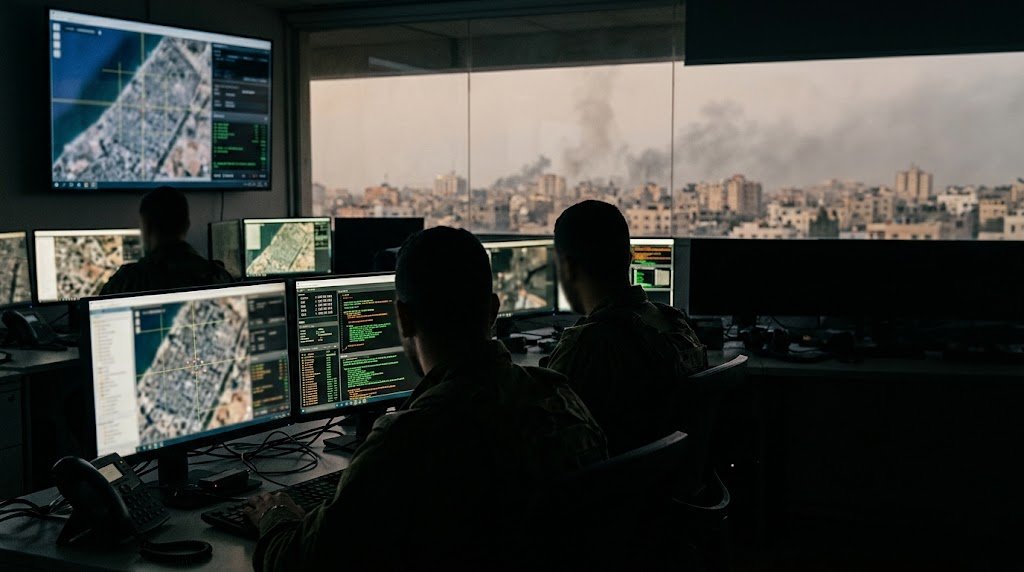
The film examines how intelligence officers identify targets, how technology and data support targeting operations, and how civilian casualties may enter calculations before a strike.
The filmmakers say the documentary grew from more than three years of investigative work involving The Guardian, Israeli-Palestinian publication +972 Magazine and Hebrew-language outlet Local Call.
The documentary includes 24 Israeli insiders
Perhaps the most important aspect of NAZA involves its sources.
The film contains testimony from 24 Israeli military personnel, officers and intelligence soldiers. They speak anonymously, while the filmmakers digitally alter their faces and voices to protect their identities.
These witnesses describe surveillance systems, intelligence work and targeting procedures connected to military operations in Gaza.
According to The Guardian’s reporting about the documentary, some interviewees describe AI-assisted systems capable of generating large numbers of potential targets. They also describe situations in which military personnel knew civilians or families could be present near targets.
However, these accounts remain allegations presented by the documentary’s anonymous sources. The Israel Defense Forces has strongly disputed major parts of the film.
That distinction matters.
The most explosive allegation: the number 500
One short promotional clip created perhaps the biggest controversy surrounding NAZA.
In the clip, an anonymous person described as an Israeli intelligence soldier receives a question about the highest anticipated civilian casualty figure reportedly approved for an operation.
The interviewee alleges that there was once an approval involving an anticipated figure of 500 civilians. He also says he does not know how many people ultimately died.
This does not mean the documentary has established that 500 civilians actually died in one such attack.
It refers to what the anonymous source claims was an anticipated casualty figure attached to an approval.
The IDF has categorically denied this allegation.
It says it never planned, approved or carried out a Gaza strike in which 500 civilians—or anything close to that figure—were expected to die. The military also argues that the filmmakers cannot independently establish the source’s account because the witness remains anonymous.
So this remains one of the film’s most serious contested claims, rather than an independently proven fact.
Does NAZA claim AI decided whom Israel should bomb?
The documentary also focuses heavily on technology and AI-assisted military systems.
This part requires careful wording.
NAZA’s witnesses and related investigations describe technology used to process intelligence and assist with identifying possible targets.
But the IDF rejects the suggestion that artificial intelligence independently chooses or approves targets.
According to the Israeli military, human personnel make decisions about target selection and strike approval, not AI systems.
Therefore, the controversy does not simply come down to “AI killed people.”
The central dispute involves how heavily automated or AI-assisted systems influence the intelligence process before human officers approve an attack.
Then came another explosive development: Israel ordered a leak investigation
This is where the story becomes even more interesting.
After the documentary began attracting international attention, IDF Chief of Staff Lt. Gen. Eyal Zamir ordered officials to examine whether classified military information had reached the filmmakers.
According to the Times of Israel, Zamir instructed senior officials to investigate information-security issues and identify possible individuals involved in the leaking of classified material allegedly used in producing the documentary.
This point needs careful interpretation.
An investigation into a possible leak does not itself prove that every claim in NAZA came from genuine leaked classified documents.
Nor does it automatically prove the documentary’s allegations.
What it does show is that the Israeli military considered the possibility that protected military information could have reached people involved with the production serious enough to investigate.
Zamir also asked Israel’s Military Advocate General to examine possible legal measures connected to the film and those involved with it.
Interestingly, the IDF had not yet watched the full film
There is another important detail.
When some of the strongest Israeli military reactions emerged on September 14, the IDF had apparently not yet viewed the complete documentary.
IDF spokesman Brig. Gen. Effie Defrin said the army wanted the filmmakers to provide access to the entire film so officials could respond to every allegation in detail.
Zamir similarly said he had not watched it and did not know the identities of those interviewed.
At the same time, he strongly criticized what he had seen and heard about the film, describing its portrayal of the IDF as false and distorted.
That makes the dispute unusually complicated.
The filmmakers say the documentary contains verified testimony collected during years of investigation.
The IDF says anonymous sources prevent independent scrutiny of their roles and that significant allegations misrepresent military procedures.
Netanyahu also entered the controversy
Israeli Prime Minister Benjamin Netanyahu publicly condemned NAZA after its Venice premiere.
Reuters reported that Netanyahu characterized the documentary as “shocking incitement” and linked it to what he described as rising antisemitic hostility toward Israel.
Military chief Zamir separately used extremely strong language against the film and called for examination of possible legal responses.
Culture Minister Miki Zohar went further, accusing the filmmakers of treason and raising the possibility of stripping them of Israeli citizenship.
Later, Netanyahu said he would pursue legislation allowing citizenship to be revoked from Israelis who, in his description, smear Israeli soldiers.
The filmmakers, meanwhile, have defended their work and say they made the documentary precisely because they are Israelis examining the actions of their own state.
The Guardian, which produced the film with JW Films, says the testimonies are genuine confidential journalistic sources and says it will defend both the documentary and its filmmakers.
Why are the witnesses anonymous?
This is likely to become one of the biggest debates around NAZA.
Critics argue that viewers cannot independently check the identities, ranks or responsibilities of anonymous interviewees.
The IDF has made exactly that argument. It says viewers cannot determine whether particular interviewees actually had access to the information they describe.
The filmmakers and The Guardian give a different explanation.
They say anonymity protects confidential military and intelligence sources who could face serious consequences for speaking publicly. Faces and voices in the documentary therefore appear altered.
This leaves viewers with an important journalistic question: how much confidence should they place in confidential sources whose identities cannot publicly appear?
That question does not have to be answered emotionally.
It requires examining whether independent evidence, documents and previous investigations corroborate individual allegations.
Why NAZA has attracted so much attention
The filmmakers are not foreign critics examining Israel from thousands of kilometres away.
Both directors are Israeli.
The witnesses are described as Israeli military and intelligence insiders.
And many of the systems under discussion reportedly come from Israeli institutions themselves.
That combination explains much of the attention around NAZA.
The controversy therefore concerns not only Gaza.
It also concerns whistleblowing, military secrecy, artificial intelligence, journalism, civilian protection and how democratic societies respond when people from inside state institutions speak publicly about wartime decisions.
Where can you watch NAZA?
As of September 24, 2026, there is an important warning for anyone searching Google, YouTube or unofficial streaming sites:
NAZA does not yet have an official public streaming release.
The Guardian announced today that the documentary will begin its theatrical rollout from September 28, with distribution secured across 56 territories. The announced regions include several European countries, the United States, Canada, Australia, Japan, Indonesia, Turkey and the Middle East.
Most importantly for online viewers, The Guardian says that after the theatrical run it plans to make NAZA available free to audiences globally on TheGuardian.com in late November 2026.
So if you currently see websites claiming to offer the “full official NAZA documentary free,” be careful.
There is no official global stream yet.
The safest option is to follow The Guardian’s official documentary coverage and wait for its announced free global release.
Did the documentary actually contain “leaked files”?
This needs one final clarification because social media posts can easily exaggerate the story.
Public reporting confirms that the IDF ordered an investigation into possible classified information leaks associated with material used in the film.
That is different from saying:
“Israel has confirmed all the documentary’s leaked documents are genuine.”
No such conclusion follows from the investigation.
At this stage, the public record contains three separate things:
- Testimony from 24 anonymous Israeli military and intelligence personnel.
- Documentary allegations based on investigative reporting conducted over several years.
- Israeli military denials alongside an investigation into whether classified information reached the production.
Those points should remain separate until additional evidence becomes public.
Why NAZA may remain important long after the controversy
NAZA has already moved beyond being simply another war documentary.
It has triggered arguments inside Israel about military accountability, confidential sources, national security, press freedom and the boundaries of criticism during war.
Its strongest claims remain disputed.
But the existence of testimony from two dozen Israeli military and intelligence insiders—and the scale of the Israeli government’s response—means questions surrounding the documentary are unlikely to disappear quickly.
For viewers, the most useful approach may therefore be neither immediate acceptance nor immediate dismissal.
Watch the documentary when the full version becomes publicly available. Compare its claims with independent investigations. Read the IDF’s responses. Examine which allegations gain additional documentary evidence and which remain dependent on anonymous testimony.
NAZA’s significance ultimately lies in that confrontation between two competing records: what Israeli insiders say happened inside the targeting system, and what the Israeli military says actually happened.
And when the full documentary reaches a global audience, that dispute will become much easier for viewers to examine for themselves.