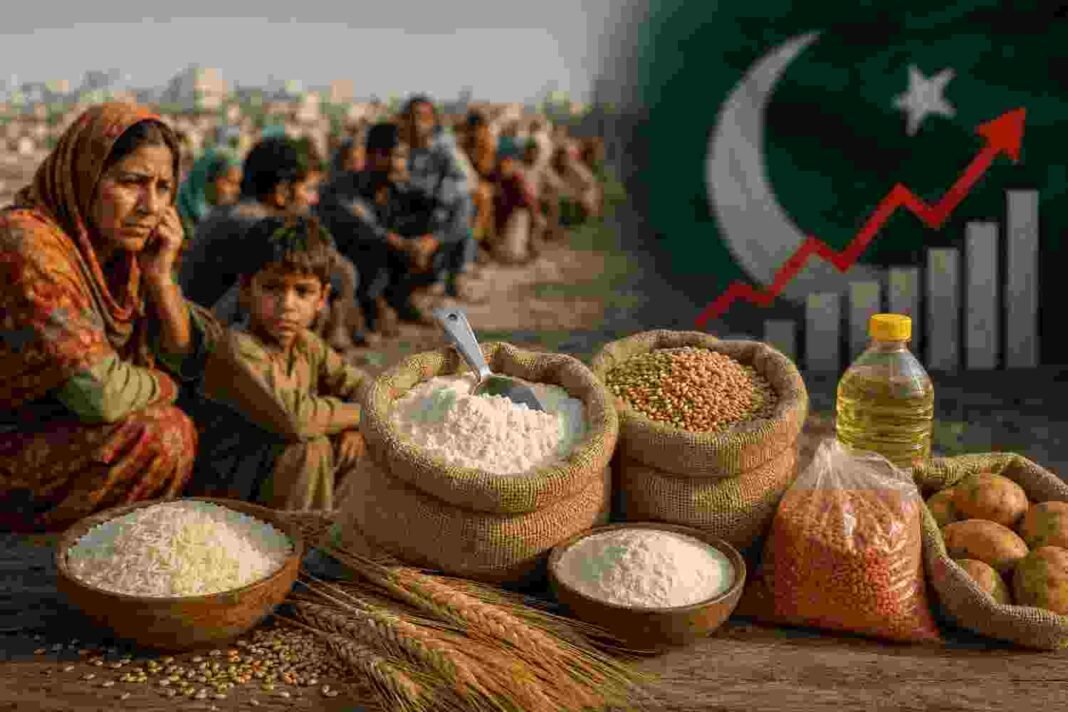
ISLAMABAD: Pakistan’s Food Crisis has become a serious economic and social challenge as millions struggle to afford nutritious meals. Experts warn that weak incomes, inflation, unemployment, and problems in the food supply system continue to increase pressure on households.
Around 63 percent of Pakistan’s population, or nearly 160 million people, cannot afford a healthy diet. Rising living costs have made the situation even harder for low- and middle-income families nationwide.
Economic experts say the Pakistan Food Crisis goes far beyond the availability of wheat, rice, sugar, and other essential commodities. Families also need enough income to buy nutritious food at affordable prices.
Economist Abid Qaiyum Suleri, Executive Director of SDPI, and food security expert Shams-ul-Islam Khan recently discussed the issue on ARY News’ program Khabar. They examined food prices, wheat supplies, storage practices, imports, and wider economic pressures.
The experts stressed that Pakistan cannot solve the problem simply by producing larger crops. Instead, authorities need to improve food storage, distribution, market monitoring, and supply-chain management.
Meanwhile, questions have emerged about wheat availability despite the completion of harvesting in several areas. Punjab experienced delays in its wheat crop, while prices continued to create concerns among consumers and market participants.
Changes in border trade with Afghanistan have also affected the informal movement of wheat. Therefore, experts believe policymakers need to understand how domestic supply, trade restrictions, storage, and market demand influence prices.
Storage practices have created another major concern. Experts claim that influential businesses and large market players use some modern storage facilities, which can affect the amount of grain available in local markets.
Similar concerns surround rice stocks from the previous crop. Experts argue that excessive storage can tighten market supplies and put additional pressure on consumers when traders keep large quantities out of normal market circulation.
However, the Pakistan Food Crisis also reflects deeper weaknesses in the national economy. Pakistan has recorded relatively low economic growth in recent years while its population has continued to expand rapidly.
When economic growth remains close to population growth, ordinary citizens see limited improvements in their living standards. Businesses also struggle to create enough jobs for the growing number of young people entering the workforce.
At the same time, debt and interest payments consume a significant share of government resources. Consequently, policymakers have less funding for agriculture, industry, infrastructure, social protection, and other development priorities.
Experts also link food insecurity to broader social risks. Children who cannot access balanced diets may face nutritional deficiencies that can affect their physical development, learning ability, and future productivity.
Young adults face another challenge when unemployment combines with high food prices and limited economic opportunities. Experts warn that prolonged deprivation can increase frustration and contribute to crime and other social pressures.
For this reason, analysts increasingly view the Pakistan Food Crisis as more than an agricultural challenge. They believe prolonged food insecurity could eventually create broader economic, social, and security concerns for the country.
A strong wheat harvest next year may provide temporary relief, but experts say production alone cannot guarantee affordable food. Pakistan must also address weaknesses in market regulation, storage systems, distribution networks, and government planning.
The government’s approach toward wheat deregulation has also attracted attention. Experts have raised questions about reducing state involvement in procurement and moving away from traditional minimum support price mechanisms.
Moreover, another round of wheat imports could create new complications if authorities fail to assess domestic stocks and market demand accurately. Experts therefore want policymakers to improve data collection before making major import decisions.
One proposed solution involves a system of smart stockpiling. Under this approach, the government could work with private companies that already operate suitable warehouses, rather than investing heavily in new storage infrastructure.
Authorities could maintain strategic reserves through these facilities while keeping stronger oversight of available stocks. During shortages or sharp price increases, the government could release food commodities into the market to improve supply.
Such a system could also help policymakers respond faster during emergencies. However, transparent monitoring would remain essential to prevent manipulation, artificial shortages, and excessive hoarding.
Experts particularly want stronger oversight of wheat, sugar, rice, and other essential commodities. Without effective monitoring, consumers may continue paying higher prices even when Pakistan produces sufficient quantities of food.
Meanwhile, poverty and declining purchasing power remain central parts of the problem. A household may live near markets full of food but still face food insecurity if its income cannot cover nutritious meals.
Therefore, addressing the Pakistan Food Crisis requires policies that increase both food availability and household purchasing power. Job creation, higher productivity, stronger economic growth, and targeted support for vulnerable families can all play important roles.
Pakistan also needs better coordination among farmers, provincial authorities, federal institutions, traders, warehouse operators, and food security experts. Reliable information on production and stocks could help authorities make faster, more effective decisions.
In addition, policymakers need to reduce unnecessary supply-chain costs that push prices higher between farms and consumers. Better transportation, modern storage, market transparency, and stronger competition could help make essential food more affordable.
Experts believe Pakistan still has the agricultural capacity to strengthen its food security. However, the country needs consistent policies that protect consumers while giving farmers enough incentives to continue producing essential crops.
Ultimately, solving the Pakistan Food Crisis will require more than another successful harvest. Pakistan needs sustainable economic growth, employment opportunities, transparent food reserves, efficient markets, and a long-term national food security strategy.
Without meaningful reforms, millions of households may continue struggling to afford nutritious meals despite the country’s agricultural potential. With better planning and stronger economic opportunities, however, Pakistan can improve food access and reduce the risks associated with long-term food insecurity.