Pakistan Self-Determination Resolution Wins UN Consensus
The United Nations General Assembly’s Third Committee on Thursday adopted by consensus a Pakistan-sponsored self-determination resolution reaffirming the right of peoples living under colonialism, foreign domination and alien occupation to decide their own future. The initiative drew 62 co-sponsors, and no member state called for a vote.
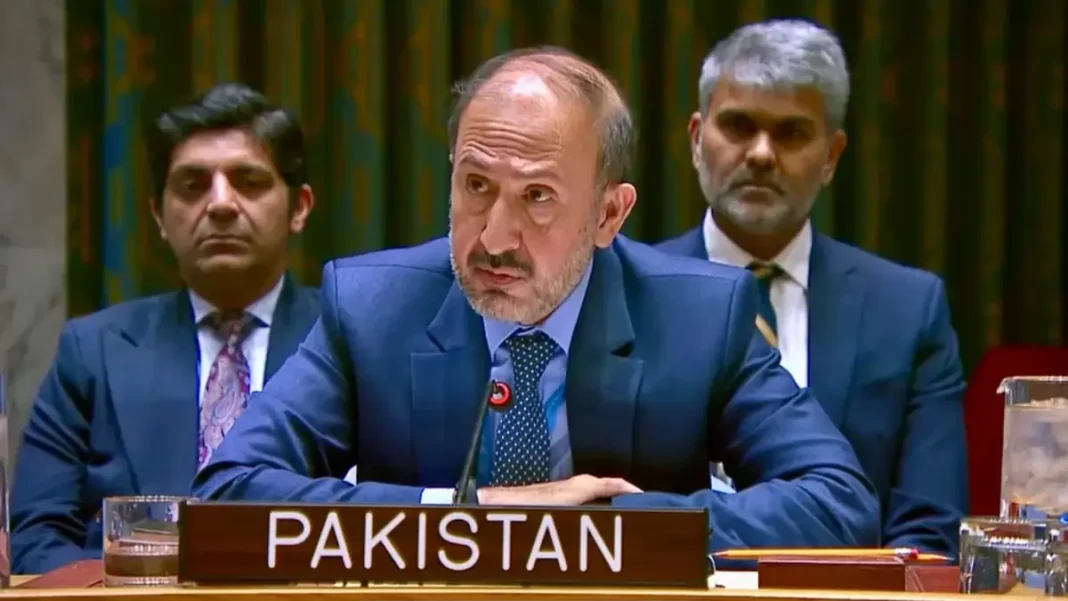
Dawn reported that the resolution, titled “Universal Realisation of the Right of Peoples to Self-Determination”, was introduced by Pakistan’s Permanent Representative to the United Nations, Ambassador Syed Haider Shah. Pakistan has sponsored the text every year since 1981.
What the self-determination resolution says
Ambassador Shah said the promise of self-determination remained unfulfilled for peoples still living under foreign occupation, including the people of Palestine and Indian-occupied Jammu and Kashmir.
He said occupied peoples still faced military oppression, excessive use of force, extrajudicial killings, arbitrary detentions, enforced disappearances, curbs on fundamental freedoms and attempts at demographic engineering. Such practices, he said, were grave violations of international law.
He said self-determination had changed history, freeing millions from foreign rule, and noted that most UN member states had won independence through it. The resolution reaffirms the universality of the right, expresses solidarity with peoples deprived of their freedoms, and underlines the shared duty to uphold it. Ambassador Shah thanked the 62 co-sponsors and urged others to join.
A resolution Pakistan has tabled since 1981
Pakistan first tabled this resolution in 1981, and it has returned every year since, keeping the world’s attention on peoples still struggling for the right to decide their future, including those in Kashmir and Palestine.
The text names no country or territory. Framing the issue as a universal principle, rather than a dispute between two states, has helped Pakistan gather co-sponsors from every region.
The Third Committee deals with social, humanitarian and cultural issues. The text is expected to come up for endorsement by the full 193-member General Assembly next month, where it would oppose foreign military intervention and occupation that suppress self-determination and call on the states responsible to stop.
Consensus adoption removes the need for a vote and signals that no delegation was willing to oppose the text openly.
India responds at the committee
India’s First Secretary at its UN Mission, Bhavika Mangalanandan, told the committee that self-determination could not be used to subvert territorial integrity, and that attempts to reinterpret Charter principles for narrow political ends were unacceptable.
Her remarks set out New Delhi’s position that the principle applies to decolonisation, not secession. The resolution was adopted by consensus after the debate, without naming any country or territory.
The exchange fits a familiar pattern at the United Nations, where Pakistan and India have pressed opposing positions on Kashmir for decades. Feature Pakistan reported that Pakistan called India’s move on the Indus Waters Treaty outlaw behaviour at the UN, and that the UN rights chief called for Imran Khan’s release. Pakistan also joined 14 states in welcoming sanctions on Israeli settlements, while seven people were killed in Gaza, including a father and his 13-year-old son. Shehbaz Sharif and Nawaz Sharif met the AJK leadership to review development work.
What the resolution rests on
The ambassador grounded the right in the UN Charter and international law, citing Article 1(2) of the Charter, Common Article 1 of the International Covenants on Civil and Political Rights and on Economic, Social and Cultural Rights, the Declaration on Principles of International Law and General Assembly Resolution 1514.
Resolution 1514, adopted in 1960, declared that all peoples have the right to self-determination and that lack of readiness should never delay independence. The Charter lists self-determination among the purposes of the United Nations, and both Covenants open with the same words.
What happens next
The resolution now moves to the full General Assembly, which is expected to endorse it next month. For Pakistan, the result keeps a 45-year diplomatic effort alive and gives its delegation a fresh mandate to raise Kashmir and Palestine in the Assembly’s main session.
Frequently asked questions
What did the UN Third Committee adopt?
A Pakistan-sponsored resolution titled “Universal Realisation of the Right of Peoples to Self-Determination”, adopted by consensus.
How many countries co-sponsored the resolution?
It drew 62 co-sponsors, and Ambassador Syed Haider Shah thanked them and urged others to join.
Who introduced the resolution?
Pakistan’s Permanent Representative, Ambassador Syed Haider Shah. Pakistan has sponsored the text since 1981.
What legal texts does the resolution rest on?
Article 1(2) of the UN Charter, Common Article 1 of both International Covenants, the Declaration on Principles of International Law and General Assembly Resolution 1514.
What happens next?
The full 193-member General Assembly is expected to endorse it next month.