What can you really do with Rs1,000?
For many young Pakistanis today, Rs1,000 may barely cover a meal, a short trip, or a few everyday expenses. Starting a business with that amount can sound almost impossible.
However, one Pakistani entrepreneur decided to see that small amount differently.
His journey started with just Rs1,000 and a simple idea: selling dates. Years later, the same journey took him to Good Morning Pakistan, where recalling his struggle became so emotional that he could not hold back his tears.
This is not simply another Pakistani entrepreneur success story about money, products, or building a brand. It is a story about starting small when your circumstances give you very little room to dream.
It is also a story that carries an important message for Pakistan’s Gen Z.
An Educated Man Searching for More
Long before building his own brand, Obaid followed a path familiar to thousands of Pakistani students.
He studied, earned an M.Phil degree, and entered the teaching profession. According to his account published by Creed Dnoir, he spent around six years teaching.
Education gave him knowledge and professional experience. However, his income did not give him the financial progress he wanted from life.
This is where his story becomes particularly relevant to young Pakistanis.
Many students grow up believing that a university degree will automatically lead to financial security. They study for years, graduate with expectations, and then enter a job market where opportunities may not match those expectations.
Obaid experienced his own version of that struggle.
Instead of immediately leaving everything behind and making a huge investment, however, he started from what he had.
And what he had was remarkably little.
The Rs1,000 That Changed the Direction of His Life
At one stage of his journey, Obaid had only Rs1,000 available to begin experimenting with business.
For someone waiting for the “perfect” amount of capital, Rs1,000 would probably look like a reason to delay.
For him, it became a starting point.
During Ramadan, he used the money to buy dates, chocolates, and packaging material. He prepared small gift packs and started selling them in local markets.
There was no glamorous office.
There was no major investor waiting behind him.
There was no guarantee that the idea would work.
There was simply a small amount of money, a product, and a willingness to try.
That simple beginning forms one of the strongest lessons in this Pakistani entrepreneur success story.
Sometimes the first business does not need to look impressive. It only needs to teach you how business actually works.
From Dates to Bottles
Obaid did not stop after selling dates.
He continued exploring products and opportunities. He moved into selling bottles and kept trying to understand what customers wanted.
Every small transaction gave him something beyond profit.
It gave him experience.
Selling teaches lessons that classrooms often cannot. A person learns how customers react to prices, how presentation influences decisions, how rejection feels, and how difficult earning even a small profit can become.
At the same time, starting small can expose a young entrepreneur to criticism.
People may question the idea.
Friends may not understand the ambition.
Others may judge an educated person for selling ordinary products after spending years earning degrees.
Obaid has openly referred to hearing people’s comments and facing criticism during his journey.
Yet he continued.
That decision matters more than it may initially appear.
When Education and Entrepreneurship Collide
Pakistan’s Gen Z faces an interesting dilemma.
Education remains extremely important. However, a degree alone does not always guarantee the career or income young people imagine while studying.
This does not make education useless.
Instead, it means young people increasingly need to combine education with practical skills, adaptability, communication, digital knowledge, and sometimes entrepreneurship.
Obaid’s journey illustrates that distinction.
His M.Phil did not prevent him from selling dates or bottles. Nor did selling small products erase the value of his education.
He simply stopped treating one career path as the only possible definition of success.
That mindset can offer an important lesson to young graduates.
Your first job does not have to define your entire life.
Neither does your first salary.
And neither does your first failure.
Small Sales Started Creating Bigger Possibilities
The early experiments gradually became more serious.
After dates came other products. After small sales came more experience. And with experience came the confidence to take larger risks.
According to Creed Dnoir’s account of the journey, Obaid eventually accumulated around Rs400,000.
Think about the difference.
The journey had started with Rs1,000.
Now he had hundreds of thousands of rupees available for a much bigger step.
From the outside, this could easily become the point where a traditional success story jumps directly to victory.
But that is not what happened.
The next chapter brought failure.
He Invested Around Rs400,000 — And the Business Failed
Obaid invested the money he had accumulated into his first store.
It was supposed to represent progress.
Instead, the venture failed.
Much of the money he had worked to build disappeared with that failure.
This may actually be one of the most valuable parts of his story.
Social media often shows entrepreneurship through carefully selected moments. People see new offices, product launches, expensive cars, revenue screenshots, and celebratory posts.
They rarely see what happened before those photographs.
They do not see failed stores.
They do not see lost savings.
They do not see months when nothing appears to work.
And they certainly do not always see the fear of starting again.
Obaid experienced that side of entrepreneurship too.
Failure Did Not Become the Final Chapter
Losing money after building it slowly can break confidence.
It can also convince a person to return to the safest available option.
But Obaid continued experimenting and rebuilding.
This is where the Pakistani entrepreneur success story becomes more useful for Gen Z than a simple “started with Rs1,000 and became successful” headline.
Because success was not a straight line.
He started.
He learned.
He grew.
He failed.
Then he started moving again.
That pattern resembles real entrepreneurship much more closely than the overnight-success stories young people often encounter online.
Eventually, There Was a Brand
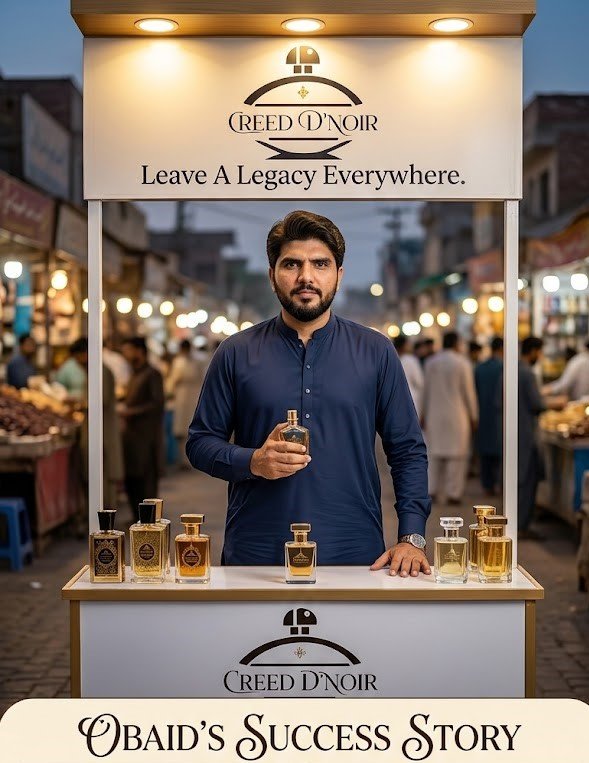
Over time, those experiences contributed to the journey that eventually led to Creed Dnoir.
The brand today operates in the fragrance space and offers perfumes for men and women.
But focusing only on the finished brand would miss the point.
The interesting part is the distance between the first Rs1,000 and the brand that exists today.
Dates did not look like a perfume business.
Selling bottles did not necessarily look like brand building.
A failed store certainly did not look like success.
Yet every stage added experience to the next one.
That is why beginnings can be misleading.
A person’s first small hustle may look completely unrelated to where that person eventually ends up.
Then Came Good Morning Pakistan
Years after those small beginnings, the story reached a much larger audience.
On August 13, 2026, Obaid appeared on Good Morning Pakistan, hosted by Nida Yasir.
For someone whose journey began with Rs1,000 and dates, appearing on a major Pakistani morning show represented more than publicity.
It created a moment to look backwards.
During his segment, Obaid spoke about his journey and the struggles behind it. According to his own account after the program, he had not gone there only to tell his personal success story.
He wanted to represent degree holders and young Pakistanis who continue searching for opportunities despite completing their education.
That message changes the meaning of the appearance.
It was not simply a founder promoting a product.
It was an entrepreneur connecting his personal struggle with a much larger challenge facing Pakistani youth.
The Moment He Became Emotional
Then came perhaps the most human moment of the appearance.
While discussing the difficult stages of his life, Obaid became emotional.
Years of struggle can sound simple when reduced to a few sentences.
“I started small.”
“My business failed.”
“I tried again.”
“I built a brand.”
But living through those sentences can mean years of uncertainty, embarrassment, financial pressure, criticism, rejection, and doubt.
Remembering those experiences on television brought the emotions back.
Later, Obaid explained the meaning of those tears in a powerful way.
“Those tears were not for sympathy. They were evidence of a long struggle.”
That thought captures something social media success stories frequently miss.
Achievement does not erase the memory of difficult years.
Sometimes reaching a milestone makes those memories even stronger.
Why This Story Matters to Pakistani Gen Z
Pakistan has one of the world’s largest young populations.
Every year, more young people enter universities, graduate, search for employment, learn online skills, experiment with freelancing, and consider starting businesses.
At the same time, social media constantly exposes them to extraordinary examples of wealth and success.
That comparison can become dangerous.
A 22-year-old sees another young entrepreneur driving an expensive car and wonders why life has not worked out yet.
A graduate sees someone earning dollars online and starts believing years of education were wasted.
A new freelancer experiences three months without clients and assumes failure has already arrived.
But real progress rarely moves that quickly.
Obaid’s story provides a different timeline.
Start with what you have.
Learn from the market.
Expect people to criticize you.
Accept that an idea can fail.
Then decide what you will do after that failure.
Rs1,000 Is Not the Real Lesson
It would be easy to reduce the entire story to one attractive number.
Rs1,000.
It makes a great headline because the amount sounds surprisingly small.
However, the money itself is not the deepest lesson.
Not everyone can start a successful business with Rs1,000. Different businesses require different resources, skills, networks, and levels of capital.
Young readers should not interpret the story as a formula promising that a tiny investment will automatically produce a major brand.
The real lesson lies elsewhere.
Obaid started testing possibilities instead of waiting for ideal circumstances.
That distinction matters.
Starting small does not guarantee success.
But refusing to start guarantees that an idea remains only an idea.
Your First Business May Fail
Another valuable lesson comes from the failed store.
Young entrepreneurs sometimes approach their first business with enormous emotional pressure.
They believe it has to work.
If it fails, they assume entrepreneurship is not for them.
But a failed business and a failed person are two very different things.
Businesses fail for countless reasons.
The location may be wrong.
Pricing may not work.
Demand may be weaker than expected.
Costs may become too high.
Marketing may fail.
Timing may simply be bad.
The important question becomes what the entrepreneur learns from that experience.
In Obaid’s case, the loss did not end the journey.
It became part of it.
Do Not Wait Until People Believe in You
Criticism also appears repeatedly in entrepreneurial journeys.
When someone follows a conventional career path, people understand it.
Study.
Graduate.
Get a job.
Earn a salary.
Repeat.
But when an educated person begins selling small products, changing careers, freelancing, or building an uncertain business, people may react differently.
That is especially true when the results are still invisible.
Success often makes unusual decisions look intelligent in retrospect.
Before success, the same decisions can look foolish.
That is why external approval cannot become the only fuel for entrepreneurship.
Sometimes people begin believing after the results arrive.
A Degree Is a Foundation, Not a Limitation
There is another reason this Pakistani entrepreneur success story deserves attention.
It challenges the idea that education and entrepreneurship sit on opposite sides.
Young people do not necessarily have to choose between being educated and being entrepreneurial.
Education can develop thinking, discipline, research ability, communication, and perspective.
Entrepreneurship can develop execution, risk management, customer understanding, resilience, and problem-solving.
Together, these skills can become powerful.
The bigger problem begins when someone believes a degree allows only one acceptable career.
Modern careers rarely remain that predictable.
Gen Z may work a job, freelance online, build a side business, learn new technology, change industries, and create entirely new income streams during the same career.
Adaptability increasingly matters.
From Rs1,000 to a Seat on National Television
There is something deeply symbolic about the two images.
In one, a teacher has Rs1,000 and begins selling dates.
In another, years later, an entrepreneur sits on Good Morning Pakistan and tells Nida Yasir about the road that brought him there.
The distance between those two moments was not created by one lucky day.
It contained selling, learning, criticism, saving, investing, losing money, rebuilding, and continuing.
That is what makes the journey worth discussing.
Not because every young Pakistani who starts with Rs1,000 will build a successful brand.
But because your current circumstances do not necessarily reveal your final destination.
The Message for the Young Person Who Feels Stuck
Maybe you have completed your degree and still cannot find the right job.
Maybe your salary feels too small.
Maybe your first freelance client has not arrived.
Maybe you tried a business and lost money.
Or perhaps you have spent months thinking about an idea but keep waiting for the “right time.”
This story does not promise easy success.
It offers something more realistic.
Permission to begin imperfectly.
Your first step can be small.
Your first idea can change.
Your first attempt can fail.
Your career can take a direction you never planned at university.
And progress can remain invisible for a long time before other people finally notice it.
The Real Success Story Starts After Failure
Today, people may see Creed Dnoir, the television appearance, or the entrepreneur behind the brand.
But those are later chapters.
The more important chapters happened when success was uncertain.
They happened when Rs1,000 had to become an opportunity.
They happened while selling simple products.
They happened when people criticized.
And perhaps most importantly, they happened after a business failed.
That is why Obaid’s journey can speak directly to Pakistani Gen Z.
The goal should not be to copy another entrepreneur’s exact path.
The goal should be to understand what his path demonstrates.
Education matters.
Skills matter.
Money matters.
Ideas matter.
But resilience matters too.
On August 13, the journey that once started with dates reached the television screens of thousands of Pakistanis.
And when Obaid became emotional while remembering where he had started, those tears told a part of the story that revenue figures never could.
They represented the distance between wanting a different life and spending years trying to build one.
For every young Pakistani currently waiting for a perfect opportunity, his journey leaves behind a simple thought:
You do not always need a perfect beginning. Sometimes you simply need a beginning.