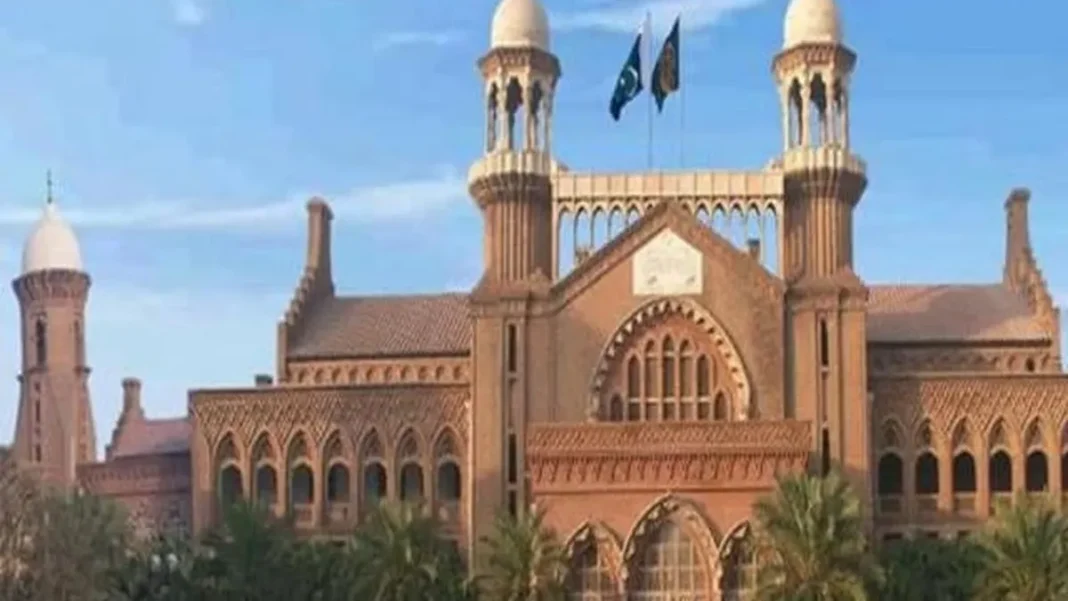
LAHORE: The Lahore High Court has ruled that Punjab Enforcement and Regulatory Authority officials cannot claim exemption from ordinary criminal law merely because a separate complaint procedure exists. Justice Muhammad Ajmal Zahid dismissed a constitutional petition by a PERA official accused of torture, holding that the nature of the alleged offence — not the official status of the accused — decides which law applies.
Announced on Tuesday, the ruling draws a clear line between complaints about administrative action and allegations of criminal conduct.
What the court decided
Tauqeer Asif, a PERA official, had challenged an August 29 order by an ex-officio justice of the peace directing the station house officer to record the complainant’s version and proceed according to law if a cognisable offence was made out.
The complainant alleged that Asif and eight to ten unidentified PERA officials tortured him, took him first to Ferozwala police station and then to an undisclosed location, filmed the incident, snatched Rs25,200 from his pocket, and threatened him against reporting it. A medico-legal certificate supported the injury claim.
Justice Zahid held that a special legal framework does not displace the general criminal law in every case involving a PERA official. Offences punishable under the special law follow its procedure, but allegations independently attracting Pakistan Penal Code provisions cannot be discarded without examining their legal character.
PERA officials and criminal law: the argument that failed
The petitioner’s counsel argued the 2024 Act created a self-contained mechanism for complaints involving PERA officials, leaving the ordinary FIR procedure under Section 154 of the Criminal Procedure Code unavailable. He relied on an earlier LHC judgment and Sections 16, 49 and 53 of the Act.
The court rejected that reading. Justice Zahid observed that the earlier judgment had to be understood in the context of the offences examined in that case, and its principle could not be stretched to cover every alleged offence by a PERA official.
On the three cited provisions, the court explained that Section 16 covers representations against specified enforcement actions, Section 49 deals with offences punishable under the Act itself, and Section 53 provides a complaint mechanism against misuse of authority. These operate within their scope, the judge said, but cannot bring every allegation of violence under the special law alone.
The court noted the allegations went beyond grievances over fines, sealing or encroachment removal — they described conduct that, if proven, constitutes criminal offences in their own right.
What this means for citizens facing PERA teams
PERA is Punjab’s unified enforcement body, created by 2024 legislation to consolidate scattered enforcement functions. Its teams run encroachment drives, seal illegal premises and regulate markets across the province.
The practical effect is straightforward: grievances over routine enforcement actions such as fines or sealing go through the Act’s internal mechanisms, but where officials face accusations of violence, threats or extortion, complainants are not confined to those channels — the police and ordinary criminal courts retain jurisdiction.
The ruling fits a wider pattern of the higher judiciary clarifying jurisdictional boundaries, including a case where the LHC upheld an FIA officials probe when special statutes are invoked to displace ordinary law (see the FCC rulings judgment). Accountability questions have surfaced elsewhere too, including the Mir Ali health clinic probe.
With the petition dismissed, the ex-officio justice of the peace’s August 29 order stands, and the police are to proceed in accordance with law if a cognisable offence is established.
*Source: The Express Tribune*
Frequently asked questions
What did the Lahore High Court decide about PERA officials?
The court dismissed a constitutional petition by a PERA official accused of torture and ruled that PERA officials cannot claim exemption from ordinary criminal law merely because the Punjab Enforcement and Regulation Act, 2024 provides a special complaint mechanism. The nature of the alleged offence decides which law applies.
What did the complainant allege?
The complainant claimed the PERA official, with eight to ten unidentified officials, tortured him, took him to Ferozwala police station and later to an undisclosed location, recorded a video, snatched Rs25,200 from his pocket and threatened him. A medico-legal certificate supported the injury claim.
What do Sections 16, 49 and 53 of the PERA Act cover?
Section 16 provides representations against specified enforcement actions, Section 49 deals with offences punishable under the Act, and Section 53 provides a complaint mechanism against misuse of authority by PERA officials. The court said these apply within their scope but cannot bar PPC provisions where independent criminal offences are alleged.
What was the August 29 order in the case?
An ex-officio justice of the peace directed the station house officer concerned to record the complainant’s version and proceed according to law if a cognisable offence was made out. The PERA official challenged that order through the constitutional petition, which the court dismissed.