


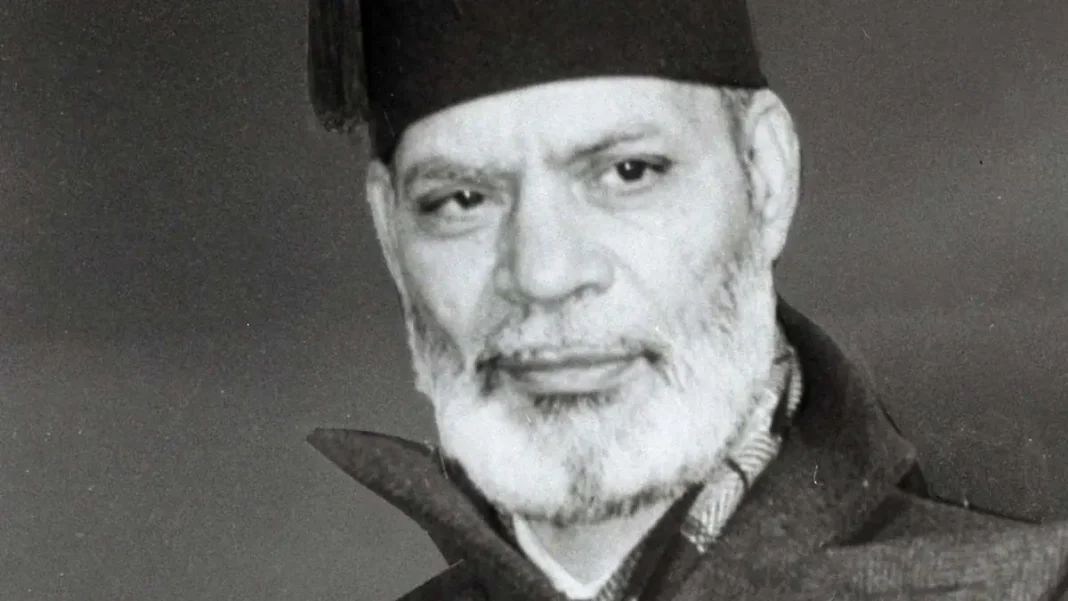
Sir Zafrullah Khan: Pakistan’s First Foreign Minister — Biography & Legacy
Sir Muhammad Zafrullah Khan (1893–1985) was Pakistan’s first foreign minister, serving from December 1947 to October 1954, and went on to become one of the most distinguished international jurists of the twentieth century. This is his full biography: from Sialkot to the Federal Court of India, from the Radcliffe Commission to the cabinet of Liaquat Ali Khan, and from the UN Security Council to the presidencies of the UN General Assembly and the International Court of Justice.
Quick answer: Sir Muhammad Zafrullah Khan (6 February 1893 – 1 September 1985) was Pakistan’s first foreign minister (1947–1954). He built the Foreign Office from scratch, argued Kashmir and Palestine at the UN, signed the 1954 Manila Pact, and later became the only person in history to preside over both the UN General Assembly (1962–64) and the International Court of Justice (1970–73).
In this guide
Early Life and Legal Career
Born in Sialkot on 6 February 1893, Muhammad Zafrullah Khan excelled at law and rose through British India’s judiciary to the Federal Court of India — the subcontinent’s highest court before independence. He was knighted for his service, and the “Sir” stayed with him for life. He was also a devout Ahmadi Muslim, a faith that would later shape the politics around his career.
Partition and the Radcliffe Commission
In 1947, Zafrullah Khan became one of the Pakistan movement’s most effective legal advocates, leading the Muslim League’s case before the Radcliffe Commission that drew the boundary through Punjab. It was high-stakes advocacy with permanent consequences — the line drawn that summer still defines Pakistan’s eastern border. When Pakistan came into being in August 1947, he moved to Karachi and joined the first cabinet. For the wider story of the independence era, see our History of Pakistan 1857–1947.
Seven Years as Foreign Minister
Sworn in as foreign minister on 26 December 1947, Zafrullah Khan inherited almost nothing: under the British, foreign affairs had been the Viceroy’s personal preserve, so there was no foreign service to take over. He recruited and organised one from scratch while handling crises from day one — in his first cabinet meeting, Jinnah directed him to represent Pakistan at Burma’s independence celebrations, and the Kashmir dispute was already taking shape.
His signature work was at the United Nations. In October 1947 — before formally taking the ministry — he led Pakistan’s delegation to the UN General Assembly and championed the Muslim world’s position on Palestine. From 1948 to 1954 he represented Pakistan at the UN Security Council, becoming the country’s foremost advocate on Kashmir and a recognised voice for decolonisation causes from Libya to Indonesia. In September 1954 he signed the Manila Pact, committing Pakistan to SEATO, and resigned the ministry in October 1954. Our pillar guide to the first foreign minister covers the office and its history in full.
The World Stage: UN and ICJ
What followed was extraordinary. Judge of the International Court of Justice (1954–1961), its Vice-President (1958–1961); Pakistan’s Permanent Representative to the UN (1961–1964); President of the UN General Assembly (1962–1964); then back to the ICJ as judge (1964–1973) and its President (1970–1973). No one before or since has presided over both the General Assembly and the World Court. The Pakistan Mission to the UN records him among the country’s most distinguished diplomats.
Legacy
Zafrullah Khan retired to Lahore and died there on 1 September 1985, aged 92. He authored several books on Islam in Urdu and English, including a memoir of his foreign ministry years. He is remembered both as a founding father who gave Pakistan its diplomatic voice and as a jurist of world standing — a combination no other Pakistani has matched. He features in our Famous Pakistani Personalities guide.
When was Zafrullah Khan born and when did he die?
He was born on 6 February 1893 in Sialkot and died on 1 September 1985 in Lahore, at the age of 92.
What was Zafrullah Khan’s role in the Kashmir dispute?
As foreign minister (1947–1954), he was Pakistan’s principal advocate on Kashmir at the UN Security Council, presenting the country’s case through the formative years of the dispute.
What is the Manila Pact?
The September 1954 treaty that created SEATO (the Southeast Asia Treaty Organization). Zafrullah Khan signed it for Pakistan, anchoring the country’s early Cold War alignment with the West.
Why is Zafrullah Khan unique in world history?
He is the only person ever to have served as President of both the UN General Assembly (1962–1964) and the International Court of Justice (1970–1973).
, UN advocate, and the only president of both the UNGA and ICJ.)