


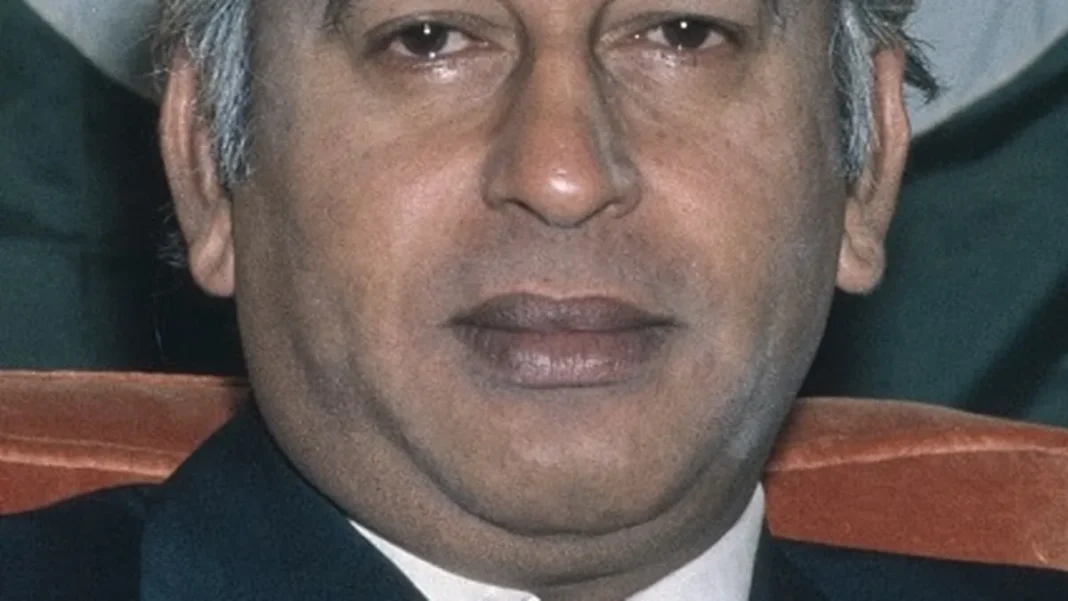
The 4th president of Pakistan was Zulfikar Ali Bhutto — the country’s first civilian head of state, who took charge of a broken, truncated Pakistan on 20 December 1971 and left the presidency to become prime minister under the constitution he authored.
Quick answer: The 4th president of Pakistan was Zulfikar Ali Bhutto (20 December 1971 – 14 August 1973). He secured the release of 90,000 POWs via the Simla Agreement (1972), launched Pakistan’s nuclear programme, and gave the country the 1973 Constitution before becoming prime minister.
In this guide
Taking Charge of a Broken Country
Born in 1928 in Larkana, Sindh, Bhutto had been Ayub Khan’s foreign minister before breaking away to found the Pakistan Peoples Party (1967) on a socialist “roti, kapra aur makaan” platform. When Yahya Khan handed him power four days after Dhaka’s fall, Bhutto inherited a demoralised army, 90,000 prisoners of war in India and an economy in shock.
The Presidency’s Achievements
In just 20 months as president and chief martial law administrator, Bhutto: negotiated the Simla Agreement (July 1972) with Indira Gandhi, bringing the POWs home and converting the ceasefire line into the Line of Control; launched Pakistan’s nuclear weapons programme (the famous Multan meeting of January 1972); withdrew Pakistan from the Commonwealth and SEATO; recognised Bangladesh (1974, as PM); and steered the 1973 Constitution — still Pakistan’s governing charter — through parliament.
From President to Prime Minister
When the 1973 Constitution took effect on 14 August 1973, Bhutto moved to the prime ministership and Fazal Elahi Chaudhry became president. Bhutto governed until the 5 July 1977 coup by Zia-ul-Haq; after a controversial murder trial he was executed on 4 April 1979 — a judicial killing Pakistan’s Supreme Court itself acknowledged as unfair in a 2024 opinion. His daughter Benazir and grandson Bilawal carried the PPP forward. See the full presidents list.
The Legacy Debate
No Pakistani leader divides opinion like Zulfikar Ali Bhutto. Admirers credit him with saving a shattered country, the constitution, the nuclear programme and a voice for the poor; critics blame his nationalisation for economic damage, his authoritarian streak, and his role in the 1971 crisis as a politician who refused to accept the election result. The Supreme Court’s 2024 opinion that his trial was unfair reopened the debate for a new generation. Whatever the verdict, his 20-month presidency shaped everything that followed.
Frequently Asked Questions
What did Bhutto achieve as president?
The Simla Agreement and the return of 90,000 POWs, the launch of the nuclear programme, and the 1973 Constitution — the framework Pakistan still lives under.
How did Zulfikar Ali Bhutto die?
He was executed on 4 April 1979 after a murder trial widely regarded as unfair. In March 2024, Pakistan’s Supreme Court opined that he had not received a fair trial.
 — the civilian who rebuilt Pakistan after 1971 and wrote its constitution.)