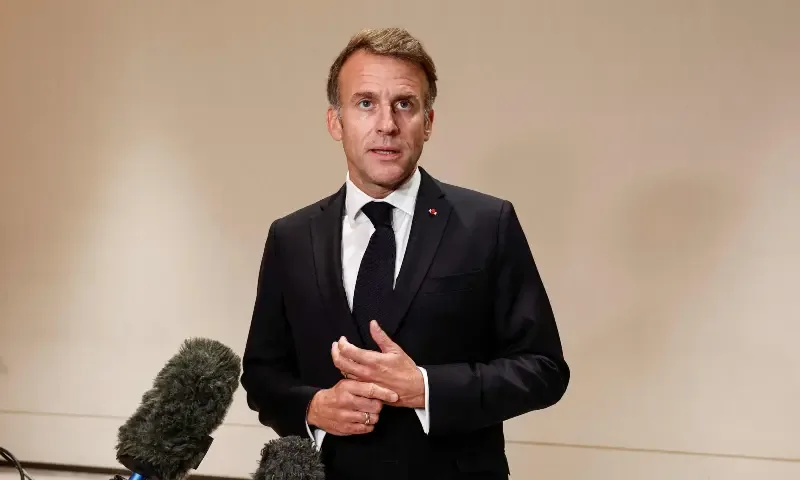
French President Emmanuel Macron on Wednesday accused Donald Trump of exploiting France’s street unrest for election gain, in remarks in Doha that stopped just short of naming the US president directly. The Macron accuses Trump row marks a sharp escalation in tensions between the two leaders.
“There are people who campaign at France’s expense, leaders who are in campaign mode, whether here in the region or on the other side of the Atlantic,” Macron told reporters in Doha, where he was on a visit to Qatar. He implied that Trump, and possibly Israeli Prime Minister Benjamin Netanyahu, had made “stupid comments” on the unrest for political gain, though he named neither leader directly.
Macron accuses Trump: what was said in Doha
Trump has sought to link what he called the “revolution” in France to “migrants, jihadists, and communists” while campaigning for his Republican Party in the United States on an anti-immigration message. On Tuesday, he also hailed French far-right leader Marine Le Pen, who shares his political outlook, as a conservative voice. Surveys place Le Pen as the frontrunner in France’s presidential race.
Netanyahu, who faces his own difficult election battle, argued on Tuesday that France had been hit by an “invasion of extremist Islam”. Several analysts have dismissed claims that migrants were driving France’s protests.
Macron made his remarks as his government struggled to regain control of a crisis that has damaged France’s image abroad and rattled financial markets, six months before presidential elections to choose his successor.
The unrest shaking France
France’s government has admitted it “lost control” during a frenzy of street violence last weekend, the worst the country has seen in years. Masked youths clashed with police, looted shops and vandalised public buildings across several cities.
The rioting overshadowed peaceful demonstrations held on Saturday, when more than half a million people marched across the country against the cost of living. Those rallies followed four weeks of student protests that closed many schools. Earlier reporting put the toll from the unrest at 1,800 arrests and 1,500 damaged businesses.
Authorities in Paris and several other cities imposed nighttime curfews on Monday and Tuesday in zones prone to protests or looting. Macron said he would chair a meeting of key ministers and intelligence officials on Thursday to receive a “detailed account” of what happened last weekend.
Prime Minister Sebastien Lecornu, who met union leaders organising marches on Wednesday, has promised a “massive” police deployment ahead of fresh demonstrations called for Saturday by the Yellow Vest movement against rising inflation. The movement announced on Wednesday that its Paris march would start from Bastille square, with follow-up nationwide demonstrations planned for November 5.
Markets and the political fallout
The convulsion in France, the European Union’s second-biggest economy after Germany, has unsettled investors already worried about the country’s growing debt and deficit. The yield on the French government’s benchmark 10-year bond rose past five per cent on Wednesday, and the Paris stock market fell. Ratings agency Moody’s is expected to lower its grade on France’s public debt on Friday.
France’s fragmented political landscape leaves Lecornu little chance of winning quick parliamentary backing for a cost-cutting budget that must be adopted before the end of this year. The latest Ifop survey, conducted after the riots, suggested Le Pen would lead first-round voting intentions by a wide margin, with far-left candidate Jean-Luc Melenchon emerging as her most likely opponent in the runoff.
Unrest has also spread beyond France’s borders on a smaller scale. Italy’s government has ordered 500 troops to Milan to contain street violence, and Belgium has seen similar disturbances. The images of France’s street violence broadcast around the world have prompted several countries, including the United States, China and Germany, to issue travel advisories for their citizens in France.
Macron ruled out tougher emergency powers, saying “we don’t need a state of emergency” and that the authorities already had the means to cope, pointing to the curfews.
Frequently asked questions
What did Macron say about Trump and the France riots?
Speaking in Doha, Macron said unnamed leaders in campaign mode were exploiting France’s unrest for political gain, in remarks widely read as aimed at Donald Trump and possibly Benjamin Netanyahu.
Why is France seeing protests and riots?
Four weeks of student protests over education conditions grew into cost-of-living demonstrations, with more than 500,000 marching peacefully on Saturday. Separately, masked youths clashed with police last weekend in the worst street violence France has seen in years.
What is the state of France’s economy during the unrest?
The 10-year government bond yield has risen above five per cent, Paris stocks have fallen, and Moody’s is expected to downgrade French public debt on Friday, reflecting investor anxiety over debt and deficits.
When are France’s next presidential elections?
The elections to choose Macron’s successor are due in about six months, with Marine Le Pen leading first-round polling after the riots.