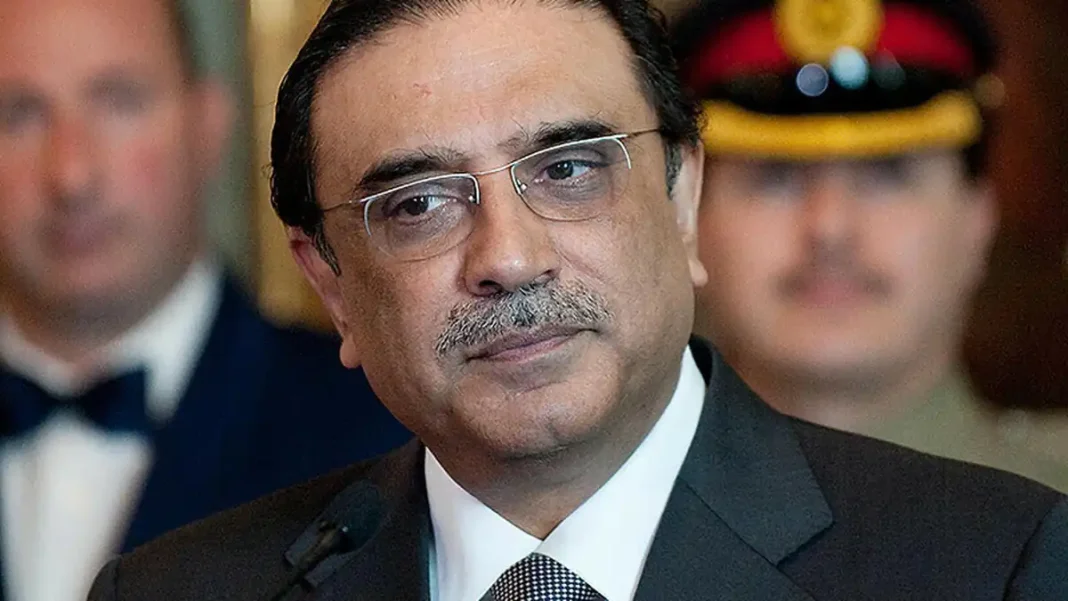
President Asif Ali Zardari has reaffirmed Pakistan’s commitment to economic reforms, fiscal sustainability, energy sector reforms, privatisation and social protection, while ensuring inclusive and green growth. He was speaking at a meeting with a visiting International Monetary Fund delegation at Aiwan-e-Sadr on Tuesday.
Zardari met Jihad Azour, director of the IMF’s Middle East and Central Asia Department, to discuss Pakistan’s economic reform agenda, progress under the IMF-supported programmes and prospects for continued economic recovery and stability. The delegation also included Iva Petrova, the IMF’s mission chief for Pakistan, and Mahir Binici, the IMF’s resident representative in Pakistan.
The president appreciated the Fund’s continued engagement and expressed confidence in the country’s progress following the successful conclusion of the latest programme reviews and a staff-level agreement. He acknowledged the IMF leadership’s confidence in Pakistan’s efforts to implement reforms under the Extended Fund Facility and the Resilience and Sustainability Facility.
Zardari IMF meeting cites $452.1bn economy
Zardari told the delegation that Pakistan had moved from economic stabilisation towards recovery, with the economy reaching $452.1 billion in fiscal year 2026 and real GDP growth accelerating to 3.7 per cent, up from 3.2 per cent in fiscal year 2025.
He also pointed to improvements in fiscal management, noting that the fiscal deficit had declined to 2.6 per cent of GDP in fiscal year 2025-26, while a primary surplus had been recorded for the third consecutive year in fiscal year 2026.
The president reaffirmed Pakistan’s commitment to strengthening revenue mobilisation, improving tax administration and reforming public sector institutions. He highlighted government efforts to expand tax documentation, digitise revenue collection and curb tax evasion.
He emphasised that the reform programme had the support of all political stakeholders and that provincial governments were contributing to meeting reform commitments and targets. The president also underscored Pakistan’s efforts to promote peace amid the ongoing conflict in the Middle East.
Jihad Azour acknowledged Pakistan’s continued engagement with the IMF under the ongoing reform programme and stressed the importance of sustaining reform efforts to strengthen macroeconomic stability, maintain fiscal discipline and support sustainable growth.
Minister for Finance and Revenue Muhammad Aurangzeb, Senator Sherry Rehman, Senator Saleem Mandviwalla, former federal minister Syed Naveed Qamar and the finance secretary were also present at the meeting.
The reform push in motion
The meeting did not happen in isolation. It comes as the government presses ahead on several fronts of the same agenda. Azour himself had called for a fairer tax structure at a tax conference, urging Pakistan to broaden its tax base and reduce exemptions. Prime Minister Shehbaz Sharif has warned tax officers that resistance to FBR reforms will not be tolerated, and the government raised National Savings profit rates across schemes from October 21.
That sequence matters. The IMF wants to see revenue mobilisation and better tax administration, and Islamabad is visibly trying to deliver both. The successful completion of the fourth review of the Extended Fund Facility and the third review of the Resilience and Sustainability Facility, along with the staff-level agreement, gives the government room to argue that the programme is on track.
The currency markets have been telling a similar story of stabilisation. The rupee’s long winning run against the dollar reached 266 days this week, even as it slipped against the pound, reflecting steadier external balances behind the reform narrative.
The test now is durability. Programme reviews reward past performance; the Fund’s concern, echoed by Azour at Aiwan-e-Sadr, is whether the reforms survive political pressure. Zardari’s assurance that all stakeholders and provincial governments back the agenda was aimed squarely at that doubt.
FAQ
Who was in the IMF delegation?
The delegation was led by Jihad Azour, director of the IMF’s Middle East and Central Asia Department, and included Iva Petrova, the IMF mission chief for Pakistan, and Mahir Binici, the IMF resident representative.
What economic figures did Zardari cite?
Zardari said the economy reached $452.1 billion in fiscal year 2026, real GDP growth accelerated to 3.7 per cent, the fiscal deficit fell to 2.6 per cent of GDP, and a primary surplus was recorded for the third consecutive year.
What are the EFF and RSF?
The Extended Fund Facility is the IMF’s main lending programme for Pakistan’s economic reforms, now past its fourth review. The Resilience and Sustainability Facility supports climate and sustainability reforms and has completed its third review.