Slug: dry-fruit-prices-surge-winter-rawalpindi-islamabad
Category: Business
Focus keyphrase: dry fruit prices in Pakistan
SEO title: Dry Fruit Prices in Pakistan Surge as Winter Begins
Meta description: Winter demand has pushed dry fruit prices higher in Rawalpindi and Islamabad, with peanuts crossing Rs1,000 a kilo and pine nuts touching Rs8,000.
Tags: dry fruits, winter prices, inflation, rawalpindi, islamabad, food prices, pakistan economy, peanuts
Original element: local angle (Rawalpindi/Islamabad winter markets — Narnkari Bazaar, Ganjmandi’s Nimco Market, neighbourhood soup stalls) plus own data point (year-on-year price comparison from the reported figures).
Dry Fruit Prices Surge as Winter Begins in Pakistan
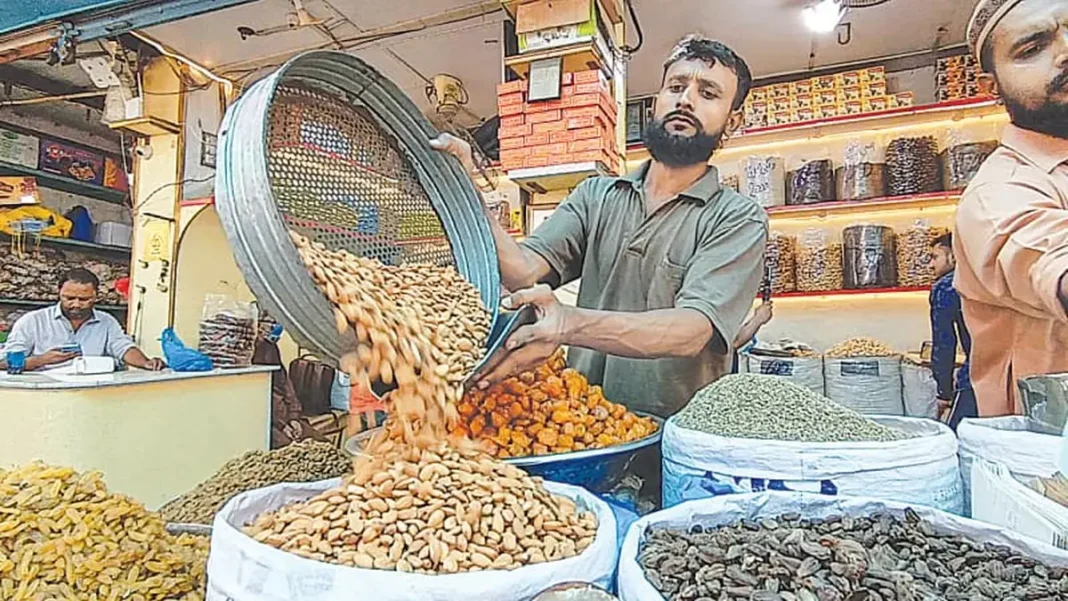
RAWALPINDI: With the onset of winter, prices of dry fruits in Rawalpindi and Islamabad have surged sharply, pushing almonds, cashews, walnuts, pistachios and pine nuts beyond the reach of many low-income households. Peanuts, roasted chickpeas, soup and yakhni have also become significantly more expensive.
Fresh peanuts have caused particular concern among consumers this year. Last year they cost Rs800 per kilogram, but their price has now crossed Rs1,000 per kilogram. Roasted black chickpeas have reached Rs800 per kilogram.
What costs what this winter
In the open market, peeled almonds are selling for Rs2,800 to Rs3,400 per kilogram, cashews for Rs3,200 to Rs4,000, pistachios for Rs3,800 to Rs4,500, walnuts for Rs1,000 to Rs1,800, and pine nuts for Rs7,500 to Rs8,000.
Raisins cost Rs1,200 to Rs1,800 per kilogram, while jaggery is selling for Rs800 to Rs1,400 per kilogram. Dried apricots have doubled in price compared with last year.
The year-on-year comparison tells the story: peanuts that sold at Rs800 a kilo last winter now fetch over Rs1,000, a rise of at least 25 per cent, while dried apricots have risen roughly 100 per cent in a single year.
Soup and yakhni stalls feel the pinch
Hundreds of soup and yakhni stalls have opened across the city with the cold weather, but their rising prices have made even these popular winter refreshments difficult for ordinary residents to afford.
A cup of Kashmiri pink tea now costs up to Rs200. Egg soup is being sold for Rs200 per cup, while a glass of plain yakhni costs Rs150 and a special serving Rs200.
The small stalls and carts have appeared in markets and neighbourhoods across the city. They generally open after sunset and continue operating until 1am. Families have also started visiting soup and yakhni shops in central markets in large numbers.
In Narnkari Bazaar, raw peanuts are being roasted on the spot and sold to customers. Wholesale trading in peanuts and roasted chickpeas has also picked up in Narnkari Bazaar and Ganjmandi’s Nimco Market.
Why prices are climbing
The immediate driver is seasonal: winter is the peak demand season for dry fruits in Pakistan, and traders pass on higher wholesale rates as the cold sets in. But the squeeze on household budgets goes deeper.
Short-term inflation has climbed to 11.97 per cent, with weekly food prices staying in double digits, and the State Bank has flagged inflation at 10.3 per cent. Fuel costs are adding to the pressure: petrol is selling at Rs398.96 a litre after the latest revision, which raises transport costs for goods moving to urban markets. Flour has already jumped in Peshawar, where a 20kg bag hit Rs3,300.
Finance Minister Ahsan Iqbal has ordered tighter price monitoring as inflation data shows mixed signals, but the dry fruit market, which is largely informal and seasonal, remains hard for regulators to control.
Families adjust
For middle- and low-income families, the price spike means smaller quantities or doing without. Shopkeepers say footfall remains steady because of the seasonal habit, but purchases per customer have shrunk. The winter ritual of roasted peanuts and hot yakhni after dark continues; it just costs noticeably more than it did a year ago.
Traders expect prices to ease once peak winter demand passes, but with broader food inflation running high, a return to last year’s rates looks unlikely any time soon.
*Source: The Express Tribune*
FAQs
How much do dry fruits cost in Rawalpindi and Islamabad this winter?
Peeled almonds sell for Rs2,800–3,400 a kilo, cashews Rs3,200–4,000, pistachios Rs3,800–4,500, walnuts Rs1,000–1,800, and pine nuts Rs7,500–8,000. Raisins cost Rs1,200–1,800 and jaggery Rs800–1,400 a kilo.
How have peanut prices changed since last year?
Fresh peanuts cost Rs800 a kilo last winter and have now crossed Rs1,000 a kilo, a rise of at least 25 per cent. Dried apricots have roughly doubled in price over the same period.
How much do soup and yakhni cost now?
A cup of Kashmiri pink tea costs up to Rs200, egg soup Rs200 a cup, plain yakhni Rs150 a glass and a special serving Rs200.