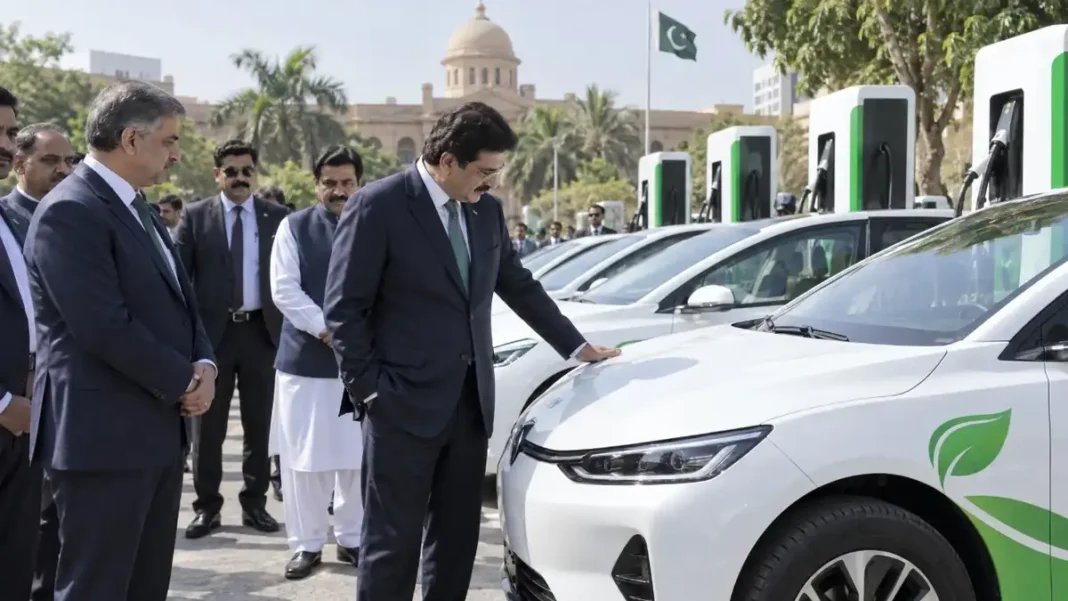
Sindh Government Electric Vehicles Shift Announced
The Sindh government electric vehicles plan will phase out petrol and diesel vehicles used by government departments and shift the fleet to electric models.
Senior Minister Sharjeel Inam Memon announced the decision after a meeting of the Cabinet Committee on Austerity in Karachi on Friday, 13 November. Future purchases of government vehicles will give priority to electric models.
“Saving public resources is among the government’s top priorities, and measures are being taken that reduce costs while also protecting the environment,” Memon said.
Sindh government electric vehicles: the plan
The shift will be gradual. The government will not replace its existing fleet at once. Instead, electric vehicles will get preference whenever a department buys new vehicles, until the whole government fleet runs on electric power.
“The future belongs to EVs, and the Sindh government wants public institutions to adopt environmentally friendly technology and reduce dependence on traditional fuel,” Memon said.
The Cabinet Committee on Austerity, chaired by Memon, reviewed cuts in government spending, fuel savings and the vehicle needs of various departments. Local Government Minister Syed Nasir Hussain Shah, provincial secretaries and other officials attended.
The meeting approved the purchase of vehicles for the Home Department, the Anti-Corruption Establishment, and universities and boards. It also decided that electric vehicles would be given priority in future purchases for government departments.
Memon said promoting EV use in the government fleet would reduce fuel costs and ease the burden of fuel spending on the public exchequer. The phased shift would also cut the daily running costs of government departments.
Shah said smoke from traditional vehicles harms the urban environment, and local government institutions were also promoting electric vehicles instead of conventional ones.
Why Sindh is making the switch
Fuel is one of the largest running costs for a government fleet. Every litre saved cuts the bill the province pays from public funds. Electric vehicles cost far less to run per kilometre than petrol or diesel cars, and they need less maintenance.
The move also fits Sindh’s wider push towards electric transport. The province has proposed buying 500 electric buses for public transport, and it has extended tax and registration incentives for non-commercial electric vehicles until May 2028. Those incentives include lower registration fees and annual motor vehicle taxes.
Karachi is also set to receive a fresh batch of double-decker and electric buses this month, with routes being finalised for the new fleet.
By switching its own vehicles first, the government hopes to show that electric transport works at scale. A government fleet that runs on electricity creates steady demand for charging points, servicing and parts, which helps the market grow for private buyers too.
The province’s push for electric buses is already under way, with local assembly of electric buses expanding. Rawalpindi has also launched electric buses for public transport. Third-party motor insurance has surged in Sindh, showing how fast the province’s vehicle market is changing. Islamabad has also moved towards electric public transport, with electric buses for women commuters.
What happens next
The decision sets the direction, but the pace will depend on purchases. Departments will buy electric models as they replace old vehicles, so the fleet will change over time rather than overnight.
Charging points will be needed at government offices and depots, and drivers will need training on the new vehicles. The government has not yet given a date for the full changeover or a count of the vehicles involved.
What is clear is the policy: from now on, when a Sindh government department buys a vehicle, an electric one comes first.
Frequently asked questions
What has the Sindh government decided about its vehicles?
It has decided to gradually phase out petrol and diesel vehicles in government departments and shift to electric vehicles, giving EVs priority in future purchases.
Will existing government vehicles be replaced at once?
No. The transition will be phased. Electric vehicles will be preferred when departments buy new vehicles, so the fleet will change over time.
Who announced the decision?
Senior Minister Sharjeel Inam Memon announced it after a meeting of the Cabinet Committee on Austerity, which he chaired in Karachi.
What other electric transport plans does Sindh have?
Sindh has proposed buying 500 electric buses, extended tax and registration incentives for non-commercial EVs until May 2028, and expects a fresh batch of double-decker and electric buses in Karachi this month.