Smog in Punjab is a daily problem this November. Thick grey air covers Lahore and other cities, while the air quality index stays in the unhealthy range. In fact, the Punjab government says it is fighting the smog with drones, fines and road washing. In short, the measures range from drones in the sky to fines on the ground. This article explains what the government is doing, and whether it is working, so you can judge for yourself. For the health risks and how to protect your family, read our guide on the health risks of smog and how to protect your family.
What the Pre-Smog Action Plan Covers
Punjab has a written plan for smog season. It is called the Pre-Smog Action Plan 2026. The plan sets out who does what before the smog arrives. In addition, the province is running a 10-year action plan to curb smog. Senior Minister Marriyum Aurangzeb said the plan covers monitoring, forecasting and enforcement. The goal is less smog in Punjab.
The middle of November is the hardest part, because the air turns colder and still. According to the minister, the period from 1 to 15 November is critical for smog. Temperature inversion, humidity, wind patterns and limited sunlight trap pollutants in the air. As a result, the smog thickens during these two weeks. The Environment Protection Department (EPD) lists six main sources of smog. They are transport emissions, industry, brick kilns, crop burning, construction dust and waste burning. The plan targets each source in turn.
Smog in Punjab: Drones Watch the Smoke Sources
Drones are now part of the fight against smog. The Pre-Smog Action Plan gives drones a clear job. They fly over cities and fields to find pollution sources. For example, a drone can spot smoke from a factory or a burning field. The drone teams then pass the location to field teams. As a result, officers can act fast instead of searching blindly.
Monitoring, however, does not stop with drones. The government has installed 59 industrial air quality monitors across Punjab. In addition, 9,000 industrial units have installed systems to monitor their own smoke emissions. The numbers come from Senior Minister Marriyum Aurangzeb. She shared them at a press briefing on 11 November. The aim is simple. Find the smoke, then stop it at the source.
Factories and Brick Kilns Face Sealing and Fines
Factories that burn tyres are a clear target, because their smoke is thick and black. Officers have shut down and fined more than 30 tyre-burning factories. Deputy Director Environment Lahore Ali Ejaz shared the figure. He acted on the directions of Senior Minister Marriyum Aurangzeb. The crackdown goes wider than tyres. In one 24-hour period, officers sealed 11 industrial units. They also imposed fines of Rs 900,000. These fines are part of the wider fight against smog in Punjab.
Similarly, brick kilns face the same pressure. Officers inspected 112 brick kilns in the same period. They demolished three kilns and sealed four more. Officers registered one case and imposed fines of Rs 200,000. They also seized 8 kilogrammes of substandard plastic. The long-term fix, however, is cleaner kiln technology. So far, 14,000 brick kilns have switched to zigzag technology. Zigzag kilns burn fuel more cleanly than old kilns.
In Lahore Division, the drive has been running since 1 October. Officers have inspected 3,435 industrial units, 2,245 brick kilns and 1,711 restaurants. As a result, officers registered 97 cases and imposed fines of Rs 12.6 million. In Rawalpindi, the deputy commissioner ordered cases against anyone burning garbage, old tyres or crop residue. He also ordered the bulldozing of kilns without environment-friendly technology. Commercial kitchens and barbecue outlets face new rules too. They must install suction hoods to control smoke. The fines send a message. A sealed factory loses money every day it stays shut. As a result, owners have a reason to fix their smoke.
Smog in Punjab: Vehicles Under Check
Vehicles are a major source of smog in Punjab. Smoke from old and badly maintained vehicles fills the air, especially in busy areas. The government is checking vehicles across the province. So far, six million vehicles have obtained fitness certificates. The certificates show that a vehicle meets emission standards, so drivers have a clear target. Traffic police and EPD squads now stand at the entry and exit points of Lahore. They stop smoke-emitting vehicles and check their fitness. The traffic police, the Regional Transport Authority and the EPD run joint operations.
In addition, officers are stopping trolleys that carry soil or sand without covers. Uncovered loads throw dust into the air, so officers stop them as well. The checks cover private cars, buses and trucks. In fact, smoke-emitting vehicles are among the most dangerous sources of pollution, according to the EPD in Rawalpindi. The minister has a clear message for drivers. Keep smoke-emitting vehicles off the roads. For example, a vehicle that trails black smoke should stay home until it is fixed. The checks will continue through the smog season.
Road Washing and Smog Guns in Lahore
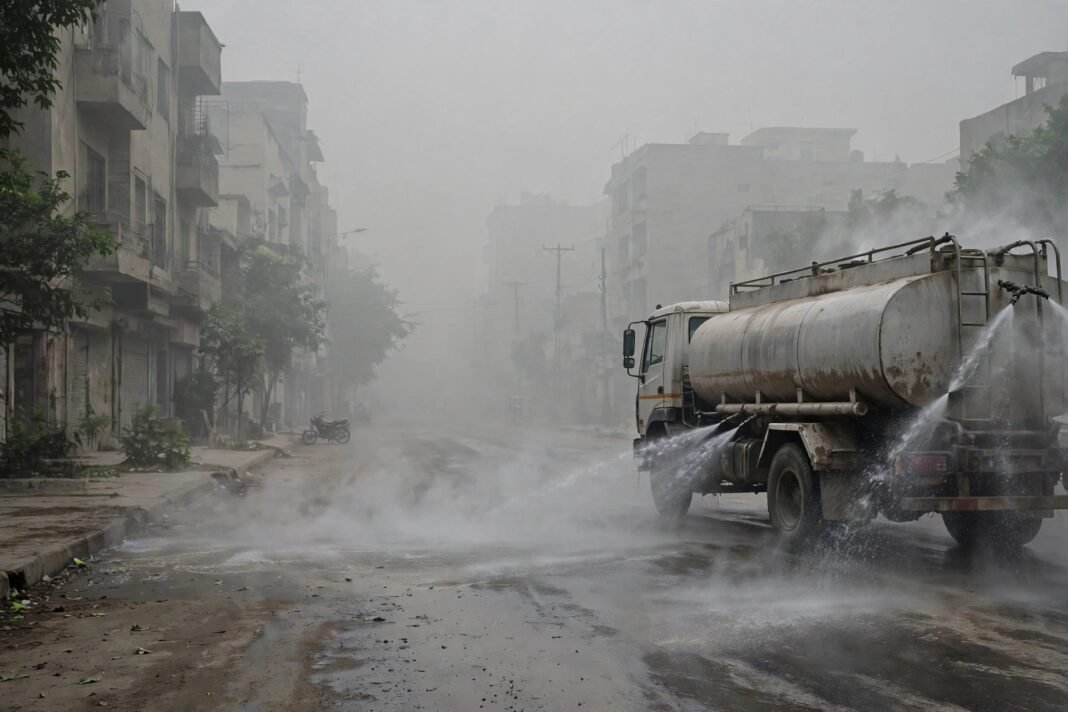
Lahore’s roads are getting a wash. The city launched a campaign called Chamkta Lahore, which means Shining Lahore. Local Government Minister Zeeshan Rafique launched it at Liberty Chowk. Water trucks and mist guns spray the roads to settle dust. Dust on the roads adds to the smog when traffic stirs it up. The washing is now more intense. Officials have therefore ordered more water spraying and more mist-spraying machines.
Road dust adds to Lahore’s smog. Traffic lifts dust from dry roads into the air, and the dust then mixes with smoke. Wet roads keep the dust down. In short, clean roads mean cleaner air. In addition, smog guns are working in the worst-hit parts of Lahore. The guns spray fine water mist into the air, so the dust falls to the ground. Artificial intelligence helps move the guns to the places where pollution is worst. The idea is simple. Wet the dust, and it stays on the ground instead of floating into the air.
Smog in Punjab: The Air Coming From Across the Border
Not all the smog starts in Punjab. The EPA studied the air from 8 to 10 November, during the Diwali period. Its assessment found that pollution-laden air from India moved deep into Punjab and, as a result, raised particle levels across the province. Nearly 50% of the province was exposed to air masses from India in 24 hours. In addition, 39% was exposed during 12 hours from 6am on 9 November. The EPA used air movement data, satellite observations and monitoring stations for its assessment. The numbers match the AQI readings. For example, Lahore’s overall AQI rose from 366 on 8 November to 440 on 9 November. Environment Protection Secretary Salwat Saeed backed the finding. She said aerosol optical depth levels in Lahore and Amritsar supported the assessment.
However, cross-border air is only part of the story. But local sources matter too. The EPD’s own list of main contributors is local. It names transport, industry, brick kilns, crop burning, construction dust and waste burning. In other words, Punjab must cut its own smoke as well as watch the wind.
How Residents Can Report Smoke
Residents can help the fight against smog. The first step is to report smoke when you see it. For example, you can report smoke sources through the Green Punjab app. In addition, the EPD runs a helpline at 1373. Reports work best with a clear location. Note the street or area when you report smoke. Officers can then reach the spot fast. A quick report can send officers to a burning field or a smoking chimney.
The government also asks residents to change small habits. Above all, do not burn crop residue, municipal waste or plastic. Smoke from any source adds to the pollution. Avoid unnecessary outdoor activities on heavy smog days, especially in the morning. Older people, children and people with breathing problems need extra care. Meanwhile, keep your own vehicle in good shape. A tuned engine makes less smoke. Every small step helps, and the reports add up.
Is the Air Getting Better?
The government says smog in Punjab is lower than last year. The EPD says smog in October 2026 was about 33% lower than in October last year. In fact, the comparison with 2024 is sharper. For example, on 11 November 2024, Lahore’s AQI crossed 2,000 and reached about 2,400. On 11 November 2026, it stayed below 450. The minister also pointed to farm fires. She said crop residue burning incidents had fallen by 39%, and fire anomalies around Lahore had decreased by 85%. The minister said air quality had improved at several monitoring locations. She credited government action, better weather, stronger winds and field monitoring.
Experts expect the smog to ease soon. They say smog levels rise until 15 November, then decline. A gradual improvement should follow after that date. However, the air is still far from clean. Lahore’s AQI stood at 211 on 13 November, which counts as very unhealthy. Faisalabad also faced severe smog this week, with its AQI hitting 600. Read the full story on Faisalabad’s smog and the widening crackdown. Senior Minister Marriyum Aurangzeb addressed the politics at a press conference on 11 November. She said smog is not a political issue.
The results so far are mixed. Enforcement is real, and the numbers show some progress, but the job is not done. However, the air still fails the healthy test on most days. For now, the best advice stays the same. Check the air before you go out, and read our guide on how to protect your family from smog.
What changes have you noticed in your city’s air this November? Tell us in the comments.