Philippines Australia Defence Pact Signed in Manila
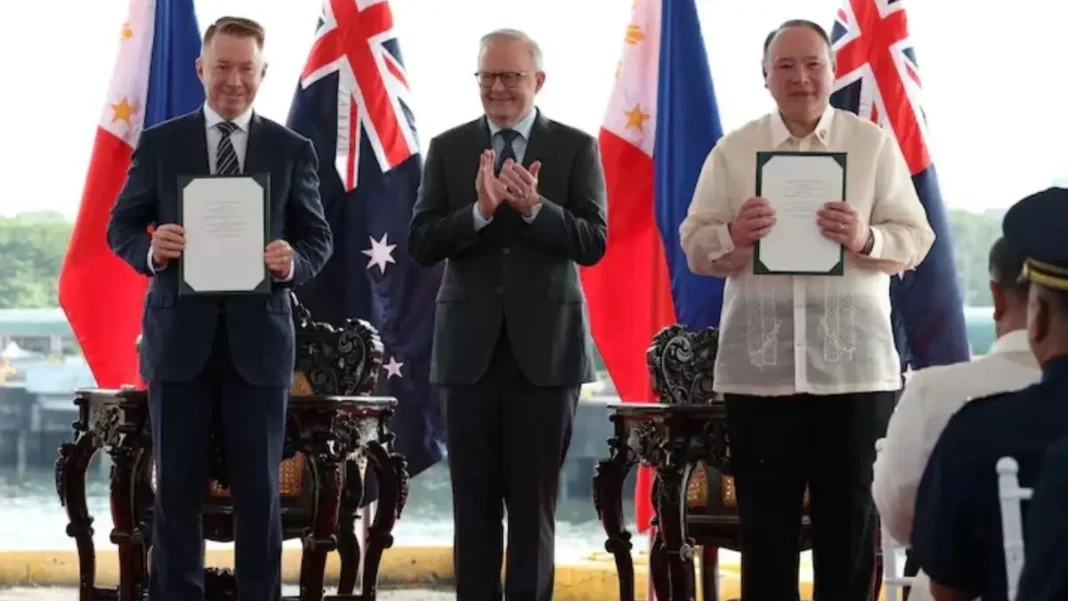
A Philippines Australia defence pact was signed in Manila on Sunday, in a deal the two countries say will cut red tape for joint military activity and deepen security ties.
The Defence Cooperation Arrangement will streamline the bilateral Status of Visiting Forces Agreement, known as SOVFA, by simplifying coordination procedures. Philippine Defence Secretary Gilberto Teodoro described the deal as an “anti-red tape measure” for putting SOVFA into practice.
“Rather than 100 steps to do a single thing, it will just now take 10,” Teodoro told reporters after the signing.
The arrangement will pave the way for closer cooperation between maritime, air and land forces, as well as humanitarian and disaster response. Teodoro said it would also bolster the Philippines’ “credible deterrence posture”, including in the South China Sea.
Australian Prime Minister Anthony Albanese witnessed the signing in Manila, where he is attending a summit of the Association of Southeast Asian Nations. The Express Tribune reported the signing on Sunday, citing Reuters.
What the Philippines Australia defence pact changes
The pact does not create a new alliance. The Philippines already has a long-standing treaty alliance with the United States, and the new arrangement with Australia sits alongside it.
What it changes is speed. Joint exercises, visits by forces and shared operations will need fewer approvals, so the two militaries can work together more often and with less delay.
Albanese said the agreement would improve maritime awareness and information sharing, and increase strategic dialogue, training, interoperability and defence infrastructure development.
He also announced extra Australian investment in maritime domain awareness, including drone technology, equipment and training aimed at improving detection of maritime and cybersecurity threats.
The South China Sea sits at the centre
The Philippines has been broadening its network of security ties in the face of what it describes as China’s aggressive behaviour in the South China Sea, where countries have overlapping maritime claims.
Australia has consistently supported Manila’s position on the strategic waterway. Canberra backs a 2016 ruling by an international arbitral tribunal that China’s sweeping claims have no basis under international law, a decision Beijing rejects.
Beijing maintains that its actions in the South China Sea have been lawful and professional. It routinely opposes Manila’s joint military activities with allied partners, saying such drills heighten tensions in the region.
The pact gives the Philippines another partner with a direct stake in the waterway, through which a large share of world trade passes.
A wider pattern of security ties
The deal fits a wider pattern. The Philippines has been building closer defence links with a string of partners as tensions persist in the South China Sea, while Australia has stepped up its engagement across Southeast Asia.
The signing also came as the region’s leaders gathered in Manila for the ASEAN summit, where maritime security featured high on the agenda. The summit season has already produced a historic meeting of the leaders of the United States, China and Russia, and a tour of Asia by the US president after midterm losses at home.
Defence pacts have multiplied across the region in recent weeks. Pakistan’s air chief discussed deeper defence cooperation with Uzbekistan, and Turkiye published the law ratifying the Makkah defence pact. The space domain is part of the same contest, as Pakistan weighs its own strategic imperatives in the space era.
For Manila, the pact adds practical weight to its deterrence posture. For Canberra, it deepens a security relationship with a Southeast Asian partner at a time when both countries are watching China’s naval reach grow.
What happens next
With the arrangement signed, the two defence forces can begin using the simplified procedures for joint activities. Further talks on training, information sharing and infrastructure are expected to follow.
The test of the pact will come in the months ahead, as the two sides put the new procedures to work in exercises and patrols across the region.
Frequently asked questions
What did the Philippines and Australia sign?
A Defence Cooperation Arrangement that streamlines the Status of Visiting Forces Agreement and deepens military cooperation.
Who signed the pact?
Philippine Defence Secretary Gilberto Teodoro Jr signed the arrangement, witnessed by Australian Prime Minister Anthony Albanese in Manila.
What does the pact cover?
Closer cooperation between maritime, air and land forces, plus humanitarian and disaster response, and better maritime awareness and information sharing.
Why does the South China Sea matter here?
The Philippines says the pact bolsters its “credible deterrence posture” in the South China Sea, where it faces what it calls aggressive behaviour from China.
Does the pact replace the Philippines’ alliance with the US?
No. It complements the long-standing US treaty alliance and adds Australia as a closer defence partner.