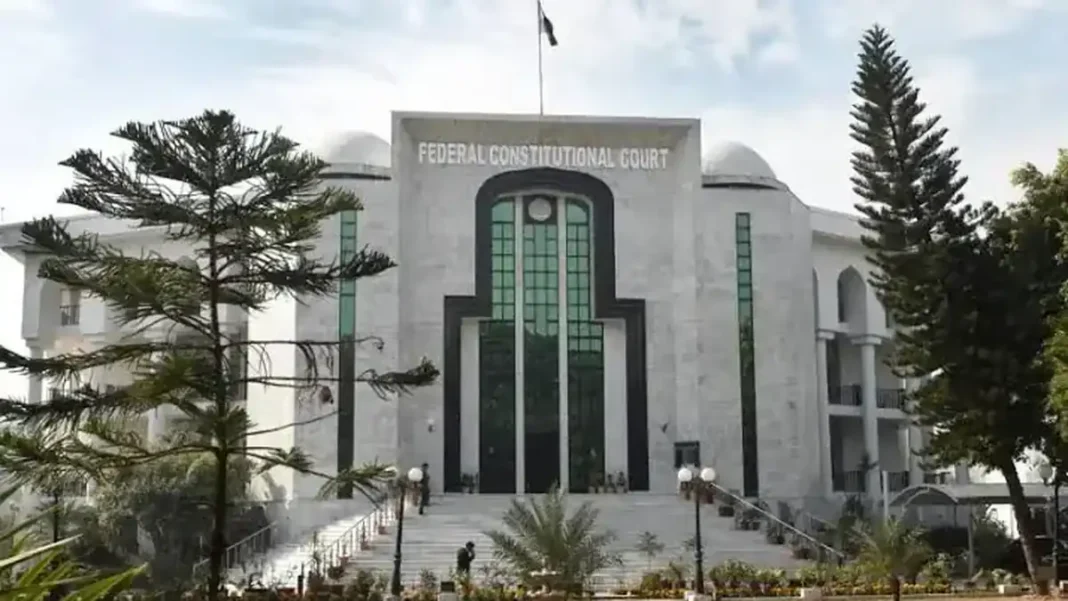
FCC Strikes Down Infrastructure Cess Pakistan
The Federal Constitutional Court on Thursday struck down the infrastructure cess Pakistan’s Sindh and Khyber Pakhtunkhwa governments charged on traded goods, ruling that both provinces had taxed a subject reserved for Parliament. The decision ends a legal fight of more than three decades and brings relief to importers, exporters and manufacturers who paid the levy on goods moving through ports and across provinces.
A two-judge bench headed by Chief Justice Aminuddin Khan, with Justice Aamer Farooq, heard 568 petitions from private petitioners against the Sindh Development and Maintenance of Infrastructure Cess Act 2017 and the Khyber Pakhtunkhwa Infrastructure Development Cess Act 2022. A detailed judgement will follow.
What the infrastructure cess Pakistan ruling decided
The bench examined provincial tax powers against imports, exports, customs transactions and the movement of goods across provincial borders.
Senior counsel Hafiz Ehsaan Ahmad Khokhar, for the Revenue Division secretary and the Federal Board of Revenue (FBR), argued that the levy had to be judged by its real nature, not its name: a charge on traded goods that worked through customs clearance belonged to the federal domain, even if the province called it an infrastructure cess.
He relied on Articles 141 and 142(a) of the Constitution, read with Entries 27, 43 and 59 of the Federal Legislative List. Entry 27 covers imports and exports across customs frontiers, Entry 43 assigns customs duties to the federation, and Article 142(a) gives Parliament sole power over those matters. Article 163, which lets provinces tax professions and trades, could not stretch to customs duties, he added.
A levy that dates back to 1994
The Sindh dispute is old: the province first imposed the cess in 1994, and the 2017 Act taxed goods that entered or left Sindh by air or sea. The Sindh High Court upheld the levy on June 4, 2021.
Khyber Pakhtunkhwa passed its own law in 2022, placing a cess on the transport and movement of goods. The KP Finance Act 2024 raised the rate from one per cent to two per cent, and the Peshawar High Court dismissed 157 petitions against the levy on November 14, 2025, and upheld it.
Punjab introduced its own version in 2015 at 0.9 per cent, which shows how widely provinces had turned to such charges.
How the two sides argued the case
Sindh and Khyber Pakhtunkhwa defended their laws as provincial taxes meant to pay for infrastructure and roads, not a customs or export duty, and said the assemblies had power to legislate under Article 142(c).
The federation argued the true test of a levy lay in its taxable event, fiscal burden and actual operation, and a provincial charge on traded goods that worked through customs clearance engaged the federal domain.
The court accepted the federation’s case, set aside both high court judgements and declared the provincial laws beyond the competence of the provinces.
The FCC recently dismissed review petitions against its super tax ruling. Tariff cuts have already stirred debate over who carries the duty burden in Pakistan’s trade system.
What happens next for traders and past payments
Importers, exporters and manufacturers in both provinces will no longer face the cess on goods that cross customs frontiers. The charge had added a cost to every shipment, and its removal should lower the cost of moving goods.
What stays open is the fate of money already collected. That will turn on the detailed judgement, which the court has yet to issue, and on whether past payments can be claimed back.
The Federal Board of Revenue has moved to tighten checks on oil imports at ports to curb under-invoicing, and it plans an online refund system for exporters by December. The government has also eased rules on used car imports, a further sign of change in how trade is taxed at the border. Dawn reported the full court proceedings, while Business Recorder covered the earlier hearings at which the court reserved its judgement.
Frequently asked questions
What is the infrastructure cess?
It is a provincial levy charged on goods that enter, leave or pass through a province, which the provinces said would pay for roads and other infrastructure. The Federal Constitutional Court has now ruled that Sindh and Khyber Pakhtunkhwa had no power to impose it on traded goods.
Which laws did the court strike down?
The court set aside high court rulings that upheld the Sindh Development and Maintenance of Infrastructure Cess Act 2017 and the Khyber Pakhtunkhwa Infrastructure Development Cess Act 2022, as amended by the KP Finance Act 2024.
Who heard the case?
A two-judge bench headed by Federal Constitutional Court Chief Justice Aminuddin Khan, with Justice Aamer Farooq, heard a batch of 568 petitions from private petitioners.
Why did the court rule against the provinces?
The court held that taxes on imports, exports and customs fall within Parliament’s sole legislative power under Article 142(a) and the Federal Legislative List. A province cannot tax a federal subject by calling the charge an infrastructure cess.
Will traders get back the cess they already paid?
That is not yet clear. The court said a detailed judgement will follow, and the treatment of past collections will depend on what it says.