


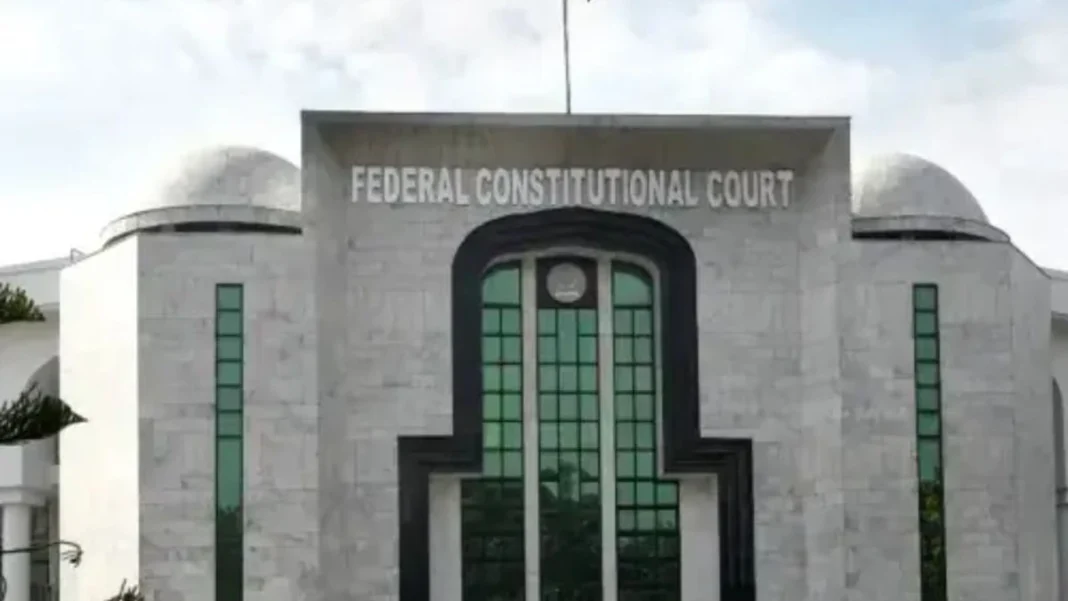
FCC Super Tax Review Petitions Dismissed
The FCC super tax ruling is now final. The Federal Constitutional Court has dismissed more than 395 review petitions challenging its earlier judgement upholding the constitutional validity of the super tax, ruling that review jurisdiction cannot be used as a substitute for an appeal.
“[Review] is warranted only to rectify a manifest error, patent illegality or other infirmity falling within the recognised parameters of review, and not to reopen controversies conclusively adjudicated,” the FCC chief justice observed in detailed reasons issued on Wednesday, Dawn reported on Thursday.
FCC super tax judgement stays operative
A three-judge bench, headed by the chief justice, had reserved its ruling on November 2 on review petitions challenging the court’s January 27, 2026 judgement. That judgement upheld the super tax under Sections 4B and 4C of the Income Tax Ordinance, 2001.
The detailed reasons left the earlier judgement intact, including the applicability of Sections 4B and 4C from the dates on which the respective provisions were introduced. “The judgement under review, along with all directions contained therein, shall remain undisturbed and operative in accordance with the law,” the FCC said.
The review petitions were filed by major banks, textile mills, fertiliser companies, pharmaceutical firms, oil and gas companies, cement manufacturers, power producers and individual taxpayers, including JS Bank, Fauji Fertiliser, Engro Corporation, Lucky Cement, Meezan Bank and Colgate-Palmolive, among others.
Review is not a disguised appeal
The judgement explained that mere disagreement with the reasoning or conclusions of a judgement, or the plausibility of an alternative interpretation, gives no juridical foundation for review. The jurisdiction cannot be used as a disguised appeal or an instrument for rehearing the matter on merits, the judgement said.
Dismissing the review petitions, the FCC held that “no error apparent on the face of the record, material omission or other legally cognisable infirmity” had been demonstrated to justify exercise of its exceptional and narrowly confined review jurisdiction.
On legislative competence, the FCC reaffirmed that the super tax falls squarely within Entry 47 of Part I of the Federal Legislative List, attracting parliament’s competence and the Money Bill procedure under Article 73 of the Constitution.
Retrospective application upheld
The court also rejected objections to the retrospective application of Section 4C, holding that the petitioners had failed to demonstrate any patent illegality and were merely seeking to reopen settled issues.
The bench repelled objections grounded in Article 25, holding that the income-based classifications and differential rates bear a rational nexus with the legislative object, and that “the constitutional guarantee of equality does not interdict reasonable fiscal classification”.
Contentions about computation of income, inclusion of capital gains, and application of Section 4C to incomes under final tax regimes were held to have been conclusively adjudicated.
Notably, the court addressed the contention that it was bound by Supreme Court judgements. It ruled that following the Constitution 27th Amendment Act, 2025, the FCC exercises independent constitutional jurisdiction, and Supreme Court decisions, while persuasive, are not binding on it. Mere divergence of judicial opinion therefore gives no ground for review, the FCC held.
What the super tax is
Section 4B, introduced through the Finance Act 2015, imposed a super tax on individuals and companies earning more than Rs500 million, originally to help fund rehabilitation of internally displaced persons. Section 4C, introduced through the Finance Act 2022, expanded the regime to those earning over Rs150 million from tax year 2022 onwards.
The tax has been contested in the courts for years, with businesses arguing that it was unconstitutional, discriminatory and wrongly applied with retrospective effect. The FCC’s January judgement settled those questions in the state’s favour, and Wednesday’s detailed reasons now close the review route as well.
The ruling lands as the tax system itself is under review. Feature Pakistan reported this month that the FBR is considering a plan to abolish the super tax, a move that would need legislation and would sit oddly beside a court ruling that has just confirmed the levy’s validity. The board has also waived a surcharge for late filers and stepped up computerised checks of income tax returns.
For the companies that filed the review petitions, the immediate consequence is clear: the January judgement stands, and individual assessments must be settled under the law. The court’s message on the retirement of Justice Jamal Khan Mandokhail this week, that parliament must never undermine judicial independence, now sits beside a ruling that underlines parliament’s competence to tax.
What happens next
With the review petitions dismissed, the FCC’s January judgement remains fully operative. Taxpayers must now pursue any remaining disputes through individual assessment proceedings, not through review. The policy question of whether the super tax should continue at all now rests with the government and parliament, not the courts.
Frequently asked questions
How many super tax review petitions did the FCC dismiss?
The Federal Constitutional Court dismissed more than 395 review petitions challenging its January 27, 2026 judgement upholding the constitutional validity of the super tax.
What did the FCC say about review jurisdiction?
The court ruled that review is warranted only to rectify a manifest error, patent illegality or other infirmity, and cannot be used as a substitute for an appeal or to reopen controversies already decided.
What are Sections 4B and 4C of the Income Tax Ordinance?
Section 4B, introduced in 2015, imposed a super tax on those earning more than Rs500 million. Section 4C, introduced in 2022, expanded the regime to those earning over Rs150 million from tax year 2022 onwards.
Did the FCC accept the retrospective application of the super tax?
Yes. The court rejected objections to the retrospective application of Section 4C, holding that the petitioners had failed to demonstrate any patent illegality.
Does the ruling bind the Supreme Court?
No. The FCC held that after the 27th Amendment, it exercises independent constitutional jurisdiction, and Supreme Court decisions, while persuasive, are not binding on it.