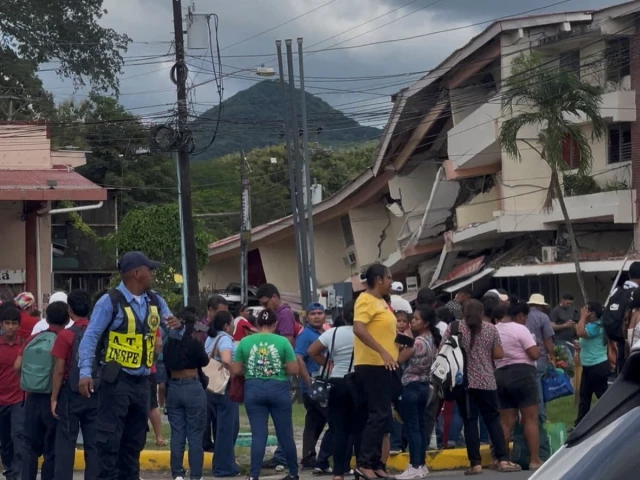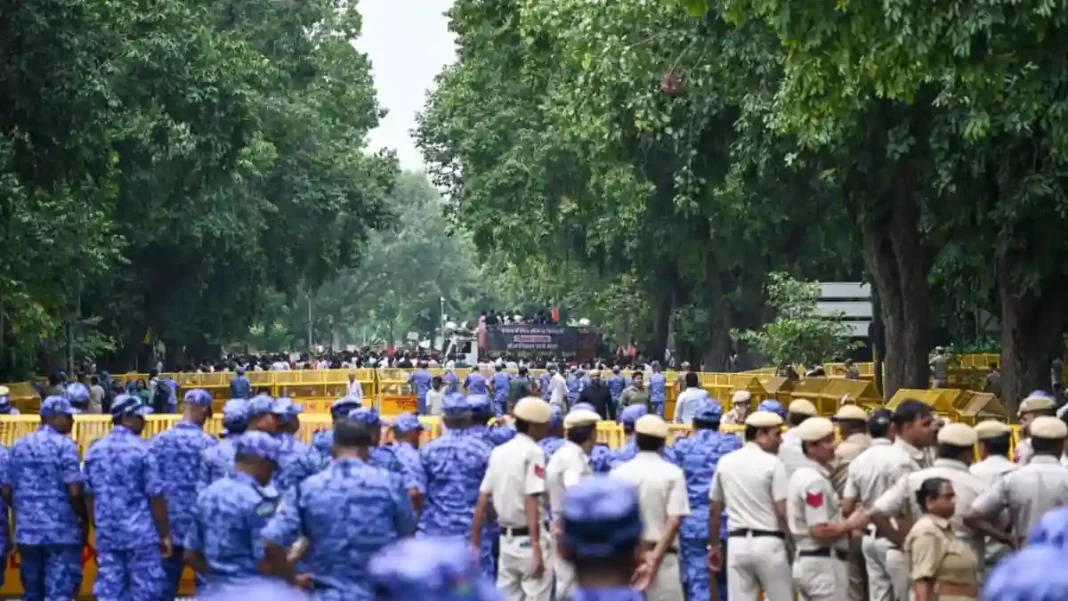
New Delhi woke on Saturday to metal barricades, shut metro stations and thousands of police on its streets. Authorities sealed off central Delhi ahead of a planned youth-led march demanding the resignation of India’s chief election commissioner over disputed voter-roll changes.
The demonstration, billed by organisers as a protest to “save democracy”, was called by the Cockroach Janata Party (CJP), the youth-led movement behind weeks of agitation. Protesters planned to gather at Jantar Mantar, the capital’s designated protest site, at 10am.
Police did not authorise the rally. Officers said the request was made too late and accused the CJP of breaking undertakings given during earlier protests. By Saturday morning, multiple layers of yellow metal barricades, concrete blocks and anti-riot vehicles with tear gas launchers blocked the roads to the site.
Capital under lockdown
More than 20,000 police and paramilitary personnel were deployed across the capital, the Press Trust of India reported, in the heaviest security build-up seen in the city this year.
Fifty-seven metro stations were shut from Friday night, several long-distance trains to Delhi were cancelled, and mobile internet was suspended within four kilometres of Jantar Mantar until Saturday night, the news agency ANI reported.
India’s Supreme Court intervened on Friday, ruling that public transport could not face a blanket shutdown and that some trains must keep running.
Reuters reported around 200 protesters detained in the central business district on Saturday, with police boarding buses at city entry points to check for demonstrators.
What the protests are about
At the centre of the unrest is the Election Commission of India’s “special intensive revision” of electoral rolls, a nationwide exercise the commission says is meant to remove duplicate and ineligible voters. The Indian Express reported last month that some 130 million names had been removed from draft lists during the revision.
Opposition parties and critics say the exercise could disenfranchise eligible voters in ways that benefit Prime Minister Narendra Modi’s Bharatiya Janata Party, an allegation both the commission and the BJP reject.
The protesters are demanding the resignation of Chief Election Commissioner Gyanesh Kumar. “The dictator would rather shut down the entire national capital and inconvenience millions of citizens than allow a peaceful protest at a designated protest site,” CJP chief Abhijeet Dipke said on X.
Dipke told ANI: “Why is the prime minister so scared of the country’s youth, the country’s people? Why did you need to close all the railways, the metro, the internet has been closed, roads have been closed? … This is nothing but fear.”
The CJP claims more than 10,000 people, including supporters travelling to Delhi by train, have been detained across the country. “You can detain the people, you cannot detain the movement,” said Neha Bora, national president of the All India Students’ Association.
A growing political challenge
The agitation has widened beyond the youth movement. Congress leader Rahul Gandhi was briefly detained during opposition rallies earlier this week, and both he and his sister Priyanka Gandhi were detained again as the protests entered their third day. Opposition leaders were expected to meet President Droupadi Murmu on Friday to complain about Kumar.
The CJP began in May 2026 as an online satire movement, but it has already shown its power. A mass mobilisation by the group in July over an examination scandal led to the education minister stepping down. Friday’s heavy police deployment showed how seriously the government is taking this round.
The near-daily demonstrations now pose a fresh political challenge to Modi, months before a series of key state elections starting in early 2027, including in the BJP-ruled state of Uttar Pradesh. India’s Supreme Court has also agreed to hear petitions seeking its intervention in the allegations against the poll body.
For further reading, see Reuters’ report on the Delhi lockdown and TBS News’ coverage of the detentions.
Frequently asked questions
Why are protesters demanding the election chief’s resignation?
Demonstrators want Chief Election Commissioner Gyanesh Kumar to quit over the “special intensive revision” of voter rolls. Critics say the process has removed millions of names and could favour the ruling BJP. The commission denies any wrongdoing.
How many police were deployed in Delhi for the protest?
The Press Trust of India reported more than 20,000 police and paramilitary personnel deployed across the capital, with heavy barricading around Jantar Mantar and central Delhi.
What is the Cockroach Janata Party?
The CJP is a youth-led movement that began as an online satire group in May 2026; a July campaign of theirs ended with the education minister stepping down.