


1st Capital of Pakistan: Karachi’s First-Capital Years and Lasting Legacy
When Pakistan was born on 14 August 1947, its first capital was not the city most people picture today. It was Karachi — the coastal metropolis chosen by Muhammad Ali Jinnah himself. For twelve years, this port city hosted the Constituent Assembly, the first central bank and the first national broadcaster. Here is the story of the 1st capital of Pakistan: why Karachi was picked, what the capital years built, and what the city kept after the ministries left.
Quick answer: The 1st capital of Pakistan was Karachi (1947–1959). Muhammad Ali Jinnah selected it for its port, its established institutions and its distance from provincial politics — it was carved out of Sindh as the Federal Capital Territory. After the capital moved north, Karachi merged back into Sindh in 1970 and remains Pakistan’s economic capital.
In this guide
Why Jinnah Chose Karachi
Three practical reasons made Karachi the obvious choice for the 1st capital of Pakistan:
- Pakistan’s only port: In 1947, Karachi was the country’s sole deep-water harbour. Trade, food imports and the arrival of millions of refugees all depended on it.
- Ready-made government buildings: The colonial administration had left behind the Governor House, the Sindh Assembly building and functioning banks and offices — the new state could start work on day one.
- The Quaid’s own city: Jinnah was born in Karachi and knew it intimately. He wanted the capital in a city he trusted, and Karachi became the cradle of the new nation’s institutions.
The Federal Capital Territory
To keep the capital free of provincial influence, Karachi was separated from Sindh and declared the Federal Capital Territory (FCT), directly administered by the federal government. The FCT covered roughly 2,103 square kilometres. This special status lasted until 1970, when Karachi was merged back into Sindh — eleven years after the capital itself had moved.
The Capital Years: 1947–1959
Karachi’s capital era was transformative. The population exploded from around 450,000 in 1947 to over 1.1 million by the 1951 census, as refugees from India settled in the city. Pakistan’s first institutions were founded here: the State Bank of Pakistan (1948), the Constituent Assembly, and Pakistan’s first radio and press institutions. The period is often called Karachi’s “golden era” — the city ranked among Asia’s fastest-modernising urban centres, and Habib Bank Plaza, completed in 1963, was briefly the tallest building in Asia.
First-Capital Landmarks That Survive
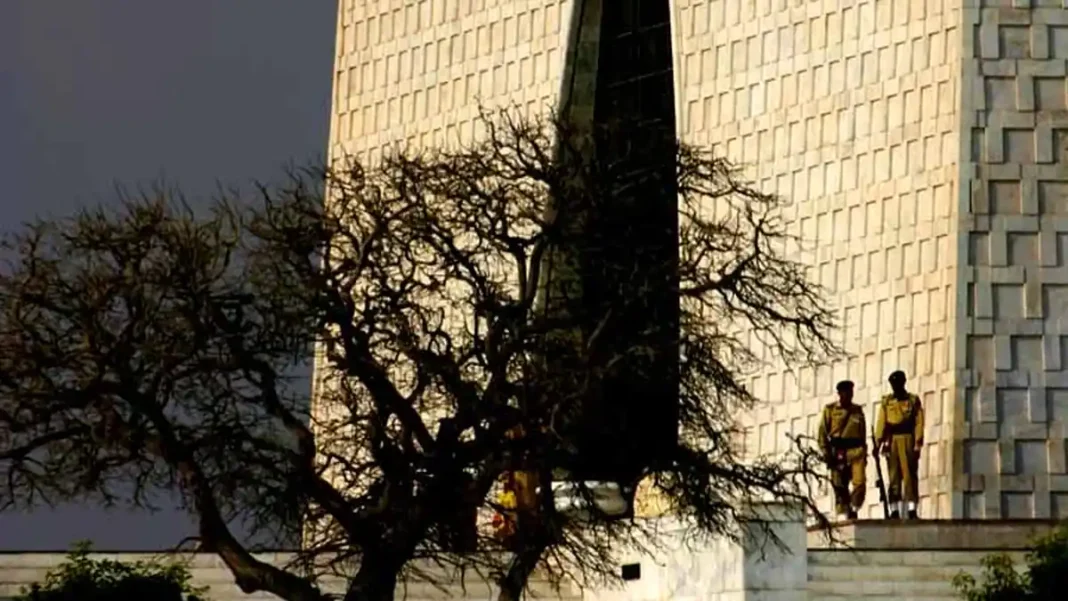
- Mazar-e-Quaid: the mausoleum of Muhammad Ali Jinnah — the founder who chose Karachi as the first capital — remains the city’s defining monument.
- Frere Hall: the 1865 colonial landmark that anchored the capital-era city’s civic life.
- Empress Market and Merewether Tower: commercial landmarks of the capital years, still standing in Saddar.
- The State Bank building: a reminder that the country’s central bank was born in the first capital.
After the Capital: 1959 to Today
When the government moved to Rawalpindi in 1959 and then to Islamabad in 1967, Karachi lost its federal status but kept its economic crown. Today it is Pakistan’s largest city — with a metropolitan population exceeding 18 million — its busiest port, the home of the Pakistan Stock Exchange, and the country’s largest taxpayer. The full three-capital journey is told on our first capital of Pakistan pillar, including when Islamabad became the capital.
Frequently Asked Questions
What was the 1st capital of Pakistan?
Karachi was the first capital of Pakistan, from independence in 1947 until 1959, when the government moved to Rawalpindi.
Who made Karachi the capital of Pakistan?
Muhammad Ali Jinnah, the founder of Pakistan, selected Karachi as the first capital. He was himself born in the city.
Why is Karachi called the economic capital?
Because it hosts Pakistan’s largest port, the stock exchange, the State Bank headquarters and the biggest concentration of industry and tax revenue — the economic functions it kept after losing political capital status.
When did Karachi stop being the capital?
The government left Karachi in 1959 for Rawalpindi. Karachi’s special federal status as the Federal Capital Territory ended in 1970, when it was merged into Sindh.
. Why Jinnah chose it, the Federal Capital Territory era, and the city's legacy as economic capital.)