

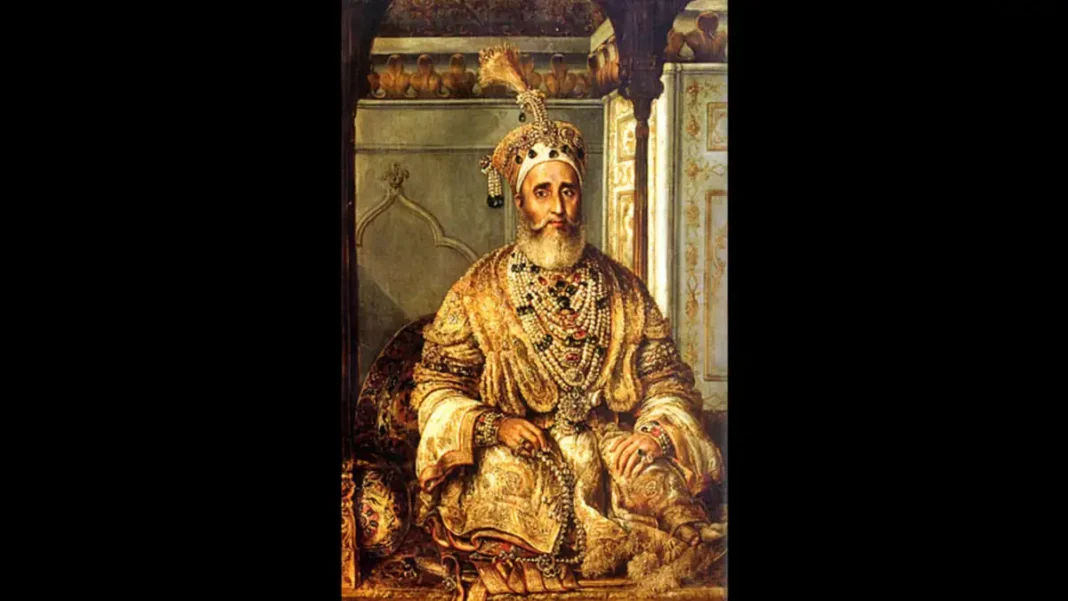
On 10 May 1857, sepoys of the East India Company’s army mutinied at Meerut, marched to Delhi, and proclaimed the aged Mughal emperor Bahadur Shah Zafar their leader. Within weeks the revolt — remembered in Pakistan as the War of Independence — had spread across northern and central India. Fourteen months later it was crushed, but nothing in the subcontinent was ever the same: the Company was abolished, the Crown took direct rule, and the Muslim community entered the darkest century of its political life.
Quick answer: The War of Independence (10 May 1857 – mid-1858) began as a sepoy mutiny at Meerut over greased cartridges and exploded into a mass uprising across northern India. It failed for lack of unity, leadership and modern arms, and its defeat ended both Mughal rule and the East India Company — the British Crown assumed direct control through the Government of India Act 1858.
In this guide
Causes of the 1857 uprising
The revolt had political, economic, religious and military roots that had been building for decades:
- Political: Lord Dalhousie’s Doctrine of Lapse annexed princely states — Satara, Jhansi, Nagpur — whenever a ruler died without a natural heir. The annexation of Oudh in 1856 on grounds of misgovernment was the final provocation; its disbanded soldiers and displaced nobles became the revolt’s backbone.
- Economic: British land settlements ruined the old landed aristocracy, while Indian artisans were destroyed by machine-made British imports. The wealth drain to Britain bred deep resentment.
- Religious: Missionary activity, the Widow Remarriage Act and rumours of forced conversion convinced both Hindus and Muslims the British meant to destroy their faiths.
- Military — the spark: the new Enfield rifle’s cartridges were greased with cow and pig fat, offensive to Hindu and Muslim sepoys alike. When 85 sepoys at Meerut refused them on 9 May 1857 and were shackled, their comrades rose the next morning — 10 May 1857.
How the revolt unfolded
The Meerut mutineers marched 60 km to Delhi, where Bahadur Shah Zafar — 82 years old and powerless — was proclaimed emperor. The revolt spread like fire: Lucknow under Begum Hazrat Mahal, Kanpur under Nana Sahib, Jhansi under Rani Lakshmibai, Bareilly under Khan Bahadur Khan. For months the British lost control of the entire Gangetic plain. But Delhi fell in September 1857, Lucknow in March 1858, and by mid-1858 the last resistance was crushed. Bahadur Shah Zafar was tried, exiled to Rangoon, and died there in 1862.
Why it failed
Historians agree on the reasons: there was no central leadership or common plan — each centre fought its own war. The rebels had no modern arms or artillery against British rifled guns and the telegraph. Crucially, large parts of India — Punjab, Sindh, most of the south — stayed loyal or neutral, and the Sikhs and Gurkhas fought for the British. The revolt was a heroic explosion, not an organised national war.
Results and consequences
- End of Company rule: the Government of India Act 1858 transferred power to the Crown; a Viceroy replaced the Governor-General.
- Queen’s Proclamation (1 November 1858): promised equal treatment, religious non-interference and Indian entry into government service.
- Muslims punished most: the British held Muslims chiefly responsible; confiscations, executions and exclusion from jobs crushed the community — the trauma Sir Syed Ahmed Khan spent his life repairing.
- Army reorganised: the British raised the proportion of British to Indian soldiers and recruited along “martial race” lines, favouring Punjabis, Pathans and Gurkhas.
The road from 1857’s ashes to 1947 runs through the Aligarh Movement and the Pakistan Movement — see our complete 1857–1947 timeline and the Two-Nation Theory.
Frequently asked questions
When did the War of Independence 1857 start and end?
It began with the Meerut mutiny on 10 May 1857 and was effectively crushed by mid-1858, with Delhi recaptured in September 1857 and Lucknow in March 1858.
Who was the leader of the 1857 War of Independence?
There was no single leader. Bahadur Shah Zafar was proclaimed emperor at Delhi as a figurehead; regional leaders included Nana Sahib (Kanpur), Rani Lakshmibai (Jhansi), Begum Hazrat Mahal (Lucknow) and Khan Bahadur Khan (Bareilly).
What was the immediate cause of the 1857 revolt?
The greased cartridges of the new Enfield rifle — rumoured to contain cow and pig fat — offended the religious sentiments of Hindu and Muslim sepoys and triggered the Meerut mutiny.
What were the results of the War of Independence?
The East India Company was abolished, the British Crown took direct rule (1858), Mughal rule ended with Zafar’s exile, and Muslims faced severe British reprisals that set back the community for decades.