


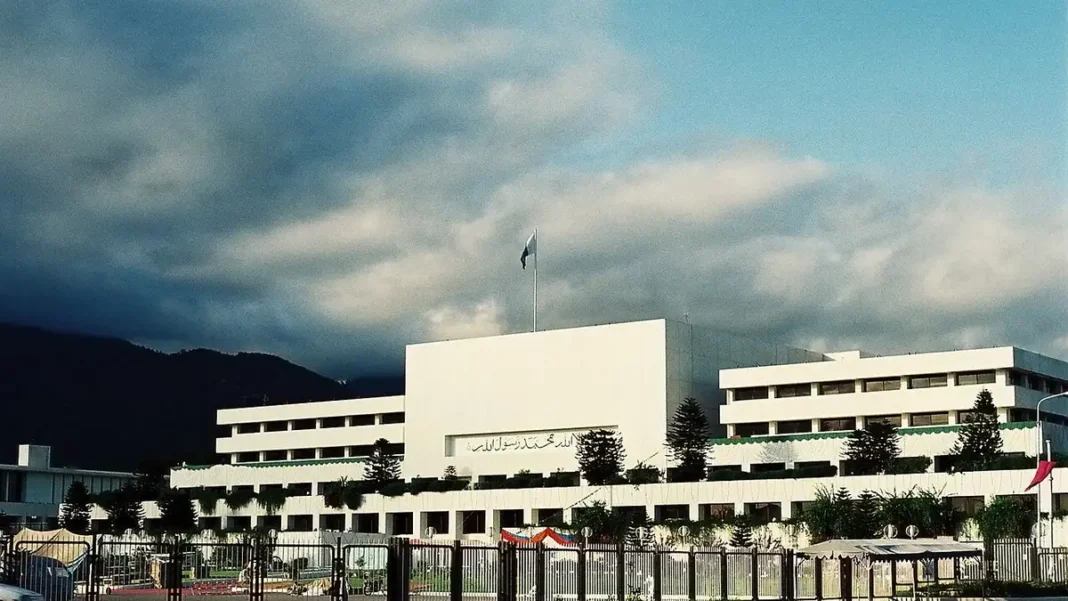
No Pakistani has been prime minister more often than Mian Muhammad Nawaz Sharif — three separate terms across three decades, each ending in removal, none completing five years. His record runs from the economic liberalisation of the 1990s to the 1998 nuclear tests that made Pakistan an declared nuclear power. This guide walks through every term: what he built, what broke, and why a fourth never happened.
Quick answer: Nawaz Sharif was Pakistan’s prime minister three times: 6 November 1990 – 18 July 1993 (dismissed by the president), 17 February 1997 – 12 October 1999 (overthrown by General Musharraf’s coup) and 5 June 2013 – 28 July 2017 (disqualified by the Supreme Court in the Panama Papers case). His signature legacies are the 1998 nuclear tests, the motorway network and CPEC’s launch.
In this guide
First Term (1990–1993): The Youngest Prime Minister
Nawaz took office on 6 November 1990 aged just 40, at the head of the Islami Jamhoori Ittehad. His government pushed privatisation and economic liberalisation — selling state enterprises, opening banking to the private sector — and began the Lahore–Islamabad motorway vision. But Pakistan’s 1990s were the era of the troika wars: in 1993 President Ghulam Ishaq Khan dismissed him under the Eighth Amendment’s infamous Article 58(2)(b). The Supreme Court restored him, only for the army chief to broker the resignation of both men. Term one ended after barely two and a half years.
Second Term (1997–1999): Nuclear Tests and the Coup
The February 1997 election gave Nawaz a two-thirds majority — the “heavy mandate” he used to curb presidential powers via the Thirteenth Amendment. Then came May 1998: after India’s tests, Nawaz authorised Pakistan’s own nuclear tests at Chagai on 28 May 1998 — Youm-e-Takbeer — making Pakistan the world’s seventh declared nuclear power. Sanctions followed, but so did lasting popularity.
The term unravelled over Kargil (1999) and a falling-out with army chief General Pervez Musharraf. When Nawaz tried to sack Musharraf mid-flight on 12 October 1999, the army struck first: a bloodless coup, martial law, and eventually exile to Saudi Arabia for the Sharif family. The man with the heaviest mandate in Pakistan’s history was out in under three years.
Third Term (2013–2017): The Comeback and the Disqualification
After returning from exile in 2007, Nawaz won the 2013 general election — the first transfer of power between two elected governments in Pakistan’s history. The third term delivered his most concrete economic record: CPEC’s launch with China, the end of crippling load-shedding, new motorways and Karachi’s operation against violent crime. GDP growth topped 5%.
It ended not in a coup but a courtroom. The 2016 Panama Papers leak triggered a Supreme Court case, and on 28 July 2017 a five-judge bench disqualified him for life from public office over undeclared receivable income from his son’s company. He left office the same day — the first Pakistani PM removed by judicial disqualification.
Why There Was No Fourth Term
After his return on 21 October 2023 and swift acquittals, Nawaz campaigned as the PML-N’s prime-ministerial candidate for the February 2024 elections. But the party fell well short of a majority, and coalition arithmetic — plus the establishment’s comfort level — pointed to Shehbaz Sharif, the younger brother with a reputation as an administrator. Nawaz accepted the PML-N presidency instead (28 May 2024). At 76, the three-time premier now rules his party rather than the country — the full story of that transition is in our main guide: Nawaz Sharif: Pakistan’s Three-Time Ex-Prime Minister.
Frequently Asked Questions
How many times was Nawaz Sharif prime minister?
Three times — 1990–93, 1997–99 and 2013–17. No other Pakistani has been elected prime minister three times.
What is Nawaz Sharif’s biggest achievement as PM?
Most historians cite the 28 May 1998 nuclear tests, which made Pakistan a declared nuclear power, alongside the motorway network and the launch of CPEC. Critics point to the repeated clashes with state institutions that cut every term short.
Why was Nawaz Sharif disqualified in 2017?
The Supreme Court disqualified him on 28 July 2017 in the Panama Papers case, ruling he was not “honest and trustworthy” (Articles 62–63) over undeclared income — ending his third term without completing it.
Who replaced Nawaz Sharif as prime minister each time?
After 1993 came caretaker setups and Benazir Bhutto; after the 1999 coup, General Musharraf ruled as chief executive; after the 2017 disqualification, Shahid Khaqan Abbasi served as PML-N’s stopgap premier until the 2018 elections.
Related Guides
- Nawaz Sharif: Pakistan’s Three-Time Ex-Prime Minister — the complete story, from Lahore to London and back
- When Nawaz Sharif Came to Pakistan — the full story of the 21 October 2023 return
- Shehbaz Sharif — the brother who became prime minister in 2024 instead
- Shehbaz Sharif: Profile & Biography — the administrator who took the fourth-term slot
. His record, the 1998 nuclear tests, the fall — and why no fourth term.)