The Partition of India in 1947 was the division of British India into two independent nations — India and Pakistan — and one of the defining events of the twentieth century. This explainer covers the causes, how the border was drawn, the human cost, and the aftermath that still shapes South Asia. For Pakistan’s side of the story, see how Pakistan was created and our pillar guide to the Partition of India and Pakistan.
Quick answer: The Partition of India (August 1947) divided British India into India and Pakistan under the Mountbatten Plan (3 June 1947) and the Indian Independence Act. The Radcliffe Line border — drawn in five weeks by Cyril Radcliffe, who had never visited India — was published on 17 August 1947. About 14–15 million people were displaced and an estimated 200,000 to 2 million died.
In this guide:
The Causes
Three forces converged. First, the Two-Nation Theory: the Muslim League’s claim, pressed by Jinnah from the 1940 Lahore Resolution, that Muslims and Hindus were two nations requiring separate homelands — vindicated, in the League’s eyes, by its sweep of Muslim seats in the 1946 elections. Second, communal breakdown: the Calcutta killings of Direct Action Day (August 1946) and spreading violence convinced many that coexistence had failed. Third, British exhaustion: drained by war, Britain wanted out; Mountbatten’s 3 June 1947 plan offered partition on a seventy-three-day timetable, and the Indian Independence Act (royal assent 18 July 1947) made it law. Congress leaders, who had long opposed division, accepted it as the price of a swift British exit.
Drawing the Border
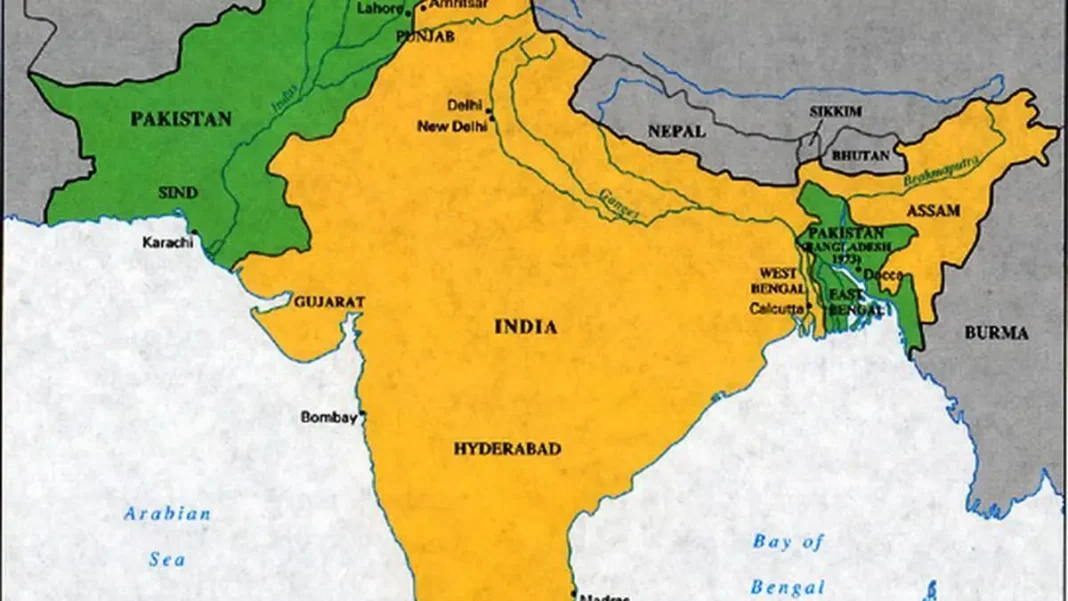
The border was drawn by Sir Cyril Radcliffe, a British judge who had never been to India, chairing boundary commissions for Punjab and Bengal. He arrived on 8 July 1947 with five weeks to divide provinces of tens of millions. The principle was religious demography — Muslim-majority areas to Pakistan, the rest to India — with “other factors” permitted. The award, published 17 August 1947 (after both independences), split Lahore to Pakistan and Amritsar to India, divided Bengal into West Bengal (India) and East Bengal/East Pakistan, and left controversies — Gurdaspur and Ferozepur going to India after Mountbatten’s intervention — that echo in the Kashmir dispute today. Radcliffe later admitted two to three years would have been a realistic timetable.
The Human Cost
Partition displaced 14–15 million people — the largest forced migration in recorded history. The 1951 census counted 7.226 million Muslims moving to Pakistan and 7.249 million Hindus and Sikhs moving to India. The death toll is bitterly uncertain: estimates run from 200,000 to 2 million, with around one million most commonly cited. Refugee trains were massacred; cities like Lahore and Amritsar were emptied and refilled by faith. Some 100,000 women were abducted or assaulted. Both new governments spent years on recovery and rehabilitation programmes — and on the refugee politics that followed.
The Aftermath
Partition’s aftershocks never stopped. The princely states — 565 of them, outside the Radcliffe scheme — produced the Kashmir dispute (the Maharaja’s October 1947 accession to India, three wars since), Hyderabad’s absorption by Operation Polo (1948) and Junagadh’s plebiscite. Pakistan itself split in 1971, when East Pakistan became Bangladesh — a second partition along linguistic, not religious, lines. The Radcliffe Line hardened into one of the world’s most militarised borders, and Partition’s refugees — the muhajirs of Karachi, the displaced of Delhi and Lahore — carried its memory into the politics of three nations. For the constitutional settlement that followed in Pakistan, see our 1973 Constitution guide.
FAQs
What caused the Partition of India?
The Two-Nation Theory and the Muslim League’s demand for Pakistan, the breakdown of Hindu-Muslim relations (notably the 1946 Calcutta killings), and Britain’s rushed withdrawal under the Mountbatten Plan of 3 June 1947.
When was the Radcliffe Line announced?
17 August 1947 — two days after India’s independence and three days after Pakistan’s. Both nations celebrated independence without knowing their borders.
How many people were displaced by Partition?
14–15 million — the largest forced migration in recorded history, with 7.226 million Muslims entering Pakistan and 7.249 million Hindus and Sikhs leaving (1951 census).
Did Partition cause the Kashmir conflict?
Indirectly, yes: Kashmir was a princely state outside the Radcliffe scheme. Its ruler’s disputed October 1947 accession to India created a conflict that has lasted ever since.
Related Guides
- Partition of India and Pakistan — the pillar guide: causes, timeline, the line, migration, legacy
- Pakistan Partition — how Pakistan was created on 14 August 1947
- 1st Capital of Pakistan — Karachi’s years as the nation’s capital
- Constitution of Pakistan 1973 — the legal settlement that followed