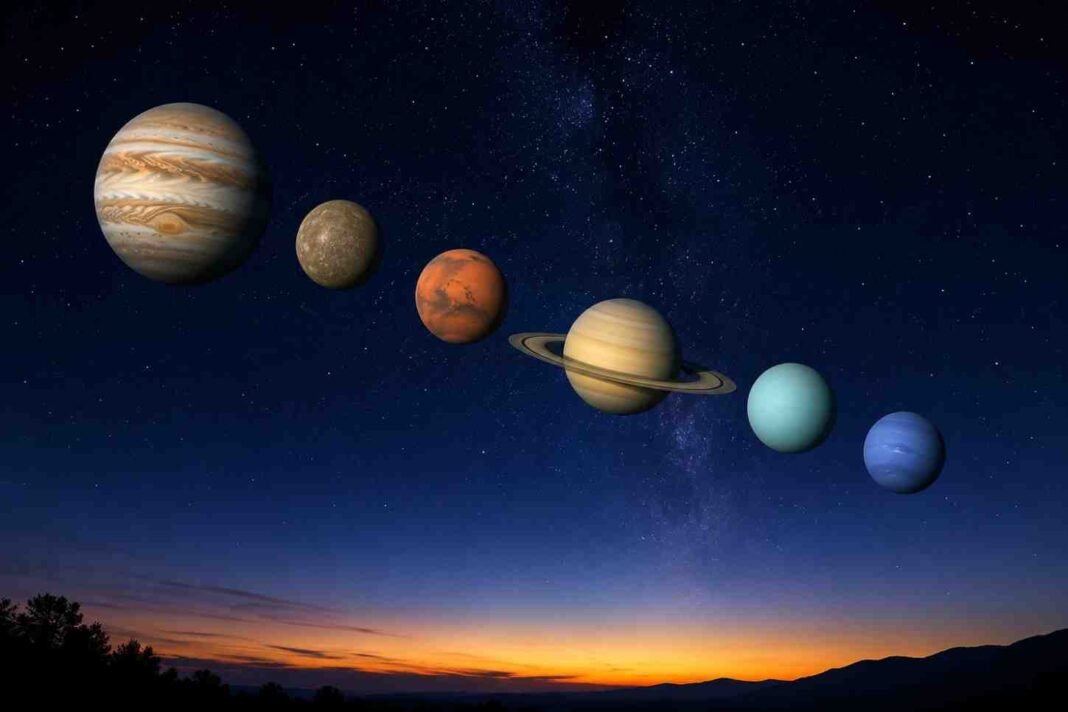
Skywatchers and astronomy lovers have an exciting reason to look toward the heavens on August 12, 2026. A rare celestial display will bring six planets into the same broad section of the morning sky before sunrise.
The event, known as the Six Planet Parade, will feature Jupiter, Mercury, Mars, Saturn, Uranus, and Neptune. Observers can find the planets stretching across the sky in a wide arc rather than forming a perfectly straight line.
However, viewers should not expect to see all six planets easily with the naked eye. Brightness, distance, morning twilight, and each planet’s position near the horizon will affect visibility.
The best viewing opportunity will come shortly before sunrise. Therefore, astronomy enthusiasts should choose a location with a clear horizon and as little artificial light as possible.
During the Six Planet Parade, Mars and Saturn should offer some of the easiest targets for observers. Their brightness and position will make them more noticeable than some of the other planets.
Mercury will present a greater challenge because it will sit relatively close to the horizon. Moreover, the approaching sunrise could make the small planet harder to distinguish against the brightening sky.
Jupiter may also require careful observation despite its natural brightness. Morning light and its position near the horizon could reduce the amount of time available to spot it clearly.
Meanwhile, Uranus and Neptune will create an additional challenge for casual observers. Uranus generally requires binoculars or other suitable optical equipment, while Neptune normally requires a telescope for successful observation.
Interestingly, Venus will not join this particular planetary gathering. Therefore, the six planets attracting attention will remain Jupiter, Mercury, Mars, Saturn, Uranus and Neptune.
The Six Planet Parade will stretch across a broad area of the sky. Observers should begin by looking toward the eastern horizon before following the apparent planetary arc across the morning sky.
However, viewing conditions will differ significantly from one location to another. Local sunrise time, cloud cover, atmospheric conditions, surrounding buildings, and the visibility of the horizon can all influence the experience.
For this reason, observers should find an open location before the viewing window begins. A rooftop, open field, or another safe area with an unobstructed horizon can provide a better chance of spotting several planets.
Clear skies will also play an important role. Clouds or haze near the horizon could hide Mercury or Jupiter even when other planets remain visible higher in the sky.
Meanwhile, people should remember that a planetary alignment does not mean the planets physically form a straight line in space. Instead, observers on Earth see several planets appearing within the same broad region of the sky.
The Six Planet Parade offers an interesting opportunity for beginners to learn more about the night and morning sky. Even people without telescopes may enjoy identifying Mars or Saturn before daylight becomes too strong.
Those with binoculars can attempt to locate Uranus under favorable conditions. Meanwhile, telescope users can add Neptune to their list and potentially experience a more complete view of the planetary gathering.
Timing will remain particularly important for Mercury and Jupiter. Observers who start too late could lose these planets in the bright morning twilight as the Sun approaches the horizon.
Therefore, skywatchers should prepare before sunrise and allow their eyes some time to adjust. Astronomy applications and sky maps can also help users identify where individual planets should appear from their specific location.
Still, experts do not expect every observer to locate all six planets. Weather, equipment, and local visibility can easily limit the number of planets that someone manages to identify.
Even spotting two or three planets can make the Six Planet Parade a memorable experience. Mars and Saturn may provide the most practical starting points for people observing the event without specialized equipment.
Photography enthusiasts may also try to capture the morning sky, although the planets will vary greatly in brightness. A clear horizon and stable camera setup can improve the chances of recording the wider celestial scene.
At the same time, observers should never point binoculars or telescopes toward the Sun once it rises. They should complete planetary observations before sunrise unless they use professionally designed solar-viewing equipment.
The event gives families, students, and astronomy enthusiasts another reason to explore the sky. It also demonstrates how the movements of planets can create striking viewing opportunities from Earth.
Ultimately, the Six Planet Parade on August 12, 2026, promises an impressive start to the day for people who wake up early enough. Clear skies, careful timing, and the right viewing location will offer the best chance to enjoy the celestial display.