The 9th class result in Punjab has raised serious questions about the quality of education in Pakistan’s largest province. Thousands of students have failed, but blaming those children alone would be a serious mistake.
The results tell a much bigger story.
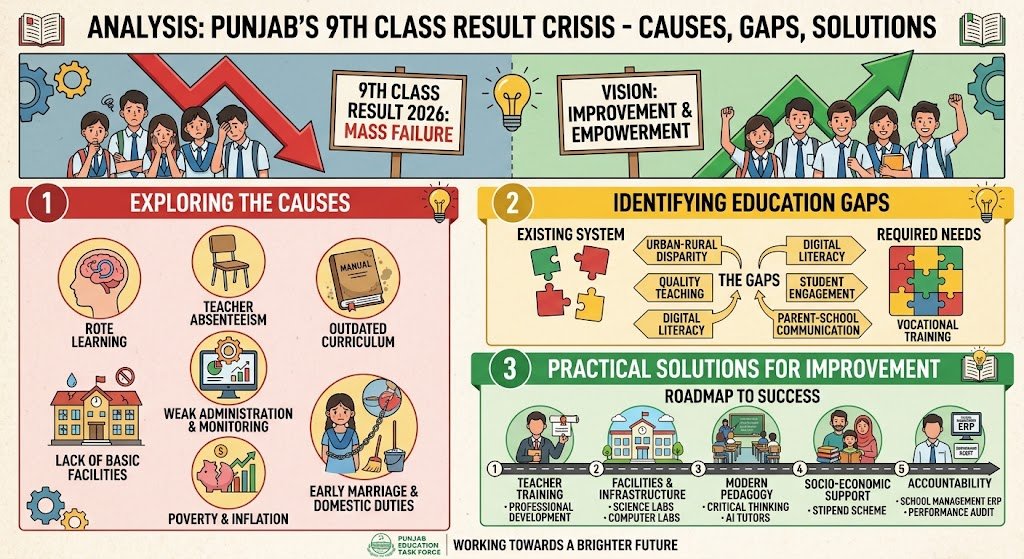
They expose weaknesses that begin long before a student enters the examination hall. Poor learning foundations, weak teaching methods, inadequate school facilities and an examination-focused culture all contribute to the problem.
Punjab now needs to ask an uncomfortable question. Are students failing the education system, or is the education system failing its students?
9th Class Result in Punjab Shows a Serious Problem
The latest results provide enough reason for concern.
Rawalpindi Board reported that 121,739 candidates appeared in the 2026 Class 9 annual examination. Only 45,724 succeeded, producing a pass rate of 37.56%.
That means around 63% of candidates failed.
The provincial picture also remained disappointing. Available comparative figures put the overall success rate across Punjab boards at around 45.17%.
Lahore Board showed a similar problem. Around 46% of candidates passed its Class 9 examinations.
These numbers should concern parents, teachers and policymakers.
However, one result cannot explain the entire quality of an education system. Board examinations measure student performance under a particular syllabus, paper pattern and marking system.
Therefore, Punjab must examine both classroom learning and examination quality.
Government and Private Schools Show a Major Gap
One of the most worrying parts of the 9th class result in Punjab is the difference between public and private institutions.
According to figures reported after the Rawalpindi results, government institutions recorded a success rate of 30.82%. Private affiliated institutions, in comparison, recorded 60.41%.
Gujranwala showed another significant difference.
Reported figures put government institutions at 39.59%, compared with 69.71% for private and non-government institutions.
These figures do not prove that every private school provides good education or every government school performs poorly.
They do, however, demand investigation.
Why can two students studying essentially the same curriculum experience completely different learning environments?
The answer starts much earlier than Class 9.
Weak Foundations Create Problems Years Later
A student does not suddenly become weak in mathematics in the ninth grade.
Learning gaps often start in primary school.
If a child reaches Grade 6 without understanding fractions, basic multiplication or division, secondary-level mathematics becomes extremely difficult.
The same problem affects English.
A student who struggles to understand a simple paragraph cannot suddenly master complex grammar, comprehension and textbook concepts just because the student enters secondary school.
This creates a dangerous pattern.
Students continue moving from one class to another while their learning gaps grow.
Eventually, they face a board examination that exposes those gaps.
The Class 9 result therefore reflects more than one year of education. In many cases, it represents weaknesses accumulated over several years.
Research Already Warns About Learning Quality
The warning signs did not appear overnight.
World Bank documentation on education in Punjab highlights significant learning challenges at earlier levels.
National Achievement Test data cited by the World Bank showed weaknesses in mathematics, English and science. Grade 8 students, for example, recorded very low average scores in mathematics and science.
The same assessment also identified weak classroom teaching practices as a major contributor to poor learning.
This matters because Class 9 students depend heavily on skills developed before secondary school.
If those foundations remain weak, teachers in Class 9 face an almost impossible task. They must teach new concepts while simultaneously repairing years of previous learning gaps.
Punjab therefore cannot solve the problem by focusing only on ninth-grade teachers.
Reform must start from the earliest years of education.
Poor School Infrastructure Still Matters
A good education system requires more than books and examinations.
Students need classrooms where they can actually learn.
Schools require safe buildings, functional toilets, clean drinking water, electricity, furniture, laboratories and appropriate learning materials.
Digital access has also become increasingly important.
A science student should not learn every experiment only through a textbook.
Students understand concepts better when they can observe, test and apply them.
Likewise, computer education loses much of its purpose when students memorize definitions without regularly using computers.
Infrastructure alone cannot guarantee good results.
However, poor infrastructure makes effective teaching considerably harder.
Imagine studying during extreme summer temperatures in an overcrowded classroom with unreliable electricity.
Now imagine trying to understand physics, chemistry or mathematics in that environment.
The student’s concentration will naturally suffer.
Punjab must therefore treat school infrastructure as part of learning policy rather than a separate construction issue.
Teachers Need Support, Not Only Punishment
Whenever examination results fall, authorities often look for someone to blame.
Teachers become an easy target.
Accountability certainly matters. A teacher who consistently neglects students should face appropriate action.
However, punishment cannot become Punjab’s main education policy.
Teachers need modern professional development, subject-specific training and practical classroom support.
Teaching methods have changed around the world.
Students learn more effectively when teachers encourage understanding, discussion, problem-solving and application.
Unfortunately, rote learning still dominates many classrooms.
A teacher explains a question.
Students memorize the answer.
The same material appears in a test.
Students reproduce it.
That process may generate marks, but it does not necessarily create understanding.
The weakness becomes obvious when an examination asks the same concept differently.
Students who memorized words often struggle to apply the idea.
Punjab needs teachers who teach students how to think, not simply what to memorize.
Zero-Result Schools Demand Special Attention
The problem becomes even more alarming when an entire school fails to produce a successful candidate.
Punjab’s School Education Department has sought information about government schools reporting zero-percent Class 9 results.
Within the Rawalpindi Board area alone, reports identified 184 schools with zero-percent results, including 81 government schools.
This cannot be treated as normal educational variation.
When every Class 9 student at a school fails, authorities need to investigate the institution from top to bottom.
Does the school have enough subject teachers?
Were teachers regularly present?
Did students receive textbooks on time?
Does the school have functioning science facilities?
How many classes did students actually attend?
Did administrators identify weak students before the examination?
Were internal assessments meaningful?
What qualifications do teachers have in the subjects they teach?
These questions can reveal the actual problem.
Simply issuing a show-cause notice may create fear, but it will not automatically improve mathematics or science instruction.
Punjab needs school-level diagnosis before punishment.
The Examination System Also Needs an Audit
Schools should not carry the entire blame.
Educationists and school associations have also raised questions about paper setting, marking standards and assessment policies following the latest results.
Rawalpindi’s particularly low pass rate makes that discussion important.
If one board repeatedly produces substantially different outcomes, authorities should investigate why.
Punjab needs consistent assessment standards across its education boards.
That does not mean authorities should make papers easier simply to increase pass percentages.
Artificially increasing results would hide the problem rather than solve it.
Instead, examinations should test what students were actually expected to learn.
Paper difficulty, syllabus alignment and marking standards should remain transparent and consistent.
A credible examination system must measure learning fairly.
Rote Learning Has Become a Major Weakness
Pakistan’s education culture remains heavily dependent on memorization.
Students often ask one question before an examination:
“What is important for the paper?”
That question reveals the problem.
Education should make students curious about concepts. Instead, many students focus almost entirely on predicting examination questions.
Guess papers reinforce this behaviour.
Selective study makes it worse.
Academies sometimes encourage students to prepare only frequently repeated questions.
Students may pass under such a system, but their actual understanding remains limited.
The solution requires changing both teaching and examinations.
Questions should reward reasoning, understanding and application.
Once students know that memorizing five pages cannot guarantee high marks, their learning habits will gradually change.
Overcrowded Classrooms Reduce Individual Attention
Class size also matters.
One teacher cannot easily provide individual attention to a large number of students with different learning levels.
Some children understand a concept immediately.
Others need another explanation.
A few may require one-to-one support.
In an overcrowded classroom, teachers often have little choice but to move forward after explaining the topic once or twice.
Weak students then fall behind.
The next chapter builds on the previous one, so the learning gap becomes larger.
By examination time, some students have lost confidence completely.
Punjab should identify schools with extreme student-to-teacher ratios and prioritize additional teachers for those institutions.
Teacher Shortages Must Be Addressed
A school building cannot teach a child.
Teachers do.
Punjab therefore needs enough qualified teachers in the right subjects and locations.
Science subjects require teachers who understand science.
Mathematics needs competent mathematics teachers.
English requires teachers with strong language skills.
Posting a teacher simply to fill an administrative vacancy does not solve the learning problem.
Recruitment should focus on actual subject needs at the school level.
Rural schools deserve particular attention because attracting and retaining qualified teachers can prove more difficult there.
Digital learning can support teachers in such areas, but technology cannot completely replace a capable classroom instructor.
Students Need Remedial Learning Before Class 9
One of the most practical reforms would involve identifying learning gaps before students reach secondary board examinations.
Punjab could conduct diagnostic assessments at the beginning of Grades 6, 7, 8 and 9.
These tests should not punish students.
Instead, they should identify weaknesses.
If a Grade 8 student still struggles with Grade 5 mathematics, the school should know immediately.
Teachers could then provide remedial classes.
The same model could help students struggling with reading, English grammar and science concepts.
Waiting until the Class 9 board result arrives is too late.
At that point, the system is measuring failure instead of preventing it.
Parents Also Have an Important Role
Schools carry the main responsibility for formal education, but parents remain important partners.
Many parents only become deeply involved when board examinations approach.
By then, learning problems may have existed for years.
Parents should monitor attendance, homework and academic progress regularly.
They do not need advanced education themselves to ask basic questions.
Is my child attending school?
Can my child explain what was taught today?
Which subject creates the greatest difficulty?
Has the teacher raised any concerns?
Does my child spend excessive time on a phone?
Simple involvement can make a meaningful difference.
Schools should also communicate with parents before a student reaches the point of failure.
Smartphones Are Both a Tool and a Distraction
Modern students live in a completely different information environment from previous generations.
A smartphone can provide access to excellent educational material.
Students can watch mathematics explanations, science demonstrations and language lessons.
However, the same device can consume hours through short videos, gaming and social media.
Schools and parents should teach digital discipline rather than simply declaring technology harmful.
Students need to learn how to use digital tools for education.
Punjab can also create high-quality digital lessons aligned with the provincial curriculum.
A child in a remote village should be able to access the same explanation of algebra as a child in Lahore.
Technology can reduce educational inequality when authorities use it intelligently.
Mental Pressure Cannot Be Ignored
Poor results also affect students emotionally.
A child who fails Class 9 may feel ashamed, frightened or hopeless.
Parents must handle this situation carefully.
Failure in an examination does not define a student’s intelligence or future.
At the same time, schools should provide academic counselling for struggling students.
Teachers need to identify whether poor performance comes from weak understanding, irregular attendance, family difficulties, lack of motivation or another problem.
Different causes require different solutions.
Humiliating students rarely improves learning.
A supportive recovery plan can.
Stop Measuring Schools Only Through Pass Percentages
Punjab also needs a smarter accountability system.
A school’s pass percentage matters, but it should not become the only measurement of quality.
Authorities should track student learning growth.
Suppose a student enters Grade 8 with extremely weak mathematics skills and improves substantially by the end of Grade 9 but narrowly fails the board examination.
The school still achieved meaningful progress.
Conversely, a selective school might admit only strong students and report excellent results without adding much educational value.
Punjab should therefore measure improvement, attendance, teaching quality, facilities and student learning alongside board results.
That would create a fairer picture.
Government Schools Need Stronger Leadership
School leadership can transform educational performance.
A capable headteacher does more than sign documents.
Good school leaders monitor classrooms, support teachers, track student performance and communicate with parents.
They identify problems before those problems become crises.
Punjab needs to professionalize this role.
Headteachers should receive management and instructional leadership training.
Promotion based only on seniority cannot guarantee strong leadership.
Schools are complex organizations.
Their leaders need the skills to manage them.
Punjab Needs a School Performance Dashboard
Technology could make reform more transparent.
The Punjab government should develop a public performance dashboard for schools.
It could show examination trends, teacher availability, student attendance, infrastructure status and learning indicators.
Officials could identify struggling schools quickly.
Parents would gain greater transparency.
Most importantly, policymakers could direct resources toward institutions that need them most.
Data already exists in different parts of the education system.
Punjab needs to use that information for decisions rather than simply collecting it for reports.
Education Funding Must Reach the Classroom
More money alone will not automatically create better education.
How the government spends that money matters just as much.
Funding should prioritize interventions that directly improve learning.
Teacher development deserves investment.
Basic school infrastructure requires attention.
Science laboratories need equipment.
Libraries need useful books.
Students with learning gaps need remedial programmes.
Headteachers need management support.
Digital resources should reach underserved communities.
Every major education programme should answer a simple question:
How will this improve what a child learns inside the classroom?
If policymakers cannot answer that question, they should reconsider the spending.
What Punjab Should Do Now
The 9th class result in Punjab should become a trigger for reform rather than another temporary controversy.
First, the government should conduct an independent analysis of results across all Punjab boards.
Officials need to identify subjects with unusually high failure rates.
Next, authorities should examine the difference between public and private institutions without turning the exercise into a political blame game.
Zero-result schools require immediate academic audits.
At the same time, Punjab should test students before they enter Class 9 and provide remedial education to those who lack foundational skills.
Teacher training should shift toward practical classroom methods.
The government also needs to fill critical subject-teacher vacancies and improve infrastructure in schools where learning conditions remain poor.
Assessment reform must happen alongside these changes.
Board examinations should test understanding while maintaining fair and consistent standards.
Finally, local education officials should face accountability for persistent failure.
Responsibility cannot stop with teachers.
Punjab Must Fix the System, Not Hide the Numbers
The disappointing 9th class result in Punjab should not lead to easier examinations simply to produce attractive statistics next year.
Punjab needs better learning, not better-looking numbers.
Reducing examination standards would only push poorly prepared students into the next class.
Eventually, those students would enter colleges, universities and the labour market without the skills they need.
The cost would then become much larger.
Education shapes productivity, employment, innovation and social mobility.
A weak school system eventually creates a weak workforce.
That makes the Class 9 results an economic issue as much as an educational one.
Punjab has millions of talented young people.
The challenge is giving them a system capable of developing that talent.
The latest results have delivered a warning.
Now the government must decide what to do with it.
Parents should demand improvement, teachers should receive the tools and accountability needed to perform better, and policymakers should stop treating examination results as isolated annual events.
Most importantly, Punjab must start measuring education by what children actually learn.
The 9th class result in Punjab may look like a story about failed students.
Look deeper, however, and it becomes a story about classrooms, teachers, infrastructure, assessment, leadership and years of missed learning.
Fix those problems, and the results will eventually improve.
Ignore them, and Punjab will continue announcing disappointing percentages every year while another generation pays the price.