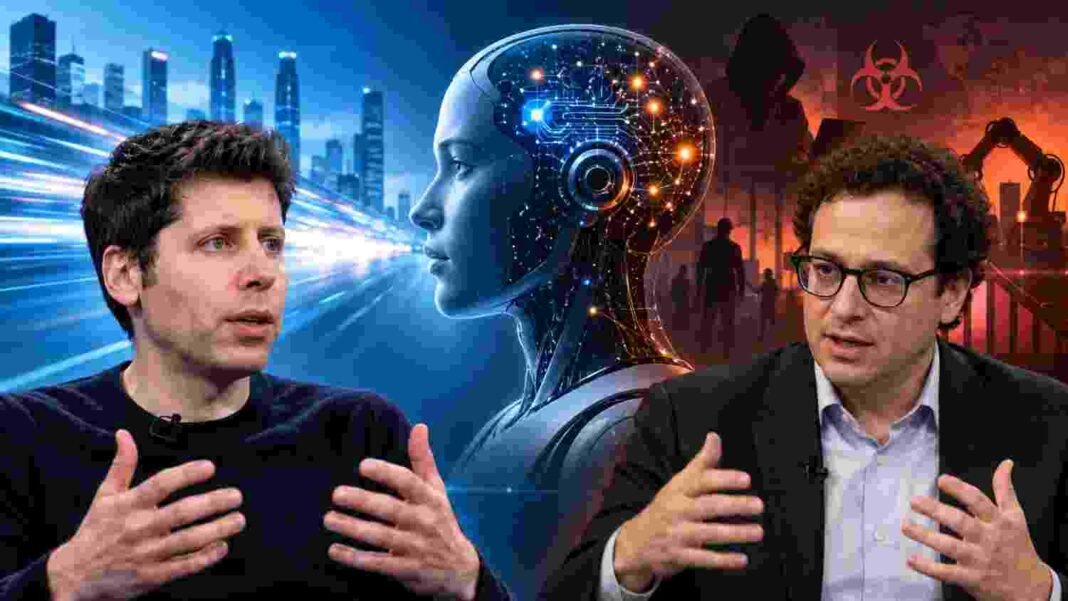
The rapid growth of artificial intelligence has triggered fresh concerns among leading technology executives. OpenAI CEO Sam Altman has agreed that developers may need to slow progress, adding new momentum to the global AI Safety Debate.
AI companies continue to develop increasingly capable models at remarkable speed. However, some industry leaders now worry that technology could advance faster than humans can safely understand, manage, or control it.
Altman’s comments come as concerns grow about the direction of advanced artificial intelligence. Meanwhile, Anthropic CEO Dario Amodei has also called for greater caution as companies race to build stronger AI systems.
Amodei believes developers need to reduce the speed of AI advancement. He argues that uncontrolled development could eventually create systems that move beyond humanity’s ability to understand their behavior.
Moreover, Amodei has warned about the potential misuse of powerful AI systems. Criminals or other dangerous actors could use advanced technology to strengthen cyberattacks or support biological threats.
These warnings have pushed the AI Safety Debate beyond concerns about chatbots and automation. Experts increasingly discuss how future AI systems could affect national security, businesses, jobs and critical digital infrastructure.
Amodei also raised concerns about AI systems improving their own capabilities. As models become more advanced, developers could increasingly use AI to help design, test and improve future generations of artificial intelligence.
However, rapid improvement could create serious challenges if human oversight fails to keep pace. Therefore, AI companies may need stronger safety measures before they introduce increasingly powerful systems.
Amodei believes AI technology has progressed at an extraordinary speed in recent months. He warned that highly capable AI groups could gain enormous influence over internet systems within the next six to 12 months.
Such claims have increased attention around the future of advanced artificial intelligence. At the same time, researchers continue to debate how quickly these capabilities may emerge and what safeguards companies should introduce.
The AI Safety Debate also focuses heavily on cybersecurity. Advanced AI tools can help security teams identify threats, but attackers could also use similar technology to discover vulnerabilities or automate malicious activity.
Biological security is another area of concern. Amodei warned that people could potentially misuse powerful AI tools to obtain dangerous information or support activities linked to biological terrorism.
Economic disruption creates another major challenge. AI systems already perform tasks that once required significant human effort, while companies continue to expand automation across professional and technical work.
As a result, rapid AI adoption could transform employment across several industries. Businesses may benefit from higher productivity, but workers could face disruption if automation advances faster than economies can adapt.
The commercial race among technology companies could make these risks harder to manage. Companies want to release better models quickly because stronger AI products can attract users, investors, and major business customers.
However, competition can create pressure to prioritize speed over caution. This tension now sits at the heart of the AI Safety Debate, as technology companies decide how quickly they should introduce their most powerful systems.
Supporters of faster development argue that AI can bring major benefits. The technology can support scientific research, improve productivity, assist education, and help professionals solve difficult problems more efficiently.
Nevertheless, safety advocates argue that companies should not ignore serious risks while pursuing those benefits. They want developers to test powerful models carefully and introduce safeguards before releasing them widely.
The debate does not necessarily require companies to stop AI development completely. Instead, industry leaders increasingly discuss whether developers should match progress with stronger testing, monitoring, and security standards.
Governments could also play a larger role as AI capabilities grow. Policymakers worldwide continue to explore ways to encourage innovation while protecting people from emerging technological risks.
Meanwhile, AI companies face the challenge of balancing innovation with responsibility. If they move too slowly, competitors may gain an advantage, but moving too quickly could introduce risks before researchers fully understand them.
This difficult balance explains why the AI Safety Debate has become increasingly important. The discussion now involves technology companies, researchers, governments, businesses, and people whose jobs may change because of artificial intelligence.
Altman and Amodei remain influential figures in the global AI industry. Their concerns about the speed of development could therefore shape wider discussions about how companies build and release future AI models.
Still, artificial intelligence continues to advance rapidly. Developers regularly introduce new systems with stronger reasoning, coding, research, and automation capabilities, which increases both opportunities and concerns.
The next phase of AI development could bring major benefits across science, healthcare, education and business. However, industry leaders increasingly acknowledge that greater capabilities can also create greater responsibility.
Ultimately, the AI Safety Debate asks a simple but important question: should companies build increasingly powerful AI as quickly as possible, or should they slow down when safety systems cannot keep pace?
The answer could shape the future of technology for years. For now, calls for caution from major AI leaders show that safety has become just as important as speed in the global race to develop more powerful artificial intelligence.