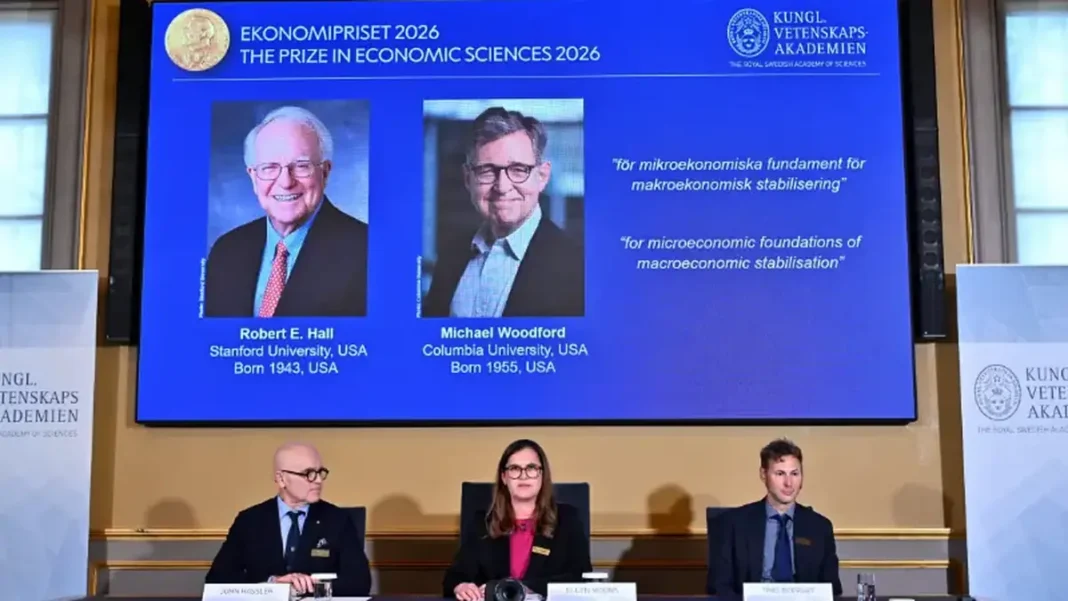
The Nobel economics prize 2026 was awarded on Monday to two American economists, Robert Hall and Michael Woodford. The Royal Swedish Academy of Sciences honoured them for their work on how monetary and fiscal policy can better stabilise sharp swings in the economy.
Hall, 83, is a professor at Stanford University. Woodford, born in 1955, is a professor at Columbia University. The two men built new models for handling recessions and crises that no longer respond to traditional tools.
The jury said that, on the basis of these models, well-timed fiscal and monetary steps can reduce the peaks and troughs of the economy. In practice, that covers the decisions that set interest rates and government spending.
Nobel economics prize 2026: what Hall and Woodford changed
Stabilisation policy has a long history. Ever since John Maynard Keynes set out his theories almost a century ago, officials have tried to boost growth when the economy weakens. For decades, Keynesian models told governments and central banks when to act, and how.
Those models stopped working during the oil shocks of the 1970s. Inflation and stagnation arrived together, and the old rules gave poor guidance. Hall and Woodford were among the economists who went back to first principles.
Rather than build on statistical links between big variables such as inflation, production and consumption, they grounded their models in microeconomics. Their work starts with the total mass of individual households and firms, and with the choices those people and businesses actually make.
One idea sits at the centre of that approach. Households look ahead when they decide whether to spend or to save. Because of that, the way a government or a central bank communicates its policy can shape what people expect, and expectations then shape the economy itself. Clear guidance, in other words, is not decoration. It is part of the policy.
John Hassler, who chairs the prize committee, said the pair’s work has given policymakers a stable theoretical foundation. He noted that the models built on it are now used by central banks and governments around the world.
Woodford, told of the award by phone during the announcement, said he was surprised and elated. He added that his research had not been driven by a political agenda. Instead, he said, it aimed to improve the foundations for discussing economic policy, and to help the public understand it.
Why the work matters beyond Stockholm
The relevance is easy to see from Pakistan. When the State Bank of Pakistan signals the direction of interest rates, firms and households react to the signal as much as to the rate itself. That is exactly the channel Hall and Woodford formalised. Finance Minister Muhammad Aurangzeb made a similar point about confidence and expectations this week, as he forecast growth above 4% and over $1bn from privatisation.
The prize also closes a busy Nobel season. Last week, South African judge Navi Pillay won the 2026 Nobel Peace Prize, a result that drew a sharp reaction from Donald Trump. The medicine prize went to a trio working on optogenetics, while Canadian-Icelandic writer Anne Carson took the literature award. On the same day as the economics announcement, the UN reported that its global poverty index has risen for the first time since 2010, a reminder that stabilisation failures are measured in people’s lives, not only in charts.
The economics award is the odd one out among the Nobels. It was not among the five prizes created in Alfred Nobel’s will. Sweden’s central bank created it in 1968, through a donation. Even so, the Academy selects the winner through the same process it uses for physics and chemistry.
Last year, the prize went to Joel Mokyr, Philippe Aghion and Peter Howitt, for research into how technology drives growth. This year’s laureates will receive a diploma, a gold medal and a cheque for $1.2 million. The formal ceremonies take place on December 10, the anniversary of Nobel’s death in 1896. (Source: Dawn)
Frequently asked questions
Who won the Nobel economics prize 2026?
Robert Hall of Stanford University and Michael Woodford of Columbia University shared the prize. They were honoured for building models, grounded in microeconomics, that help governments and central banks stabilise the economy.
What is stabilisation policy?
It is the use of monetary and fiscal tools, such as interest rates and public spending, to soften recessions and cool overheating. Hall and Woodford showed why expectations, and official communication, are central to whether those tools work.
Is the economics prize one of the original Nobel Prizes?
No. Alfred Nobel’s will created five prizes. The economics prize was added in 1968 through a donation from Sweden’s central bank, although the Royal Swedish Academy of Sciences picks the winner in the same way as for physics and chemistry.