Austria’s headscarf ban for under-14 girls draws protests across the country
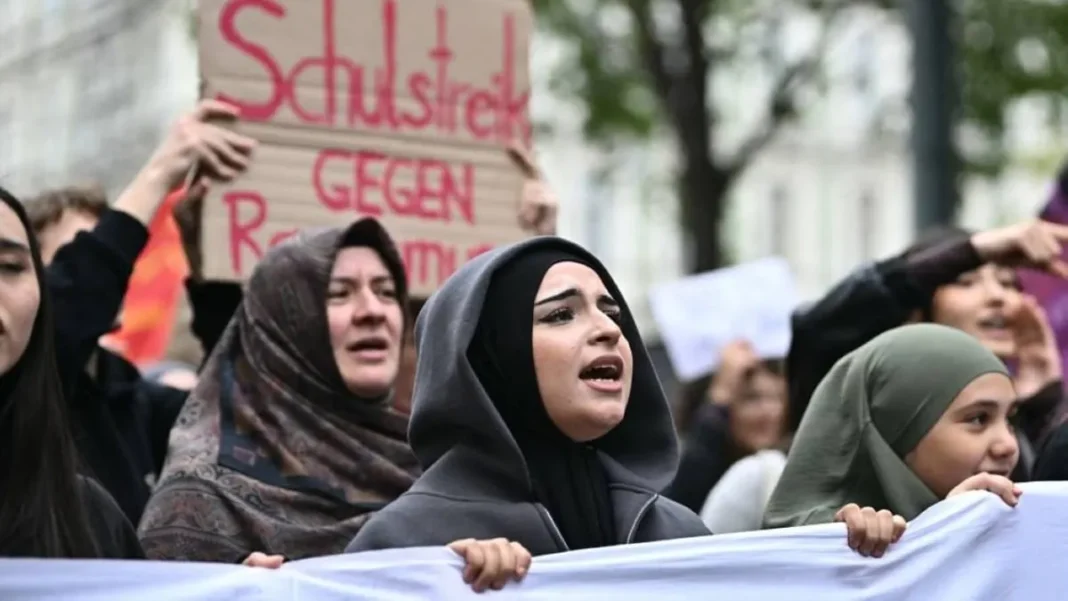
The Austria headscarf ban protests have taken to the streets after a law barring girls under 14 from wearing headscarves took effect on September 1. Several hundred people have gathered at each demonstration, AFP reports, as schoolgirls refuse to comply.
Austria’s conservative-led government says the ban promotes gender equality and protects Muslim girls from segregation and oppression. Critics argue it singles out Muslims, curtails religious freedom, and forces girls to dress in a way that makes them feel uncomfortable.
How the Austria headscarf ban protests began
Since the law came into force, education authorities across the country have held 127 meetings with parents and filed 52 reports over alleged breaches, according to the education ministry. Dozens of pupils have refused to remove their headscarves at school.
Schools cannot punish girls straight away. They must first hold discussions with pupils and parents before referring cases to education authorities, and only persistent parents can ultimately be fined.
Education Minister Christoph Wiederkehr told AFP the small number of meetings showed most families were cooperating, and said discussion had resolved most cases.
Girls and parents push back
At a demonstration in Vienna on October 9, Zehra, 37, who did not want to give her last name, said her daughters, nine and 13, were “sad and angry” about the ban.
“We raise our children by telling them, you can decide who you want to be — and this law is the exact opposite,” she said.
Seham, 12, said she felt afraid to remove her headscarf because she had worn it for two years and it had become part of her identity. Her school allowed an alternative non-traditional head covering, though she said she would rather wear the full headscarf.
Vienna’s education authorities said discussions so far suggested the girls wished to wear headscarves of their own accord. A teacher who has worked with two affected girls told AFP there was no sign they were being forced to wear them.
The Islamic Religious Community in Austria, which backs legal action against the ban, says it has received around 70 reports from families facing difficulties with the restrictions.
“A law that was justified as protecting children’s welfare is putting precisely those children under pressure at school,” the organisation said.
The Constitutional Court has confirmed it received a legal complaint, and a decision is expected in the first half of 2027.
Not Austria’s first attempt to restrict headscarves
Austria has been here before. A coalition between the conservatives and the far-right Freedom Party introduced a ban for primary school pupils in 2019, but the Constitutional Court overturned it, ruling that a regulation targeting only Muslims was incompatible with religious neutrality.
Parliament had earlier approved an anti-face-veiling law in May 2017, effective that October, banning garments such as the burqa and niqab in public places, schools and on public transport, with fines for offenders.
Roughly 8% of Austria’s nine million residents are Muslim, according to 2021 government statistics, and a 2024 report by Europe’s FRA rights agency found they face the highest rates of racism and discrimination against Muslims in the EU.
Politics around the ban
The dispute plays out in a charged political climate. The anti-immigration Freedom Party won the 2024 elections for the first time, though it failed to form a government, and it continues to top opinion polls. Whether the new law survives now depends on the court’s ruling next year, where the government’s new wording will be tested against the 2020 standard.
Europe has seen repeated clashes over youth and schooling this year. French students shut around 400 high schools in mass protests, and police fired teargas in Paris as teachers joined the demonstrations. Governments are also tightening rules in the name of protecting children: Britain announced a social media ban for under-16s, while 500 former European officials urged EU action in a broader rights debate.
*Source: ProPakistani (AFP reporting carried by Malay Mail)*
FAQs
What does Austria’s headscarf ban cover?
The ban prohibits girls under 14 from wearing headscarves in schools. It took effect on September 1, 2026, and applies across Austria.
What happens to families who break the ban?
Schools must first hold discussions with the pupil and parents before referring the case to education authorities. Persistent parents can eventually be fined.
Has Austria tried a headscarf ban before?
Yes. A 2019 ban for primary pupils was struck down by the Constitutional Court, which ruled that rules targeting only Muslims violated religious neutrality. A 2017 law also banned full-face coverings in public places.
When will the court decide on the new law?
The Constitutional Court confirmed it received a legal complaint against the ban, with a decision expected in the first half of 2027.