Police Fire Teargas as French Students, Teachers Take to Streets in Biggest School Protests in Decades
Police Fire Teargas as French Students, Teachers Take to Streets in Biggest School Protests in Decades
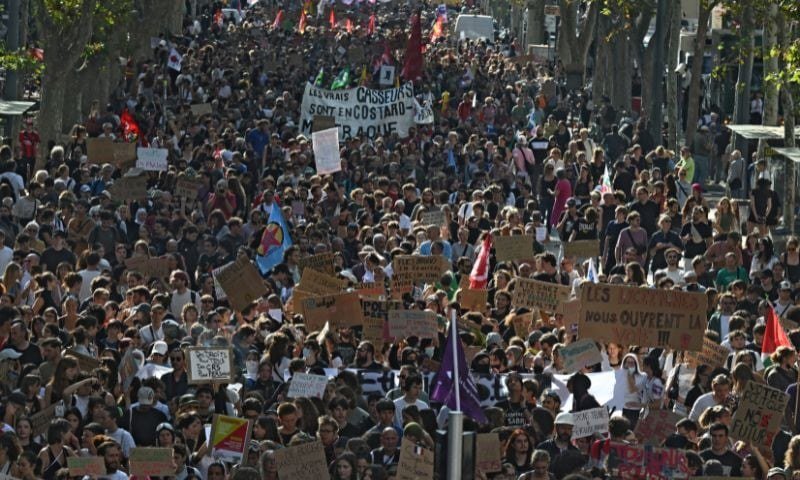
Police fired tear gas at high-school protesters across France on Tuesday as the France student protests reached their biggest day yet, with students, teachers and parents marching nationwide against understaffed and crumbling schools.
Teenage students stood on barricades of rubbish bins outside schools from Lille to Marseille and Strasbourg to Nantes. In Paris they held up banners reading “We want to be heard, not teargassed” and “Our future is not optional”.
The demonstrations follow a fortnight of unrest that began in the deprived suburbs of Paris before spreading across the country. The government has responded with riot police, saying the movement has now morphed into urban violence.
A teenager loses a hand in Monday’s clashes
The mood darkened on Monday when a 15-year-old lost his hand and part of his lower arm after picking up a police dispersal grenade during clashes with riot police in northern France. La Voix du Nord reported the details; the prefect of Pas-de-Calais, François-Xavier Lauch, declined to comment on the exact circumstances, saying 200 to 250 protesters had been hurling objects at police.
Dawn’s reporting put the toll since the movement began at 215 students and 715 police officers injured. Interior Minister Laurent Nunez said late on Monday that police had opened 10 internal investigations into allegations of brutality since the protests started.
Amnesty International accused the authorities of “disproportionate police repression”. The group’s Anne Savinel-Barras said images and testimonies circulating over the past week raised alarming concerns about the dangerous use of tear gas, batons and policing techniques.
How big were the France student protests?
Estimates of Tuesday’s turnout varied widely. The interior ministry counted about 256,000 protesters nationwide, including 56,000 in Paris. The Union Syndicale Lycéenne, one of the high-school student unions organising the demonstrations, claimed a far larger turnout of 450,000 across the country.
Television footage showed riot police using shields to push back crowds who had formed a human chain and blocked a road near a school in eastern Paris. Protests were also reported in Marseille, Nantes and Lyon.
Trade unions joined the demonstrations. CGT leader Sophie Binet said union members would be present to “protect high-school students”, while Green Party leader Marine Tondelier urged local officials and parents to wear white and join the marches to “protect our children”.
What the students want, and the PM’s response
The students’ demands centre on schools they say are underfunded and falling apart: absent teachers are not replaced, classrooms are overcrowded, the school day runs from 8am to 6pm, and buildings need repair.
Prime Minister Sébastien Lecornu has ordered his ministers to tackle the leading demands, including replacing absent teachers, reviewing the length of the school day and lunch breaks, and repairing ageing school buildings. He demanded first proposals by the end of October, though finding spare cash will be difficult for a government trying to narrow a ballooning budget deficit.
Speaking in the National Assembly on Tuesday, Lecornu said “extreme violence has reached the gates of our high schools and it must be condemned unequivocally.”
The unrest comes months before the 2027 presidential election, in which Emmanuel Macron cannot seek a third consecutive term. Damage to schools in the greater Paris region alone is estimated at 7 million euros.
Frequently asked questions
Why are French students protesting?
High-school students across France are protesting against underfunded facilities, overcrowded classrooms, teacher shortages, long school days from 8am to 6pm, and dilapidated buildings. The movement began in the suburbs of Paris and spread nationwide.
What happened to the teenager in northern France?
On Monday, October 5, 2026, a 15-year-old lost his hand and part of his lower arm after picking up a police dispersal grenade during clashes in northern France, according to the regional newspaper La Voix du Nord.
How has the French government responded?
Prime Minister Sébastien Lecornu ordered ministers to address the students’ demands, with first proposals due by the end of October. Police have used tear gas and riot shields against protesters, and 10 internal investigations into alleged brutality are underway.