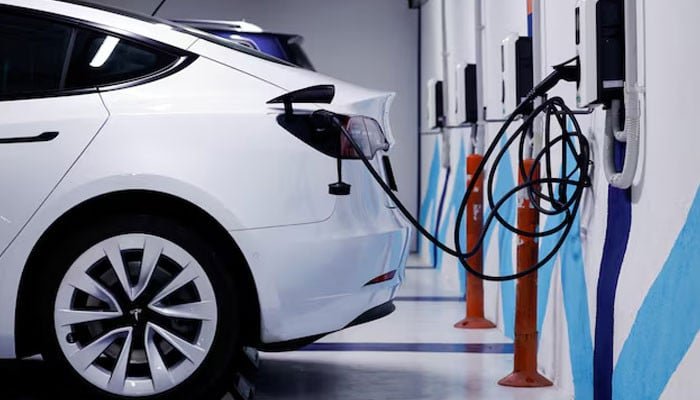
Electric cars can save Pakistan $1 billion in fuel costs, NEV policy projects
Electric cars can save Pakistan $1 billion in fuel costs, NEV policy projects
ISLAMABAD: Pakistan’s New Energy Vehicle (NEV) Policy 2025-30 projects that shifting toward electric mobility could save the country nearly $1 billion in fuel costs, the headline figure officials have used to sell the country’s EV push. The claim rests on official projections linking 30 per cent electric share in new vehicle sales by 2030 to lower fuel imports.
Electric cars save Pakistan money because transport is the country’s biggest oil consumer. The transport sector accounts for up to 79 per cent of total oil demand, and Pakistan spent more than $16 billion on petroleum imports in 2024. Any dent in that bill matters for the external account.
The numbers behind the electric cars save Pakistan $1 billion claim
The government briefing on the NEV policy puts the target at $950 million in fuel savings over the policy period, equivalent to 1.823 million tonnes of oil equivalent. Officials separately project the transition could save 2.07 billion litres of fuel every year.
The headline targets:
| Target | Figure |
|---|---|
| Electric share in new vehicle sales by 2030 | 30 per cent |
| Projected fuel savings | $950 million |
| Fuel saved annually | 2.07 billion litres |
| Net economic benefit by 2030 | Rs732.8 billion |
| Cumulative fuel-cost savings | Rs537.86 billion |
| EV charging stations by 2030 | 3,000 |
Cumulative fuel-cost savings alone are estimated at Rs537.86 billion, easing pressure on the external account while making use of surplus electricity generation capacity.
What the policy promises beyond fuel savings
The push is not only about the import bill. Officials project the shift could cut carbon emissions by 4.5 million tonnes and reduce pollution-linked healthcare costs by up to $450 million a year.
The government has backed the targets with money. Rs100 billion in subsidies are planned over five years, with Rs9 billion allocated in the current fiscal year for 116,053 electric motorbikes and 3,171 electric rickshaws. Buyers of electric motorcycles costing Rs250,000 get an Rs80,000 subsidy. Charging station electricity rates were cut from Rs92 to Rs39.7 per unit.
The policy has outside backing too: the International Monetary Fund endorsed it with $1.4 billion in financing, while the International Finance Corporation granted $1.8 million for EV infrastructure. More than 76,000 electric vehicles are already on Pakistani roads.
The sceptics’ case
Not everyone is convinced the arithmetic holds. Critics ask whether Pakistan will simply replace its oil import bill with a new one for Chinese cars, batteries and components. More than a dozen Chinese EV brands have entered the market in the past two years, and BYD alone imported over 2,000 New Energy Vehicles in a single month, while its local assembly plant is expected to begin operations by the end of 2026.
There are also questions about battery life, resale value, after-sales service and trained technicians in Pakistan’s heat and flood-prone conditions. One estimate suggests tax relief averaging Rs3 million on 50,000 vehicles could mean Rs150 billion a year in forgone revenue.
For now, the government’s bet is clear: the $1 billion in fuel savings is worth the cost of the transition.
Frequently asked questions
What is the $1 billion savings claim based on?
The NEV Policy 2025-30 briefing projects $950 million in fuel savings if 30 per cent of new vehicle sales are electric by 2030, roughly $1 billion at current fuel economics.
What is the NEV Policy 2025-30?
It is Pakistan’s New Energy Vehicle policy, targeting 30 per cent electric share in new vehicle sales by 2030, with subsidies, cheaper charging power and local manufacturing incentives.
Will EVs create a new import bill for Pakistan?
That is the main criticism. Analysts warn the country could swap its oil import dependence for dependence on imported vehicles, batteries and parts unless local manufacturing grows alongside sales.
What subsidies are available for EV buyers?
The government plans Rs100 billion in subsidies over five years, including Rs80,000 off electric motorcycles, with a quarter of the two-wheeler quota reserved for women.