Justice Mandokhail Retires from Supreme Court
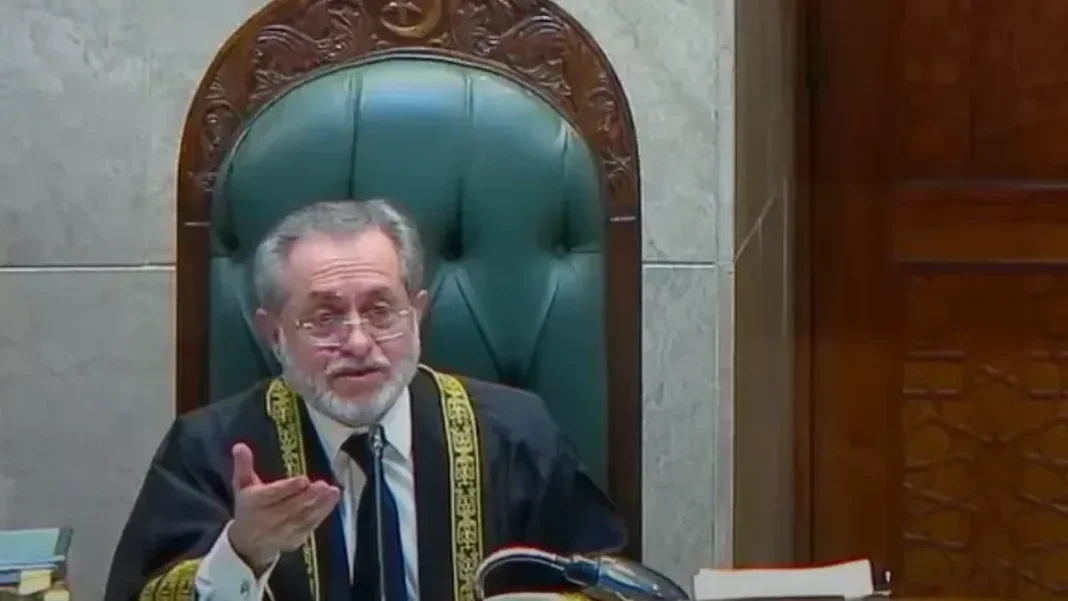
Justice Mandokhail retires on Wednesday after nearly 17 years on the bench, a career shaped by major rulings on constitutional, political and legal questions.
He was among the judges who declared the trial of civilians in military courts unconstitutional, and he sat on benches that ruled on a no-confidence motion, the votes of defecting lawmakers and the courts’ own powers.
His retirement leaves a vacancy on the Supreme Court at a time when the court is hearing some of the most sensitive cases in the country.
Justice Mandokhail retires on Wednesday
Justice Jamal Khan Mandokhail began his judicial career on September 7, 2009, when he was appointed a judge of the Balochistan High Court. He later served as chief justice of that court from October 5, 2019, until his elevation to the Supreme Court on August 9, 2021.
Across both courts, his judgements covered property rights, parliamentary proceedings, reserved seats, military trials and the constitutional jurisdiction of courts.
He worked closely with former chief justice Qazi Faez Isa and Chief Justice Yahya Afridi, and some of his positions drew criticism from sections of the legal fraternity and PTI supporters.
Days before his retirement, he addressed a Balochistan Bar Council reception in Quetta. Feature Pakistan reported that he spoke of the pain Balochistan’s situation caused him and urged all sides to work for peace.
Landmark rulings and controversies
At the Balochistan High Court, Justice Mandokhail authored a ruling that the “unsettled land” of Balochistan belonged to the indigenous tribes who had lived on its plains and mountains for centuries, rather than to the provincial government.
In another significant judgement, he declared several provisions of the Defence Housing Authority (DHA) Act, 2015, unconstitutional, holding that the DHA functioned like a non-government agency. The Supreme Court later suspended that ruling, and appeals against both judgements are now pending before the Federal Constitutional Court.
After his elevation in 2021, he joined the bench that set aside former deputy speaker Qasim Suri’s ruling rejecting the no-confidence motion against then prime minister Imran Khan under Article 95 of the Constitution.
He was also among the minority judges who held that the votes of defecting lawmakers should be counted under Article 63A. He opposed the suo motu proceedings started by former chief justice Umar Ata Bandial to hold elections to the Punjab and Khyber-Pakhtunkhwa assemblies within 90 days, holding with Justice Syed Mansoor Ali Shah that the Lahore High Court should first be allowed to proceed.
Following the 26th Constitutional Amendment, he joined the constitutional benches and the committee that constituted benches. He also sat on the constitutional bench that ruled the trial of civilians in military courts unconstitutional.
He was among the members of the Judicial Commission of Pakistan who did not support the appointment of Justice Sardar Muhammad Sarfraz Dogar as chief justice of the Islamabad High Court.
How lawyers remember him
Supreme Court advocate Faisal Siddiqi described Justice Mandokhail as a polite judge with some prominent dissenting judgements, but he criticised the judge’s overall approach.
“His overall jurisprudence of balancing between executive interests and citizens’ rights ended up in a confused jurisprudence, destroying the power and reputation of the Supreme Court as the apex court,” Siddiqi said.
Waqas Ahmed, an advocate who worked as a law clerk with Justice Mandokhail, gave a warmer account. He said the judge was humble and gracious, listened to lawyers with patience and respect, and stayed encouraging and supportive of young members of the bar.
“His legacy is not confined to his judgments; it also lives in the dignity, humility and kindness with which he treated the legal fraternity,” Ahmed said. He added that Justice Mandokhail would also be remembered for his work on constitutional jurisprudence and the protection of fundamental rights.
The Supreme Court has meanwhile ruled that civil cases should ordinarily be decided on merit, restoring two revisions that had waited since 2016. The Express Tribune reported the retirement in a profile of the judge’s career.
Frequently asked questions
When does Justice Mandokhail retire?
He retires on Wednesday, November 11, 2026, after a judicial career of nearly 17 years.
When did he join the Supreme Court?
He joined the Supreme Court on August 9, 2021, after serving as a Balochistan High Court judge from September 7, 2009, and as its chief justice from October 5, 2019.
What are his best-known judgements?
They include the ruling that Balochistan’s “unsettled land” belonged to indigenous tribes, the decision striking down parts of the DHA Act, 2015, and his role in benches that decided the no-confidence motion case, the Article 63A defections question and the military courts trial case.